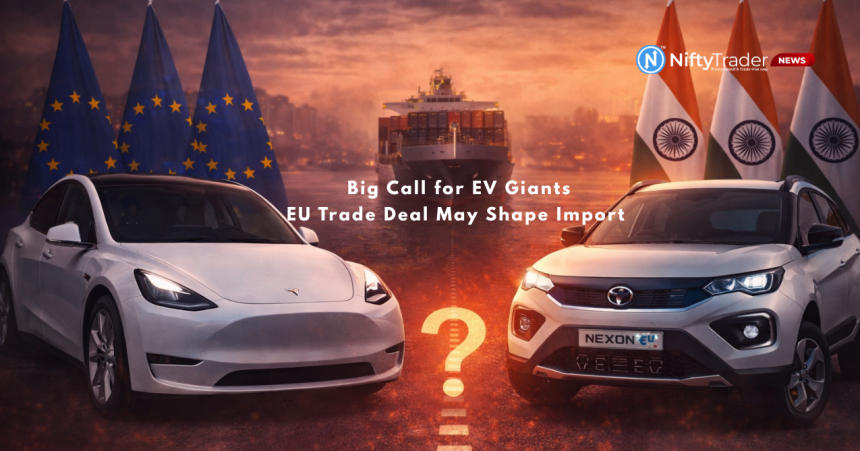
Will the India–EU trade deal reshape the EV market by deciding who imports and who manufactures in India?
India’s electric vehicle (EV) story may be approaching a defining inflection point. A long-pending free trade agreement (FTA) between India and the European Union (EU) — expected to be signed as early as January 27 — could decisively influence whether global EV giants choose to import premium electric cars into India or commit upfront to local manufacturing.
European Commission President Ursula von der Leyen recently heightened expectations by saying India and the EU are “on the cusp of a historic trade agreement”, calling it the “mother of all deals” that could create a market of two billion people and nearly a quarter of global GDP. For investors tracking autos, EV suppliers, and policy-sensitive sectors, the implications could be far-reaching.
Why the India–EU FTA could become a turning point for the Indian EV ecosystem
The EU is home to many of the world’s most influential automobile exporters and premium EV manufacturers, particularly German brands that dominate the global luxury and mid-premium electric vehicle segments. These companies have long viewed India as a strategic long-term market, but progress has been constrained by steep import duties.
Trade data from the European Commission and Eurostat show that the EU exported about $180 billion worth of automobiles in 2024, yet vehicle exports to India were estimated at only $330 million. The primary reason: import duties on fully built cars can go up to 100 percent or more, making European EVs prohibitively expensive for most Indian buyers.
If the FTA introduces meaningful tariff concessions on automobiles, especially electric cars, the competitive landscape in India could change quickly.
Also Read : Markets Slip Again as Bulls Lose Momentum — 7 Key Factors Dragging Sensex, Nifty Lower
Tariff concessions may determine whether EV makers import cars or build factories
Industry executives believe the final structure of tariffs under the trade deal will be the deciding factor in business strategy.
An industry executive, speaking on condition of anonymity, explained:
“Any reduction in duties under the India–EU trade pact could materially change how European EV makers approach India. If import duties move closer to 15 percent, companies may prefer an import-led entry rather than commit early to manufacturing.”
This is a crucial point for investors. Lower tariffs could mean:
-
Faster entry of European EV brands into India
-
Increased competition for domestic players
-
Pressure on pricing of premium electric vehicles
-
Short-term boost for luxury EV sales
But it could also mean slower commitments to local manufacturing, which would have different implications for auto ancillaries and component suppliers.
Government’s EV manufacturing scheme now hangs in the balance
The outcome of the India–EU FTA is also closely linked to the future of the government’s Scheme to Promote Manufacturing of Electric Passenger Cars in India (SPMEPCI).
The scheme had offered global automakers the option to:
-
Import a limited number of EVs at a reduced 15 percent customs duty
-
In return for committing to manufacturing facilities in India
-
And meeting phased localisation targets
However, despite the incentives, the scheme failed to attract any applicants before the application window closed in October. According to industry insiders, automakers deliberately held back.
The reason was simple: companies were waiting for clarity on the tariff structure under the India–EU trade deal, which could offer similar concessions without binding manufacturing obligations.
Government signals willingness to rework EV policy after trade clarity
Officials in the heavy industries ministry have indicated that the EV policy framework may be revisited once the trade agreement terms become clear.
A senior government official said:
“The scheme was framed keeping India’s manufacturing priorities in mind, but its design will have to align with India’s trade commitments. Any revision would depend on how tariffs on cars are finally structured under the trade pact with the EU.”
This suggests policymakers are balancing two competing priorities:
-
Attracting global EV brands quickly
-
Ensuring India does not lose long-term manufacturing and localisation opportunities
For markets, this policy direction matters because it influences the outlook for:
-
Auto OEMs
-
EV component manufacturers
-
Battery ecosystem players
-
Infrastructure-linked companies
What this means for stock market investors tracking auto and EV themes
For equity markets, the trade deal is not just a geopolitical story — it is a sectoral trigger.
If tariff cuts favour imports:
-
Luxury EV demand could rise
-
Competition may intensify for domestic premium models
-
Margins of Indian automakers could come under pressure
If manufacturing commitments remain central:
-
Auto ancillaries, battery makers, and localisation-driven suppliers could benefit
-
Long-term capex visibility improves for industrial and infrastructure-linked stocks
Investors should closely watch companies exposed to:
-
EV supply chains
-
Auto component manufacturing
-
Power electronics
-
Charging infrastructure
-
Metals linked to EV manufacturing
The trade deal’s final structure will likely influence earnings expectations across these segments over the next few quarters.
Here’s what happened today and why traders reacted
Market participants remained cautious as news flow around the India–EU trade deal gained momentum. Auto and EV-linked stocks saw selective activity as traders began positioning for potential policy shifts. While no immediate market-wide rally was seen, the narrative has started influencing sectoral stock selection, particularly in:
-
Auto OEMs with EV ambitions
-
Companies linked to localisation and manufacturing
-
Firms exposed to premium vehicle consumption
Traders are now treating the trade agreement as a medium-term catalyst, rather than a short-term headline, with positioning likely to evolve as more clarity emerges.
What lies ahead as the signing date approaches
The India–EU FTA is expected to be signed around January 27, with Ursula von der Leyen and European Council President António Costa attending Republic Day celebrations in Delhi. That timing has only intensified market interest.
If the agreement includes concrete tariff language on automobiles, the reaction in markets could be immediate across:
-
Auto stocks
-
Auto ancillary stocks
-
EV ecosystem players
-
Policy-sensitive sectors linked to manufacturing
For investors, the key takeaway is this: the trade deal may not just open borders for cars — it could reshape the long-term structure of India’s EV industry.