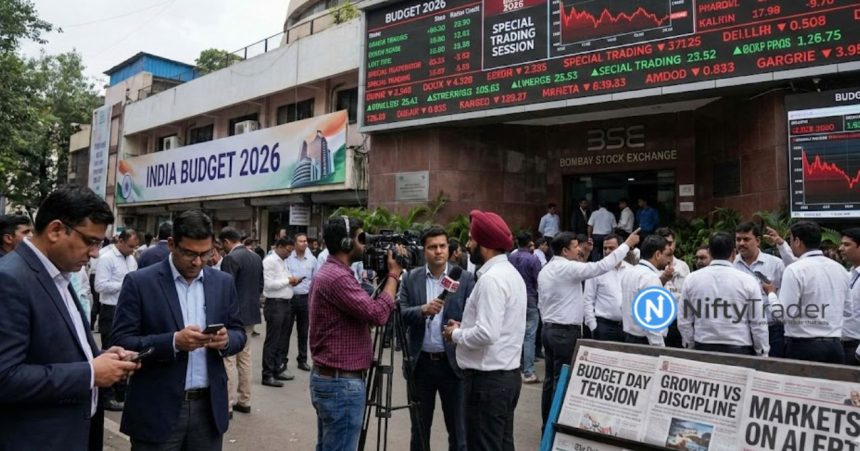
Budget day always has a strange feel on Dalal Street. There’s excitement, tension, rumours, and a lot of positioning that happens quietly before the Finance Minister even steps up to speak. Budget 2026 is shaping up to be one of those events that could set the tone for markets well beyond the initial headline reactions.
Traders are already preparing for special trading sessions, analysts are gaming out policy scenarios, and investors are asking the same old question in a new context: Is this budget about growth, discipline, or political signalling?
As Always, the answer is likely to be a mix of all three.
Special Trading Sessions: Markets on Alert Mode
Indian stock exchanges typically conduct special trading sessions on Budget day to manage volatility and allow investors to react in real time to policy announcements. This year is no different. The exchanges have lined up extended sessions to coincide with the Finance Minister’s speech, giving traders a chance to adjust positions as fiscal announcements roll out.
For professional desks, Budget sessions are less about wild speculation and more about execution. Algorithms are tuned for sudden volatility spikes, brokers staff their desks heavily, and institutional investors keep liquidity lines ready.
Retail investors often assume Budget day is a one-way rally or crash event. In reality, it’s more chaotic. The market often swings sharply during the speech, then reverses as details sink in.
What Policymakers Are Likely Aiming For
Budget 2026 comes at an interesting moment. India’s economy has held up well compared with many peers, but growth is uneven, global demand is patchy, and fiscal discipline is under constant scrutiny from rating agencies and foreign investors.
Expect the government to walk a tightrope.
On one hand, there’s pressure to boost capital spending, support manufacturing, and keep consumption strong. On the other, the fiscal deficit cannot spiral without consequences for bond yields, the rupee, and foreign capital flows.
So, the market is expecting a budget that tries to look bold without being reckless.
Infrastructure and Capital Expenditure: The Market’s Favourite Theme
If there’s one theme that markets love, it’s capital expenditure.
Infrastructure spending has been one of the government’s strongest levers in recent years, and Budget 2026 is widely expected to push this further. Railways, roads, defence manufacturing, power transmission, and urban infrastructure are all likely to see allocations.
For equities, capex is a multiplier. It benefits cement, steel, capital goods, construction, PSU banks, and a range of industrial stocks. Investors often treat a strong capex push as a proxy for long-term growth commitment.
The key detail investors will watch is not just the headline number, but how credible and executable the spending plan is.
Tax Policy: Relief, Tweaks, or Stability?
Tax announcements always dominate headlines, but markets usually care less than individuals.
Still, personal income tax changes can influence consumption stocks, especially FMCG, auto, and retail. If the government offers middle-class relief, discretionary spending could get a boost.
Corporate tax is less likely to see major changes. Stability is often more valuable than sudden cuts. Companies plan capital allocation based on predictable tax regimes, and any signals of stability are generally welcomed.
One area to watch is capital gains taxation. Even minor tweaks can move markets, especially if they affect equity investors or mutual fund flows.
Banking and Financial Sector: Liquidity, Credit, and Bond Yields
Banks are watching Budget 2026 closely for a different reason: liquidity and borrowing.
Government borrowing plans directly influence bond yields. A larger borrowing programme could push yields higher, tightening financial conditions. That affects banks’ treasury portfolios, lending rates, and overall market sentiment.
At the same time, any push for credit growth, MSME support, or financial inclusion schemes could benefit lenders and NBFCs.
Traders will dissect the fiscal deficit target line by line. A credible path toward consolidation usually calms bond markets and supports equities. A surprise overshoot can trigger selloffs in bonds and equities simultaneously.
Manufacturing and ‘Make in India’ Signals
Manufacturing has been a political and economic priority, and Budget 2026 is expected to continue incentives under production-linked incentive (PLI) schemes.
Electronics, semiconductors, defence equipment, and renewable energy manufacturing are key areas where the government wants India to build domestic capacity.
For markets, this theme plays out in industrial stocks, specialty chemicals, electronics manufacturers, and select midcap names tied to supply chains.
Investors are less interested in slogans and more in actual allocation numbers and implementation timelines.
Green Energy and Climate Spending
Climate policy is no longer just a global talking point; it’s an investment theme.
Budget 2026 is expected to allocate funds for renewable energy, green hydrogen, EV infrastructure, and grid upgrades. Any strong push here could lift renewable energy stocks, power equipment makers, and battery-related plays.
Global funds are increasingly aligning portfolios with ESG themes. A clear green policy narrative could attract incremental foreign capital, especially from long-term institutional investors.
Agriculture and Rural Demand: Quiet but Powerful
Agriculture announcements rarely move markets intraday, but they shape consumption trends.
Support prices, rural infrastructure spending, and subsidy schemes can influence rural income. That matters for FMCG, two-wheelers, tractors, and affordable housing demand.
If the budget signals strong rural support, analysts may revise earnings expectations for consumer companies with heavy rural exposure.
Defence Spending: Geopolitics in the Background
Defence spending has become a structural theme, not just a political one.
Budget 2026 is expected to continue increasing defence allocations, with a focus on domestic manufacturing. Defence PSUs and private sector players have already been market darlings in recent years, and any fresh procurement plans could keep the narrative alive.
Geopolitical uncertainty adds another layer of urgency, and markets tend to price defence spending as a long-term secular trend.
Digital Economy, Startups, and Tech Policy
The government’s stance on the digital economy will also be watched closely.
Data policy, digital infrastructure, fintech regulation, and startup incentives can influence tech stocks and venture sentiment. While listed tech giants may not react immediately, broader investor sentiment toward the digital ecosystem can shift.
Budget statements on AI, digital public infrastructure, and startup tax treatment could influence risk appetite in tech-heavy portfolios.
What Traders Will Watch During the Speech
On Budget day, traders usually track three things in real time:
First, the fiscal deficit number. It sets the tone for bond yields and currency markets.
Second, the borrowing programme. Large borrowing plans can spook bond investors.
Third, any surprise tax or regulatory changes affecting equities.
The headline announcements often cause knee-jerk moves, but the real trend usually forms in the days after analysts digest the fine print.
Sector Winners and Losers: Early Market Playbook
If Budget 2026 follows expectations, some sectors are likely to see positive sentiment:
- Infrastructure and capital goods
- PSU banks and select private lenders
- Defence stocks
- Renewable energy and power equipment
- Select manufacturing-linked midcaps
Sectors that could face uncertainty include:
IT services, if global demand remains weak and no domestic support emerges
Consumption stocks, if tax relief is limited
Real estate, depending on housing incentives and interest rate signals
But Budget reactions are rarely linear. Often, the sectors everyone expects to rally sell off because expectations were already priced in.
Global Investors: Watching Fiscal Discipline
Foreign investors care less about political messaging and more about macro stability.
They will scrutinise fiscal discipline, debt trajectory, and growth assumptions. If Budget 2026 looks credible, foreign flows could stabilise. If it looks populist and fiscally loose, risk premiums could rise.
The rupee, bond yields, and equity valuations are all tied to this perception.
Why Budget Day Moves Don’t Always Last
One thing retail investors often misunderstand is Budget day rallies.
Markets often spike during the speech, then fade. Sometimes they drop first, then recover days later. The immediate reaction is driven by positioning and sentiment, not necessarily fundamentals.
Long-term investors focus on structural themes: capex, manufacturing, financial stability, and productivity reforms.
The Bigger Picture Beyond Headlines
Budget 2026 isn’t just a single-day event. It’s part of a multi-year economic narrative.
India is trying to balance growth ambitions with fiscal prudence, manufacturing goals with global trade realities, and political pressures with investor expectations.
Markets will ultimately judge the budget not by applause in Parliament, but by execution over the next few years.
What Investors Should Do
For traders, Budget day offers volatility and opportunity, but also risk. Stop-loss discipline matters more than predictions.
For long-term investors, Budget day is more about confirming themes than changing portfolios overnight. Structural capex, financial stability, and manufacturing competitiveness are multi-year stories.
The smart approach is to listen to the announcements, read the fine print, and avoid emotional decisions based on intraday noise.
Final Thought
Budget 2026 will likely deliver a mix of ambition and caution. The market will cheer some lines, frown at others, and ultimately settle on a narrative once the numbers are dissected.
Special trading sessions will capture the drama. Analysts will fill spreadsheets. Tll charaders wise momentum. But the real impact of this budget will be visible in bond yields, credit growth, corporate investment, and earnings trajectories over the next few quarters.
That’s where the story really unfolds.