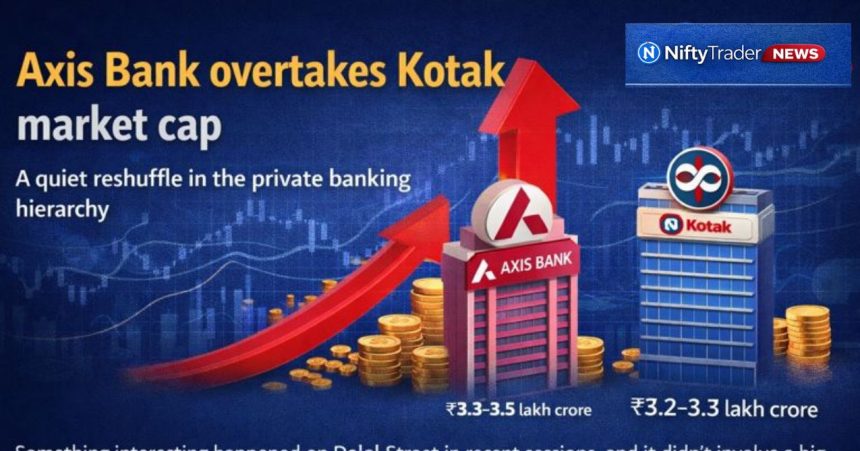
A quiet reshuffle in the private banking hierarchy
Something interesting happened on Dalal Street in recent sessions, and it didn’t involve a big merger or a flashy earnings beat. Axis Bank quietly crossed Kotak Mahindra Bank in market value, becoming the third-largest private lender by market capitalisation in India. By the end of the session, Axis Bank’s market capitalisation hovered around ₹3.3–3.5 lakh crore, while Kotak Mahindra Bank slipped below ₹3.2–3.3 lakh crore, according to exchange data.
For years, Kotak sat comfortably among the top three private banks by valuation, often trading at a premium compared to peers. But markets change fast, and this time, investor sentiment tipped the scale in Axis Bank’s favour.
What exactly changed in the rankings
Axis Bank’s market capitalisation climbed past Kotak Mahindra Bank after a sharp drop in Kotak’s stock price. The fall came right after regulatory action by the Reserve Bank of India, which restricted Kotak from onboarding new customers through digital channels and issuing fresh credit cards due to persistent IT system deficiencies.
That move rattled investors. Kotak’s shares plunged around 10–11% in a single session, wiping out tens of thousands of crores in shareholder wealth. The restrictions were imposed after repeated supervisory findings flagged weaknesses in the bank’s technology infrastructure and governance systems. Axis Bank, on the other hand, held steady and even benefited from better-than-expected results, pushing its valuation above Kotak’s.
The broader ranking now keeps HDFC Bank firmly at the top among private lenders, followed by ICICI Bank. Axis Bank has slipped into the third spot, with Kotak moving just behind it.
Why this shift matters beyond headlines
Analysts say the reshuffle shows how quickly regulatory risk can reshape investor perception in banking stocks, especially when digital growth engines are affected. This isn’t just about bragging rights. Market capitalisation reflects how investors see a bank’s future growth prospects, risk profile, management quality, and regulatory comfort.
Kotak has long commanded a premium valuation because of its conservative risk culture and strong asset quality. Axis Bank, meanwhile, has built scale faster, growing its loan book aggressively and expanding its retail and corporate footprint. Historically, investors gave Kotak higher multiples for perceived stability. Now, the gap is narrowing, and in this case, flipping.
The bigger story: investor confidence and regulatory risk
The episode is also a reminder of how sensitive bank valuations are to regulatory signals. A single RBI directive was enough to trigger a steep sell-off in Kotak’s stock.
Digital onboarding and credit cards are core growth engines for private banks. Restrictions there directly hit future growth assumptions, and markets react instantly. Axis Bank didn’t do anything dramatic this week Kotak simply stumbled, and Axis walked past.
How Traders Reacted to the Axis–Kotak Shift
Kotak Mahindra Bank’s stock saw heavy selling after the RBI restrictions, with traders pricing in slower growth and higher regulatory risk. The near 10–11% fall in a single session triggered short-term caution, and many desks reduced exposure until there is clarity from the regulator.
Axis Bank, meanwhile, benefited from relative positioning. Traders rotated into Axis as a safer private banking bet, seeing no immediate regulatory overhang. Overall, the banking sector stayed stable, but the episode reminded markets that governance and technology risks can quickly impact valuations and stock rankings.
Is this a permanent change or just a temporary crossover?
That’s the real question investors are asking. Axis and Kotak have swapped positions before, and leadership in market cap often shifts based on earnings cycles, asset quality trends, and regulatory clarity. Kotak is already working with regulators to fix the issues, and once restrictions ease, the stock could recover. Axis Bank, meanwhile, needs to keep delivering on profitability and asset quality to hold on to its new ranking.
What it signals for Indian banking stocks
This small reshuffle says a lot about how investors are pricing India’s private banks right now. Growth matters, but governance and technology stability matter just as much.
The top two, HDFC Bank and ICICI Bank, still dominate the sector by a huge margin. But the battle for third place shows how competitive the private banking space has become and how quickly perception can shift.
For now, Axis Bank enjoys the spotlight, but in Indian banking, rankings change fast, sometimes in a single trading day. Traders were quick to point out that these rankings often shift during volatile market phases, especially when regulatory headlines dominate sentiment.