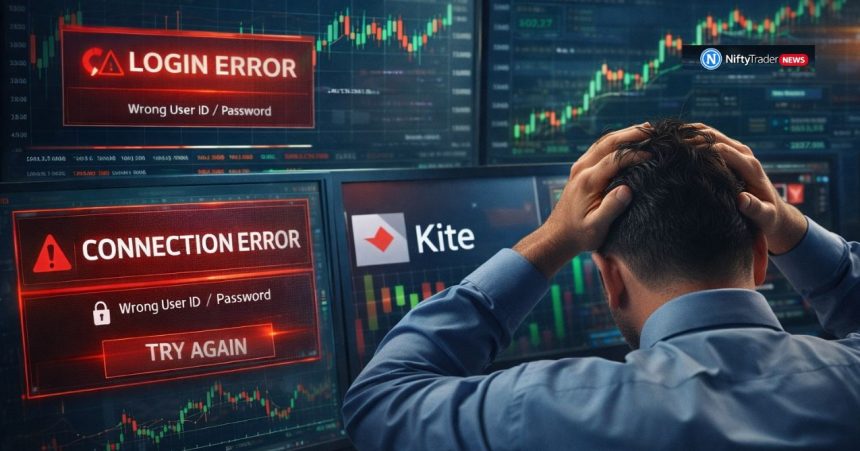
New Delhi, February 3, 2026—Traders across India woke up to frustration and confusion Tuesday as Zerodha’s flagship trading platform, Kite, hit a rough patch right in the thick of an equities surge. Complaints poured in throughout the morning, with users reporting everything from forced logouts and failed logins to prices that wouldn’t update and portfolios that looked wrong just as the market was staging one of its most powerful rallies in months.
It was ironic timing. Benchmark indices were in overdrive, with Nifty jumping as much as 4.7% and the Sensex rising up to 4.4% on optimism around the long-anticipated India–US trade deal. Bulls were running, and investors wanted in. But on the other end of the screen, thousands of retail traders were locked out, stuck, or watching prices freeze, and every second lost meant real money left on the table.
Chaos on Kite: Login Failures, Wrong Data and Missed Trades
Social media, especially X (formerly Twitter), lit up with anger and confusion. Traders shared screenshots of forced logouts mid-order, charts resetting on their own, and prices that lagged so badly they might as well have been antiques. Several users complained that their positions weren’t reflecting correctly, and orders were stuck in limbo, not executed, and not canceled.
This wasn’t a handful of isolated glitches. The complaints were widespread and persistent throughout the trading session, hitting both equity and derivatives traders. For those in high-speed intraday or options strategies, timing is everything, and for many, that perfect setup turned into a missed opportunity. Some noted that support follow-ups had dragged on for days, with portfolio-related issues still unresolved despite repeated attempts to get clarity.
Zerodha’s Response—”Looking Into It”
In response to the flood of user complaints, Zerodha spokespeople and official social media accounts acknowledged the disruptions but stopped short of a full explanation. The message was consistent, if restrained: “We are looking into this, and our team will get back to you shortly with an update.”
That kind of reply does little to soothe traders when markets are swinging hard and execution windows are narrow. Users on X pressed for more specific timelines, better interim fixes, and, in some cases, compensation for financial harm they say they suffered because they couldn’t enter or exit positions as conditions shifted.
A Pattern, Not a One-Off
To seasoned observers, this disruption felt eerily familiar. Zerodha’s platform has run into tech troubles multiple times over the past few years, sometimes tied to broader internet outages or infrastructure problems outside the broker’s immediate control. Notably, a Cloudflare network outage last year briefly knocked out access to web and app services for Zerodha and several other major brokers, triggering similar complaints about delayed orders and stranded traders.
But regardless of the cause, whether exchange connectivity issues, third-party network hiccups, or software limitations under load, the impact on traders is the same: a loss of control at the very moments they can least afford it. Unlike a textbook outage that affects all platforms equally, some Zerodha users reported inconsistent experiences, as if the system was working for a few while failing for others.
From Frustration to Real Losses
There’s more than annoyance at stake. Across previous incidents, traders have publicly claimed significant financial damage due to glitches, in some cases running into lakhs of rupees, because their orders sat in pending states or execution prices drifted while the platform struggled to keep up. A handful of these situations have even been taken up with market regulators or exchange grievance committees, drawing attention to the broader implications when platforms don’t hold up under stress.
For many retail participants, the question now isn’t whether the app will go down again; it’s whether the broker will take responsibility when it does.
What Traders Want Going Forward
In the trading community, the calls are growing louder for better communication, clearer escalation paths, and more robust fallback systems. Some traders have begun exploring backups, alternative brokers, manual order submission routes, and even emergency channels (like WhatsApp-based trading options) that could serve as lifelines when primary systems falter.
Others go a step further, urging regulators like SEBI and exchange bodies to mandate stricter reporting requirements and accountability standards for trading infrastructure, especially given how little buffer retail investors often have when technology fails.
Markets Won, But Traders Lost Time
By late afternoon, the Kite platform showed signs of stabilization. Prices and positions began to reflect accurately again, and new orders started going through more reliably. But the damage in time lost, stress felt, and opportunities missed was already done for many.
For a generation of Indian traders increasingly comfortable with digital markets, these recurring outages remain a sore reminder: technology has democratized access, but it’s still brittle when markets move fast. The test for Zerodha now is not just fixing the bug this time it’s persuading its users that it won’t happen again when stakes are high.
Zerodha Outage: Q&A for Readers
Q1: What happened with Zerodha on February 3, 2026?
A1: Zerodha’s trading platform, Kite, faced widespread outages during the morning trading session, with users reporting login failures, stuck orders, and incorrect portfolio data.
Q2: Which traders were affected?
A2: Both equity and derivatives traders were affected. Complaints came from retail traders across India, using both web and mobile versions of Kite.
Q3: How did the outage impact trades?
A3: Traders were unable to place, modify, or cancel orders at critical moments. Some portfolios showed incorrect positions, leading to missed opportunities during a strong market rally.
Q4: Did Zerodha respond to the problem?
A4: Yes, the company acknowledged the issues and said their technical team was investigating. However, they did not provide a detailed timeline for resolution or compensation.
Q5: Is this the first time Zerodha has faced such problems?
A5: No. The platform has experienced outages before, sometimes linked to external network issues or high trading volumes.
Q6: Did the outage affect market performance?
A6: The outage did not affect overall market indices, which saw strong gains. However, individual traders may have missed the opportunity to fully benefit from the rally.
Q7: How long did it take for the platform to stabilize?
A7: The platform gradually became stable later in the trading session, with prices and order execution returning to normal.
Q8: What steps are traders taking to avoid similar issues in the future?
A8: Traders are exploring alternative brokers and backup trading methods and monitoring Zerodha updates closely. Some are also calling for clearer regulatory guidelines for broker accountability.