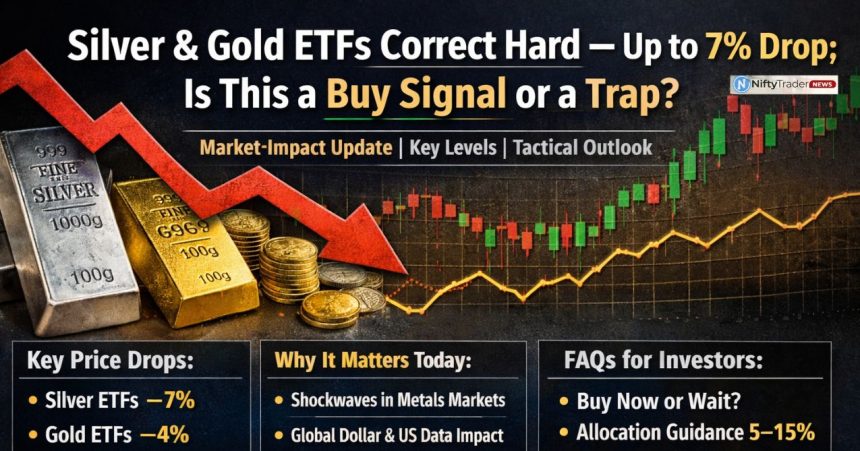
On Monday, Feb 16, 2026, India’s premier silver and gold ETFs corrected sharply, with some funds sliding up to ~7% as profit‑booking hit after a strong rally last Friday. MCX futures for both metals also opened notably lower, reflecting the broader sell‑off in precious metals.
Key price action:
-
Silver ETFs led the slide—e.g., Kotak Silver ETF down ~7%, Mirae Asset Silver ETF ~5%, and others ~2–4%.
-
Gold ETFs weren’t spared. Motilal Oswal & Zerodha Gold ETFs were ~4% lower; Choice & HDFC Gold ETFs were ~2%.
-
MCX Gold futures slid ~0.6% (~₹1,000/10 g). Silver futures dropped ~3.3%.
-
Spot gold and silver also fell in global trade after Friday’s gains.
Why the sharp move?
-
Profit booking after a steep rally last week.
-
Stronger U.S. economic data and firm dollar pressure are weighing on metals’ appeal.
-
Heightened volatility in global markets, with metals swinging more than usual.
Why It Matters Today
-
Immediate market impact: Today’s ~7% ETF correction is sending shockwaves across short-term gold/silver derivatives and ETF positions, increasing intraday volatility for traders.
-
Trading signals: Sharp drops can trigger stop-losses or short-covering, offering tactical opportunities for nimble traders.
-
Liquidity sensitivity: ETF price swings affect fund flows and NAV-based arbitrage—crucial for traders managing leverage or margin.
-
Macro relevance: Moves coincide with global dollar strength and U.S. economic data, highlighting metals as a hedge; any continuation could influence broader equity sentiment in India.
-
Portfolio decisions: Investors tracking 5–15% exposure to metals must adjust allocations dynamically, balancing long-term hedge logic with short-term market swings.
Trader‑Useful Interpretation
The volatility regime is high, not a technical breakout failure. Corrections of this magnitude in ETF prices can reflect both fundamental rebalancing and liquidity flows exiting at short timeframes.
Support & resistance cues (MCX guidance):
-
Gold support: ~₹1,54,400–₹1,53,150; Resistance: ~₹1,56,800–₹1,58,200.
-
Silver support: ~₹238,800–₹232,000; Resistance: ~₹249,100–₹255,000.
A break below these support zones could signal deeper corrective risk.
Tactical signals:
Gold: Dips toward primary support can be used for staggered buying with tight risk controls.
Silver: Extreme swings—avoid large single lots; consider range trading only until volatility settles.
ETFs vs. Futures: ETFs can overshoot NAV in volatile times; check indicative NAVs before entry.
Risk buckets: Precious metals exposures are typically sized 5‑15% of the overall portfolio to manage drawdown.
Should You Invest Now?
Bullish view (disciplined):
-
Use SIP or staggered entries rather than a lump sum.
-
Long‑term metal interest, especially gold, remains strong on macro uncertainty.
-
Corrections can be entry windows, not panic signals.
Cautionary view:
-
Silver remains far more volatile than gold, not ideal for aggressive bets without risk limits.
-
ETFs can diverge from MCX/fundamentals in short windows of stress.
-
Keep stops and portfolio caps in place.
Actionable Guidelines for Traders & Investors
✔ Short‑term traders: Only trade clearly defined ranges; respect support/resistance bands.
✔ Medium/long investors: Systematic or staggered buys improve risk‑adjusted entry.
✔ Stop management: For gold, stop below ₹1,52,000; silver trades more erratically—avoid if unable to size risks.
✔ Diversification: Precious metals hedge, not core return engine cap exposure to target risk budget.
Bottom Line: Sharp ETF corrections don’t automatically signal “buy now at all costs.” Instead, this is a volatility event where measured buying around structural support levels with disciplined risk management can tilt the odds in your favor.
FAQs:
Q1: Why did silver and gold ETFs drop sharply today?
Profit-booking after last week’s rally, global dollar strength, and U.S. economic data drove ETF corrections of up to ~7%.
Q2: Should I buy ETFs at these levels?
Corrections can be an entry point, but staggered buying or SIPs with proper risk management are recommended to avoid lump-sum positions in volatile conditions.
Q3: How do ETFs compare to MCX futures during volatility?
ETFs can overshoot NAV in volatile markets. Check indicative NAVs before entering; futures may reflect global metal moves more directly.
Q4: What is the short-term trading strategy?
Trade within defined support/resistance bands: gold ₹1,54,400–₹1,56,800, silver ₹2,32,000–₹2,49,100. Use tight stops and avoid large single lots.
Q5: How much of my portfolio should I allocate to precious metals?
Metals are hedges, not core returns. Maintain 5–15% exposure, adjusted for risk appetite and market volatility.
Q6: What signals indicate further downside risk?
Breach of primary support zones (gold < ₹153,150, silver < ₹232,000) could trigger deeper corrections. Monitor global cues for confirmation.