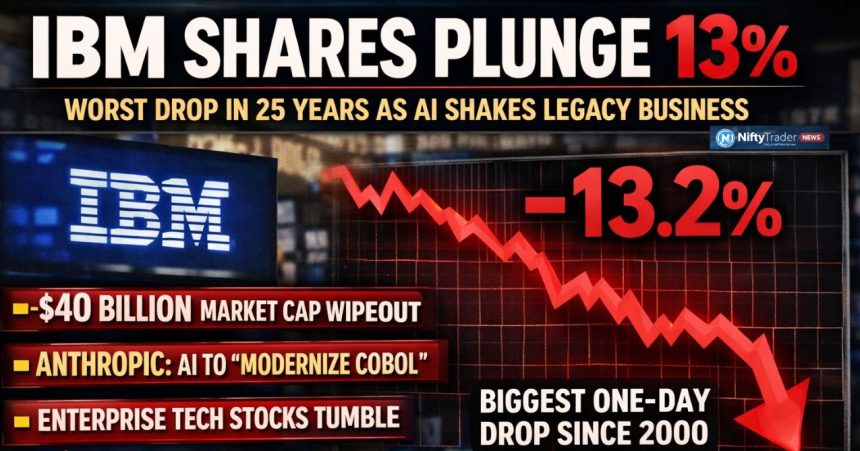
IBM shares plunged 13% today, marking their steepest single-day drop in over 25 years, after Anthropic revealed that its AI, Claude Code, can automate COBOL modernization. This announcement sent shockwaves through the market, wiping nearly $40 billion off IBM’s valuation, as traders re-evaluated the risk to the company’s legacy consulting revenue. The move also triggered a broad IT sector sell-off, highlighting how AI is now a tangible earnings risk, not just a future promise.
Why It Matters Today:
-
Immediate Market Signal: Traders are pricing in structural revenue risk for IBM and legacy IT services.
-
Sector Contagion: Peer enterprise software and IT services stocks face elevated volatility.
-
Portfolio Relevance: Investors must now factor AI-driven automation risk into short- and medium-term positions.
Key Market Takeaways
-
IBM stock plunged ≈ 13.2%, marking its steepest single‑day percentage drop since Oct 2000 amid fresh AI disruption fears.
-
The sell‑off was triggered by Anthropic’s announcement that its new “Claude Code” AI can automate COBOL modernization, a legacy tech area long dominated by IBM’s consulting ecosystem.
-
Market cap hit: Roughly $40 billion wiped from IBM’s valuation in one session as investors recalibrated legacy tech risk.
-
Broader software weakness: Cybersecurity and IT peers including CrowdStrike, Datadog, and other software names also slid sharply on the news.
Why This Hit Traders Hard
1) Direct Threat to IBM’s Legacy Revenue:
COBOL runs core systems in banking, insurance, and government. Traditionally, modernization required large consultant teams, a high-margin service IBM has sold to clients for decades. Anthropic claims AI can reduce this from “years to quarters,” undercutting IBM’s core value‑add and revenue model.
2) AI Disruption Angst Is Now Quantifiable:
This isn’t hype — it’s the first time a major blue‑chip tech stock sold off materially on an AI tool alone. Traders interpreted the announcement as a real earnings risk to legacy software services, not just optimistic marketing.
3) Cross‑Market Contagion:
IT indices and related tech names fell on the broader perception that AI could shorten lifecycle costs across established enterprise tech stacks, not just for COBOL.
Breaking Down the Market Reaction (Trader Lens)
Price Action:
-
IBM: –13.2% intraday, biggest daily drop in >25 years.
-
Cybersecurity & enterprise software names: double-digit to high single-digit losses as traders hedged exposure.
Volume & Volatility:
Expect elevated volatility and higher put buying in near‑term expiries as options traders price in structural risk. (Implied, market behavior)
Technical Levels:
-
Watch key support near $210–$215 (short‑term), and longer‑term uptrend breaks below ~200 EMA for confirmation of trend shift. (Technical implication)
Fundamental Implication
1) IBM Revenue Mix:
Legacy systems modernization has been a defensive revenue pillar. If AI truly commoditizes that service, analysts may cut earnings forecasts for FY26/27 on lower consulting throughput.
2) Competitor Response:
IBM’s ecosystem (e.g., WatsonX AI suite) will likely feature defensive positioning. Any guidance on maintaining mainframe relevance could stabilize sentiment.
3) Broader Sector Correlation:
This event could mark a regime shift in how AI adoption risk is priced into enterprise tech stocks — beyond just growth names.
What Traders Should Act On
Short‑Term Signals
-
Monitor volatility spike & option skew for directional bias.
-
Watch bounce levels near key support zones oversold conditions can produce relief rallies.
Medium-Term Strategy
-
Assess earnings revisions from key brokerages post this shock.
-
Rebalance sector exposure; consider hedges in enterprise/legacy services.
Long-Term View
-
Structural AI disruption is now priced into markets. Legacy tech valuations will be reevaluated not just for IBM but for similar revenue models across the tech landscape.
Bottom Line
AI disruption isn’t hypothetical anymore — it’s priced directly into stock performance. IBM’s 13.2% plunge — the steepest in a quarter‑century — validates that investors now treat automation threats as earnings and valuation risks, not just future potential. This shift is pivotal for both stock selection and risk management in tech portfolios.
FAQ
Q1: Why did IBM shares drop 13% today?
A: IBM plunged after Anthropic announced that its new AI, Claude Code, can modernize COBOL systems — a legacy tech segment where IBM has historically earned high-margin consulting revenue. Traders fear this could materially reduce IBM’s legacy services revenue.
Q2: What is COBOL, and why does it matter to IBM?
A: COBOL is a decades-old programming language used in banking, insurance, and government systems. IBM has a large consulting business modernizing COBOL systems, so any AI that automates this work threatens its revenue.
Q3: Could this AI disruption affect other IT stocks?
A: Yes. Similar enterprise software or legacy system players could see valuation adjustments if AI reduces demand for traditional consulting services. Traders are watching sector peers like TCS, Infosys, and Wipro for follow-on effects.
Q4: Is IBM’s AI business affected?
A: IBM’s AI efforts, like WatsonX, are separate from legacy COBOL consulting. The drop primarily reflects fear of revenue loss in legacy services, not AI innovation capabilities.
Q5: What should traders watch in the near term?
A:
-
Support levels: $210–$215 per share.
-
Options volatility: Monitor put-call skew for hedging activity.
-
Earnings revisions: Analysts may adjust FY26/27 forecasts.
-
Sector ripple: Watch IT indices and software stocks for correlated moves.
Q6: Could this drop be temporary?
A: A short-term relief rally is possible if IBM reassures investors on COBOL modernization contracts or if market sentiment stabilizes, but structural AI risk may keep volatility elevated.