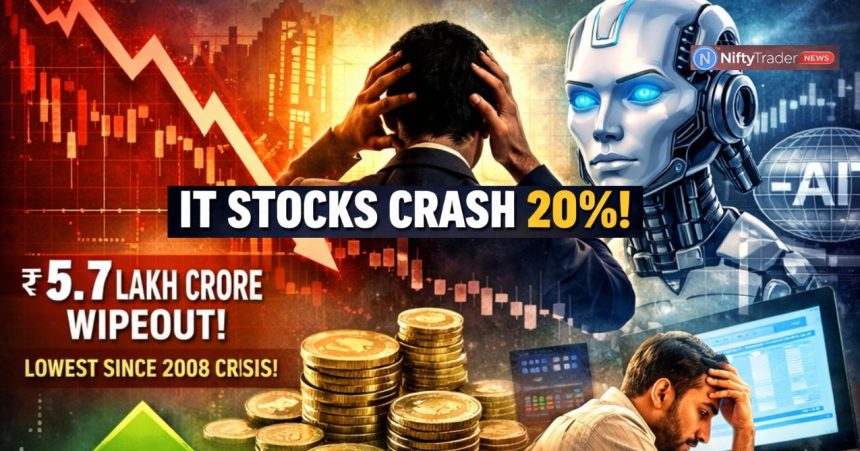
Nifty IT slipped sharply in Friday’s session as renewed AI-led disruption fears triggered aggressive profit-booking across frontline tech stocks, wiping out nearly ₹5.7 lakh crore in market value in February alone. Traders are now rapidly rotating out of IT and repositioning into defensives and domestic cyclicals, setting up high-volatility trade conditions for the day.
Indian equity markets open under intense sector-rotation pressure as Nifty IT collapses nearly 20% in February, its sharpest monthly drawdown since the 2008 financial crisis, triggering a high-stakes debate: structural breakdown or generational deep-value entry?
The selloff is not event-driven but fear-driven, centered around a single macro disruptor, Artificial Intelligence (AI) which markets now believe could fundamentally dismantle India’s $250 billion IT outsourcing model.
Yet, after six straight weeks of selling, smart money is selectively accumulating, setting up a high-volatility stock-picker’s market rather than a broad-based recovery trade.
Why IT Is Today’s Most Important Sector Call
-
Nifty IT: –20% in Feb 2026
-
Worst monthly fall since Lehman collapse (2008)
-
₹5.7 lakh crore market cap erosion in just 8 sessions
-
Valuations now at 8-year lows vs Nifty 500
Short-term traders are closely tracking the 50-DMA zone near 34,200 a decisive break below this level could accelerate selling pressure and trigger deeper rotational flows into banks, infra, and PSU stocks.
Unlike 2008, there is no single crisis event. Instead, this is a slow structural fear unwind, driven by the belief that Generative AI threatens labor-arbitrage economics, the backbone of Indian IT services.
This creates a classic institutional dilemma:
Structural disruption vs cyclical valuation opportunity.
Real Money-Flow Logic: Who Is Buying, Who Is Exiting?
Bull Camp – Deep Value Hunters Activate
Brokerage flows show contrarian accumulation starting at 14–18x forward P/E, with free cash flow yields of 4–6% now pricing in sub-5% terminal growth and historically deep pessimism.
Key institutional calls:
-
Emkay Global: Bottom formation zone, 13–25% 3-year return potential.
-
CLSA: TCS Outperform | Target ₹3,593 | Q4 dividend ₹35 + buyback optionality.
-
J.P. Morgan: Dividend yields at GFC + COVID extremes → “deep value barbell strategy.”
Preferred longs: Infosys, TCS, HCL Tech, Persistent Systems
Bear Camp – Structural Breakdown Thesis
Long-only funds & global brokers warn this is not just a valuation reset but business model compression.
Jefferies’s shock call:
Worst-case scenario = 30–65% further valuation derating
Core risks:
-
AI replacing coding + testing → billing compression
-
Managed services shrinking, consulting cyclicality rising
-
Talent pyramid inversion → margin squeeze
Stocks downgraded: Infosys, TCS, HCL Tech, LTIMindtree, Mphasis, Hexaware
Predictive Sector Rotation Framework
Sector Losing Leadership:
IT Services → Structural de-rating phase
Capital Rotating Toward
-
Banking + Financials (rate cycle + credit growth)
-
Capital Goods + Infra (capex revival)
-
Energy + PSU (valuation comfort + dividend yield)
This confirms a macro regime shift:
Growth certainty → Cash-flow certainty
Retail and institutional money is rotating away from global tech exposure into domestic cyclical visibility.
Quantified Technical Structure: Nifty IT Trading Zones
| Zone | Level | Market Signal |
|---|---|---|
| Major Support | 33,800 – 34,200 | Panic bottom zone |
| Range Base | 34,000 | Structural breakdown risk |
| Pullback Resistance | 36,800 – 37,200 | Sell-on-rise zone |
| Trend Reversal | 38,500+ | Bull cycle restart |
Bias: Volatile sideways → Downtrend unless 38,500 decisively reclaimed
Trade Setups
Aggressive Mean Reversion (Short-Term Traders)
-
Buy Zone: Nifty IT 33,800–34,200
-
Target: 36,500–37,000
-
Stop: 32,900
-
Probability: 60–65%
Structural Accumulation (Positional Traders)
Stock Picks:
-
Infosys
-
TCS
-
HCL Tech
Strategy:
-
Staggered accumulation on 5–7% dips
-
12–24 month horizon
-
Expectation: 18–30% upside if AI fears stabilize
Trend-Following Shorts (Momentum Traders)
Sell-on-rise:
-
Nifty IT near 36,800–37,200
-
Stop: 38,600
-
Downside: 34,200 → 33,000
Risk Matrix: What Can Trigger Next Big Move?
| Trigger | Impact |
|---|---|
| US Tech Capex slowdown | Negative |
| AI-led automation wins | Negative |
| Large deal pipeline revival | Positive |
| INR depreciation | Positive |
| Share buybacks + dividends | Positive |
Market Intelligence Verdict
This is NOT a simple buy-the-dip environment.
This is a structural repricing zone, where:
Only select stocks + tactical timing will generate alpha.
Expect:
-
High volatility
-
False breakouts
-
Sharp 3–5% intraday moves
Bottom Line:
India IT is transitioning from growth leadership → cash-flow defensive bucket.
Priority Trading Tag
Sector View: HIGH VOLATILITY
Strategy Bias: Selective Long + Tactical Shorts
Time Horizon: 2–6 weeks (trading), 12–24 months (investment)
Frequently Asked Questions
1. Why did Indian IT stocks crash 20% in February 2026?
Indian IT stocks crashed nearly 20% in February 2026 due to rising fears that Artificial Intelligence (AI) could structurally disrupt the traditional outsourcing business model, leading to billing pressure, automation-driven job displacement, and margin compression. This triggered large-scale institutional derisking and valuation reset, causing a ₹5.7 lakh crore market cap erosion in less than two weeks.
2. Is the IT sector crash a buying opportunity or a structural breakdown?
This selloff is not a typical cyclical correction. It reflects a structural repricing phase, where markets are resetting long-term growth expectations due to AI-led productivity shocks.
However, select IT leaders now trade at 8-year valuation lows, creating tactical deep-value opportunities for investors with a 12–24 month horizon, while short-term volatility remains extremely high.
3. Which IT stocks are best positioned after the crash?
High-conviction accumulation candidates:
-
Infosys
-
TCS
-
HCL Tech
-
Persistent Systems
These companies possess strong deal pipelines, deep AI integration strategies, superior cash flows, and dividend visibility, allowing them to outperform in a structurally challenged environment.
4. What is the key risk to Indian IT stocks in 2026?
The biggest risk is rapid AI adoption by global enterprises, which could reduce human coding, testing, and support requirements, directly compressing revenue per employee, billing rates, and project volumes.
This may lead to long-term margin erosion and growth downgrades across the IT services sector.
5. What technical levels should traders watch in Nifty IT?
| Level Zone | Market Signal |
|---|---|
| 33,800 – 34,200 | Panic support + bounce probability |
| 36,800 – 37,200 | Heavy sell-on-rise resistance |
| 38,500+ | Structural trend reversal zone |
| Below 33,000 | Fresh breakdown risk |
6. What is the best short-term trading strategy in IT stocks now?
Best high-probability setups:
-
Aggressive traders: Buy Nifty IT near 33,800–34,200, target 36,500–37,000, stop 32,900
-
Momentum traders: Sell on rise near 36,800–37,200, stop 38,600, downside 34,000–33,000
This volatility-based trading approach maximizes risk-reward in panic phases.
7. Which sectors are benefitting from IT sector money outflows?
Capital is rotating into:
-
Banking & Financials
-
Capital Goods & Infrastructure
-
Energy & PSU stocks
This reflects a macro shift toward cash-flow visibility, domestic demand, and dividend stability, away from global tech-linked uncertainty.
8. When will the IT sector trend turn positive again?
A sustainable bullish reversal requires:
-
Stabilisation in US tech spending
-
Large-deal wins visibility
-
Successful AI monetisation models
-
Nifty IT reclaiming 38,500+
Until then, the sector is expected to remain range-bound and highly volatile.
9. What is the long-term outlook for Indian IT stocks?
Long-term outlook (2–3 years):
Selective compounding remains possible, but return expectations reset from 20–25% CAGR to 10–14% CAGR due to structural margin compression and growth normalization.