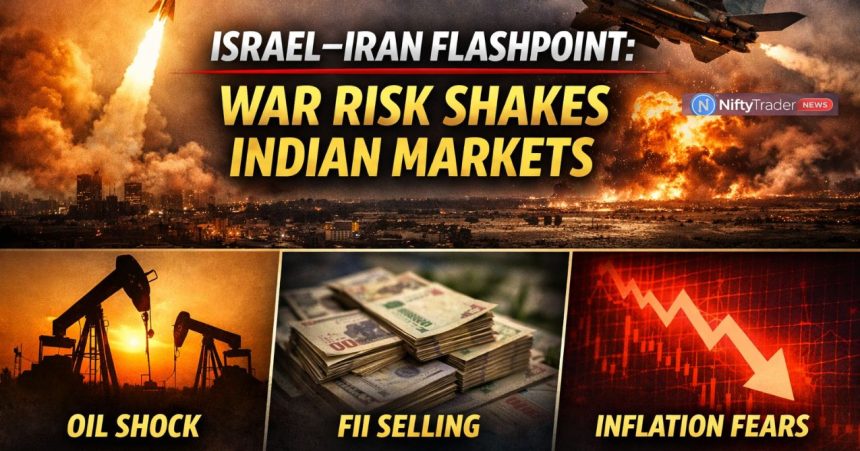
Indian equity markets are staring at a fresh geopolitical volatility trigger after Israel’s pre-emptive strike on Iran pushed the Middle East to the brink of a broader military escalation, prompting India to issue an emergency advisory for its citizens in Israel. The development sharply raises oil-supply risk, global risk-off probability, and FII positioning uncertainty, injecting a new macro stress layer into already fragile market sentiment.
Why this matters today:
Asian markets are already reacting to rising Middle East war risk, and Indian equities face a fragile opening as oil, currency, and FII flows become tightly tethered to every geopolitical headline — amplifying volatility and widening the expectation gap.
Real Money-Flow Logic — Why Markets Care Today
This event is not just geopolitical noise. For markets, this is a direct crude oil + inflation + global risk appetite transmission channel.
Key market sensitivities:
-
Crude oil risk premium: Any escalation involving Iran threatens Hormuz Strait supply flows, risking sharp oil price spikes.
-
India’s vulnerability: India imports ~85% of its crude → oil spikes directly hit inflation, fiscal math, current account deficit & rupee stability.
-
FII behavior: Rising geopolitical risk historically pushes foreign flows into risk-off mode, especially in high-beta EM equities.
-
Safe-haven rotation: Gold, USD, and US treasuries attract flows → equity risk premium expands.
This creates a clear expectation gap: markets are still pricing limited escalation, while geopolitical reality is now shifting toward extended conflict probability.
What If: Translating Geopolitics into Market Scenarios
| Scenario | Direct Market Impact |
|---|---|
| Crude Oil ↑ 10% | Inflation ↑ → RBI hawkish risk ↑ → FMCG, Autos, Paints ↓ |
| Sustained FII Outflows | Sensex ↓ → Midcaps ↓↓ → Rupee weakens → Volatility spikes |
| Safe-Haven Rotation | Gold ↑ → USD ↑ → EM equities underperform |
| Hormuz Supply Risk | Crude shock → India CAD widens → Bond yields ↑ |
| Rapid Diplomatic De-escalation | Oil cools → Risk-on rebound → Tactical rally in cyclicals |
Predictive Sector Rotation — Who Wins, Who Bleeds
High-Risk Zones
-
Aviation & Logistics: ATF cost sensitivity + airspace disruptions.
-
Paints, Chemicals, FMCG: Input cost inflation risk.
-
Mid-cap IT & Export-heavy stocks: Dollar volatility + global growth risk.
-
Autos: Margin pressure if crude sustains higher levels.
Defensive + Hedge Zones
-
Oil & Gas upstream (ONGC, Oil India): Earnings leverage to crude upside.
-
Defence stocks: Geopolitical tension keeps order-flow visibility elevated.
-
Gold-linked themes: ETF flows + bullion demand revival.
Index Impact Zones — Tactical Risk Map
| Index | Immediate Risk Level |
|---|---|
| Nifty 50 | Medium |
| Bank Nifty | Low–Medium |
| Midcap Index | High |
| Small-cap Index | Very High |
Midcaps & small caps remain structurally fragile due to the following:
-
Elevated valuations
-
Narrow leadership
-
Weak FII participation
-
Rising global volatility index
Market Reaction Snapshot — Day of / Next Session
| Market Variable | Expected Reaction Zone |
|---|---|
| Sensex / Nifty | Volatile → Negative bias unless de-escalation signals emerge |
| Crude Oil | +3% to +8% spike risk if conflict escalates |
| FII Net Flows | Risk-off bias → Higher probability of selling |
| Sectoral Winners | Defence, Energy Upstream, Gold-linked themes |
| Sectoral Losers | Aviation, FMCG, Autos, Paints, Logistics |
| Rupee | Depreciation risk → Import cost pressure |
| India VIX | Expansion → Elevated option premiums |
Forward-Looking Risk — The Real Market Threat
The biggest forward-looking risk is mispricing of escalation probability.
Markets currently assume:
Short conflict → diplomatic containment → oil stabilises.
But if
-
Iran retaliates directly, or
-
Regional proxies enter the conflict, or
-
Shipping routes get disrupted
Then:
Crude spike + currency volatility + FII selling = Sharp risk-off repricing.
This is where market tension builds. Investors are positioned for calm, while geopolitics is moving toward instability.
Trading & Investment Strategy Framework
Priority: HIGH ALERT
-
Hedge portfolios via:
-
Energy exposure
-
Gold ETFs
-
Low-beta defensives
-
-
Reduce leverage in:
-
Midcaps
-
High valuation momentum stocks
-
-
Tactical long bias:
-
Defence
-
Energy upstream
-
Select PSU defensives
-
Bottom Line
Israel’s strike on Iran has reintroduced a global macro shock variable that markets were not pricing aggressively, creating a dangerous expectation gap. For Indian equities, the oil-inflation-FII nexus becomes the critical transmission channel, keeping volatility elevated and risk skewed to the downside unless rapid diplomatic de-escalation emerges. Traders should treat every Middle East headline as a volatility trigger, not noise, until oil and currency markets confirm stability.
Frequently Asked Questions
1) Why did India issue an advisory for its citizens in Israel?
India issued the advisory after Israel launched pre-emptive military strikes against Iran, sharply escalating regional conflict risk. The move reflects rising uncertainty over security conditions and the growing probability of wider geopolitical disruption.
2) Why is the Israel–Iran conflict important for Indian stock markets?
The conflict directly threatens crude oil supply routes, raising fears of oil price spikes, inflation pressure, rupee volatility, and FII risk-off flows—a combination that historically amplifies market corrections.
3) How does Middle East tension impact crude oil and inflation?
Any escalation involving Iran raises the risk of supply disruptions near the Strait of Hormuz, through which ~20% of global oil flows. Even a moderate spike in crude can quickly lift India’s inflation expectations and fiscal stress.
4) What is the biggest market risk from this geopolitical shock?
The biggest risk lies in the expectation gap — markets are still pricing limited escalation, while geopolitical signals suggest rising probability of prolonged conflict, which could trigger abrupt repricing and volatility spikes.
5) Which sectors face the highest downside risk?
Aviation, paints, FMCG, logistics, chemicals, and auto stocks face elevated margin pressure due to fuel and input cost inflation if crude sustains higher levels.
6) Which sectors could benefit if tensions escalate?
Energy upstream companies, defence stocks, and gold-linked themes may attract defensive and hedge-driven capital flows during periods of rising geopolitical risk.
7) How could FII flows react to rising war risk?
Higher geopolitical uncertainty often pushes global funds toward safe-haven assets, increasing the probability of near-term FII outflows from emerging markets like India.
8) What should traders and investors monitor going forward?
Crude oil price action, dollar movement, FII flow trends, and diplomatic developments will be critical signals to gauge whether this shock remains temporary or evolves into a structural market risk.
9) Is this risk temporary or structural?
While short-term de-escalation remains possible, the forward-looking risk of prolonged conflict introduces a structural volatility layer that markets cannot ignore.
10) What is the immediate market strategy?
Maintain risk discipline, avoid leverage, monitor oil closely, and stay positioned in low-beta defensives until geopolitical clarity improves.