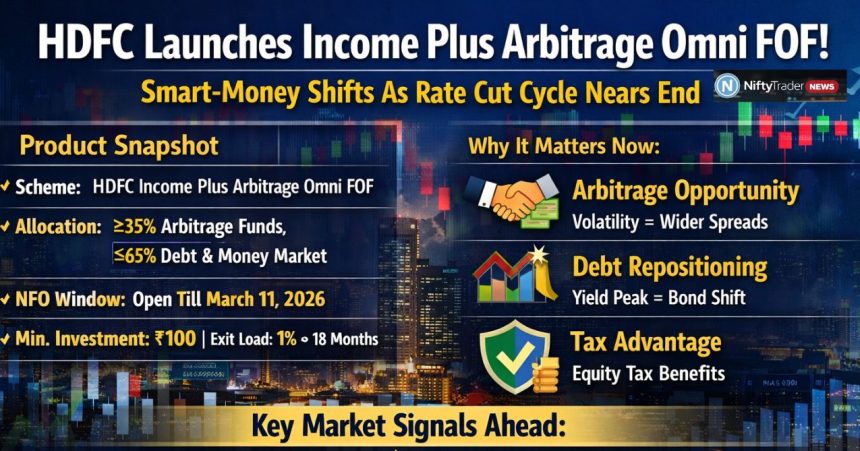
As bond yields soften and equity volatility stays elevated, institutional money is quietly rotating into tax-efficient, low-volatility structures, setting the stage for a fresh product cycle in India’s ₹55 lakh crore mutual fund industry. In this backdrop, HDFC Mutual Fund has launched the HDFC Income Plus Arbitrage Omni FOF, a hybrid fund-of-funds designed to capture arbitrage spreads while tactically exploiting debt-market inefficiencies a strategy increasingly favoured by treasury desks, high-net-worth investors, and conservative allocators.
What Was Launched — And Why It Matters Today
Product Snapshot
-
Scheme: HDFC Income Plus Arbitrage Omni FOF
-
Structure: Open-ended Fund of Fund (FoF)
-
Allocation Framework:
-
≥35% in arbitrage schemes
-
≤65% in debt-oriented mutual funds & money market instruments
-
-
Benchmark: 40% Nifty 50 Arbitrage Index (TRI) + 60% Nifty Short Duration Debt Index
-
NFO Window: Open till March 11, 2026
-
Minimum Investment: ₹100
-
Exit Load: 1% if redeemed within 18 months
Strategic Trigger:
With RBI widely seen near the terminal point of the rate-cut cycle, yield compression and arbitrage spreads are emerging as the next income-generation frontier. This launch is a direct response to that macro inflection.
Smart-Money Logic: Why Arbitrage + Debt Is Gaining Institutional Traction
This product structure reflects three converging money-flow forces:
1️⃣ Arbitrage Revival Amid Volatility
-
Elevated futures–cash spreads due to rising index volatility are reopening alpha windows for arbitrage strategies.
-
Institutional desks increasingly prefer arbitrage as equity-classified, low-volatility income, especially post-tax changes.
2️⃣ Debt Curve Repositioning
-
With benign inflation, ample system liquidity, and peaking yields, duration positioning is back in favour.
-
Spread compression in non-AAA corporate bonds offers additional carry upside.
3️⃣ Tax-Efficiency Play
-
Hybrid equity classification enables lower post-tax returns volatility, making this structure superior to conventional short-duration debt funds for many investors.
This is not merely a product launch; it is a tactical expression of evolving capital allocation behaviour in a maturing rate cycle.
Market Tension: The Expectation Gap Investors Must Track
Despite favourable macro positioning, a clear expectation gap remains:
-
Markets are pricing smooth yield compression + stable arbitrage spreads, but:
-
Any liquidity shock, RBI policy surprise, or sharp volatility contraction could compress arbitrage returns faster than anticipated.
This creates a forward-looking risk:
👉 If arbitrage spreads normalize too quickly or yields fail to drift lower, short-term return expectations may face downside pressure.
That uncertainty makes dynamic allocation — rather than static debt exposure — increasingly relevant.
Predictive Sector & Flow Implications
What This Signals for Markets Ahead:
-
Debt Mutual Funds: Structural inflows likely to rise as investors reposition away from pure duration risk.
-
Arbitrage Funds: Expected to witness AUM acceleration, especially from corporate treasuries.
-
Banking & Money Market Instruments: Beneficiaries of renewed institutional churn and liquidity rotation.
This product launch reinforces a macro shift toward stability-first portfolio construction, particularly in uncertain rate and growth regimes.
Strategy View: Who Should Consider This?
Best suited for:
-
Investors seeking low volatility + tax efficiency
-
Treasury desks deploying short-to-medium term surplus capital
-
Conservative allocators rotating out of traditional short-duration debt
Not ideal for:
-
High-growth equity seekers
-
Investors expecting double-digit return acceleration
Bottom Line: Why This NFO Is a Market Signal — Not Just a Product Launch
The launch of HDFC Income Plus Arbitrage Omni FOF reflects a deeper shift in institutional capital psychology — away from aggressive yield chasing and toward structured, volatility-managed income strategies.
Yet, uncertainty around policy timing, liquidity flows, and arbitrage sustainability ensures that return paths will not be linear, keeping tactical positioning crucial.
Translation for traders & allocators:
This is a macro allocation signal — not just another fund launch.
Frequently Asked Questions
Q1. What is HDFC Income Plus Arbitrage Omni FOF?
It is an open-ended fund-of-funds investing dynamically in arbitrage schemes and debt-oriented mutual funds to generate stable, tax-efficient income.
Q2. Why are arbitrage funds gaining popularity?
Due to rising market volatility, arbitrage spreads have widened, offering low-risk income with favourable tax treatment.
Q3. Is this fund risky?
It carries moderate risk, but returns depend on arbitrage spreads, interest rate trends, and liquidity cycles introducing forward-looking uncertainty.
Q4. Who should invest?
Investors seeking stable, tax-efficient returns over short to medium horizons.