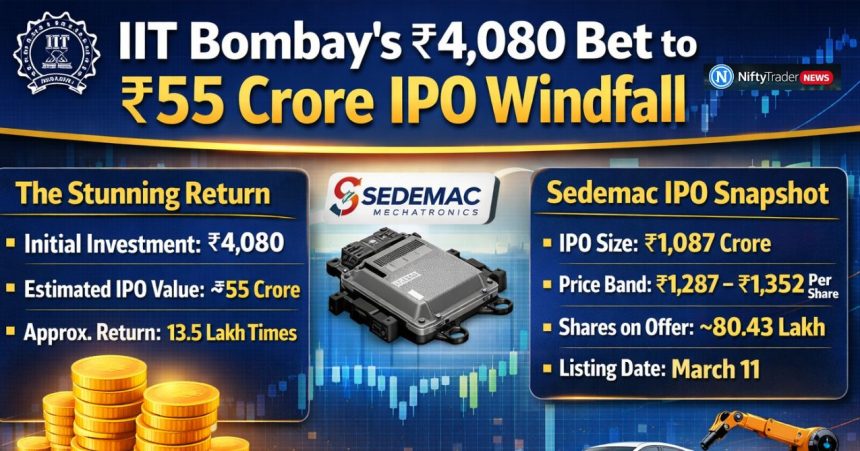
A tiny early investment of just ₹4,080 by the startup incubator at the Indian Institute of Technology Bombay is set to deliver an extraordinary ₹55-crore windfall, thanks to the upcoming IPO of auto-electronics company Sedemac Mechatronics.
The stunning return is drawing attention across India’s startup ecosystem, highlighting how university incubators and deep-tech research projects are increasingly producing IPO-scale companies.
With Sedemac preparing to list on the National Stock Exchange of India, the early IIT Bombay bet is turning into one of the most remarkable startup investment returns in recent years.
What Just Happened
The Society for Innovation and Entrepreneurship (SINE) IIT Bombay’s startup incubator invested in Sedemac at a very early stage, acquiring shares at roughly ₹0.01 per share when the company was still a research-stage venture.
Now, as Sedemac launches its ₹1,087-crore IPO, the value of that tiny stake has skyrocketed.
Sedemac IPO Snapshot
-
IPO size: ₹1,087 crore
-
Price band: ₹1,287 – ₹1,352 per share
-
Shares on offer: ~80.43 lakh
-
Issue type: Entirely Offer For Sale (OFS)
-
Expected listing: March 11
Because the issue is a pure OFS, the company will not receive fresh capital. Instead, early investors and promoters are partially monetising their stakes, marking a major liquidity event after years of growth.
The Extraordinary Return
The numbers behind SINE’s investment are striking:
-
Original investment: ₹4,080
-
Estimated value at IPO price: ~₹55 crore
-
Approximate return: nearly 13.5 lakh times
SINE plans to sell around 2.04 lakh shares in the IPO, potentially realising about ₹27.6 crore, while still retaining a small stake in the company after listing.
Even in venture capital, returns of this scale are extremely rare, underscoring the payoff potential of very early-stage deep-tech investments.
From IIT Research Project to IPO
Sedemac Mechatronics was founded in 2007 as part of a research initiative at IIT Bombay by Shashikanth Suryanarayanan and collaborators.
The Pune-based company develops electronic control units (ECUs) used across a wide range of mobility and industrial applications, including:
-
Two-wheelers
-
Three-wheelers
-
Electric vehicles
-
Industrial generator systems
Its technology helps manage engine performance, vehicle electronics, and power systems, supplying components to both Indian and global OEMs.
Business Growth Ahead of the IPO
Sedemac’s financial performance has accelerated in recent years as demand for vehicle electronics and smart mobility systems grows.
| Year | Revenue | Profit |
|---|---|---|
| FY23 | ₹423 crore | ₹8.57 crore |
| FY24 | ₹531 crore | ₹5.88 crore |
| FY25 | ₹658 crore | ₹47.05 crore |
For Q1 FY26, the company reported:
-
Revenue: ₹217 crore
-
Profit: ₹17 crore
The sharp jump in profitability signals improving operating leverage and stronger demand from automotive manufacturers.
Why Markets Are Watching This IPO
1️⃣ Startup exits are accelerating
Listings like Sedemac show that India’s startup ecosystem is beginning to deliver large public-market exits, which is critical for venture capital returns.
2️⃣ University incubators are producing IPO-scale companies
Institutions like IIT Bombay’s SINE are increasingly acting as early discovery platforms for deep-tech startups, creating a pipeline of companies that could eventually reach public markets.
3️⃣ Auto-electronics is becoming a strategic sector
As electric vehicles, connected mobility, and stricter emission norms reshape the automotive industry, companies specialising in vehicle electronics and control systems are becoming increasingly important to global supply chains.
Market Takeaway
Sedemac’s upcoming IPO is more than just another listing.
It demonstrates how deep-tech research, university incubation, and patient early capital can generate extraordinary returns while also signalling that India’s next wave of IPO candidates may increasingly come from research labs and technology startups.
For investors tracking India’s IPO pipeline, the Sedemac story offers a clear signal: the country’s innovation ecosystem is beginning to translate into real public-market value.
Frequently Asked Questions
1. Why is the Sedemac Mechatronics IPO attracting so much attention?
The IPO is drawing attention because an early ₹4,080 investment by the IIT Bombay incubator SINE could be worth nearly ₹55 crore at the IPO price, translating into an extraordinary return of about 13.5 lakh times. Such returns are extremely rare even in venture capital.
2. What is the size and price band of the Sedemac Mechatronics IPO?
Sedemac Mechatronics is launching a ₹1,087-crore IPO with a price band of ₹1,287 to ₹1,352 per share. The issue consists of about 80.43 lakh shares and is structured as a pure Offer For Sale (OFS).
3. Will Sedemac receive fresh capital from the IPO?
No. Because the issue is entirely an Offer For Sale, the company itself will not receive new funds. Instead, existing shareholders and early investors will partially sell their stakes to public investors.
4. How much stake is IIT Bombay’s SINE selling in the IPO?
SINE plans to sell around 2.04 lakh shares in the offering, which could generate roughly ₹27–28 crore at the upper price band, while still retaining a small stake after listing.
5. What does Sedemac Mechatronics do?
Sedemac develops electronic control units (ECUs) used in automotive and industrial applications. These systems help manage engine performance, vehicle electronics, and power systems across vehicles such as two-wheelers, three-wheelers, electric vehicles, and industrial generators.
6. How has Sedemac’s financial performance evolved recently?
Sedemac’s revenue has grown steadily, reaching ₹658 crore in FY25, while profit jumped sharply to ₹47.05 crore, indicating improving operating leverage as demand for vehicle electronics increases.
7. Why is the auto-electronics sector gaining investor interest?
The sector is benefiting from structural shifts in the automotive industry, including electric vehicles, connected mobility, and stricter emission regulations, all of which require more sophisticated electronic control systems.
8. What risks or uncertainties should investors watch in the Sedemac IPO?
Despite strong growth, investors may watch valuation expectations, the absence of fresh capital in the OFS structure, and cyclical demand in the auto sector. Any slowdown in vehicle production or EV adoption could affect future revenue momentum.
9. What does this IPO signal for India’s startup ecosystem?
The Sedemac story highlights how university incubators and deep-tech research platforms are beginning to produce IPO-scale companies, potentially expanding India’s pipeline of innovation-driven listings in the coming years.