Government Moves to Safeguard Gas Supply as LNG Disruptions Raise Energy Security Concerns
The Indian government has stepped in with an emergency regulatory measure to stabilise the country’s energy supply chain as global fuel disruptions intensify. The Ministry of Petroleum and Natural Gas has notified the Natural Gas (Supply Regulation) Order, 2026, invoking provisions under the Essential Commodities Act, 1955, to ensure that essential sectors continue receiving uninterrupted natural gas and LPG supplies.
The decision comes amid growing concerns about disruptions in Liquefied Natural Gas (LNG) shipments passing through the Strait of Hormuz, one of the world’s most critical energy transit routes. A large portion of India’s LNG imports passes through this corridor, and geopolitical tensions in the Middle East have begun to affect shipments and logistics.
For the government, the immediate priority is clear: protect domestic LPG supply for households and ensure industries that are vital to economic stability—such as fertiliser manufacturing and city gas distribution—continue to operate smoothly. For financial markets and investors, however, the order signals deeper concerns about global energy volatility and its potential ripple effects on India’s economy and stock market.
Why the Government Introduced the Natural Gas Regulation Order
The Natural Gas Supply Regulation Order was introduced after authorities assessed the growing risk of fuel supply disruptions triggered by escalating geopolitical tensions in the Middle East. The ongoing conflict in the region has begun to disrupt LNG shipping routes, forcing several international suppliers to invoke force majeure clauses, which allow them to suspend contractual supply obligations due to extraordinary circumstances.
Such disruptions have raised alarms within India’s energy ecosystem because LNG plays a crucial role in powering several sectors, including city gas networks, fertiliser plants, power generation units, and industrial facilities. Any prolonged disruption in imports could have cascading effects on domestic fuel availability and prices.
To prevent such a scenario, the government decided to regulate the distribution and allocation of natural gas supplies across sectors. The goal is not only to prevent shortages but also to ensure that essential sectors continue to function even if global supply constraints persist.
Key objectives of the regulation include:
-
Ensuring uninterrupted LPG supply for domestic households
-
Prioritising natural gas allocation to critical sectors
-
Preventing panic buying, hoarding and black marketing
-
Maintaining stability in fertiliser production and agricultural supply chains
-
Protecting the economy from energy-driven inflation shocks
By proactively issuing the regulation, policymakers are attempting to minimise the economic and social impact of global energy supply disruptions.
Also Read : Precious Metals Slip — Why Are Gold and Silver Falling Despite Rising War Tensions?
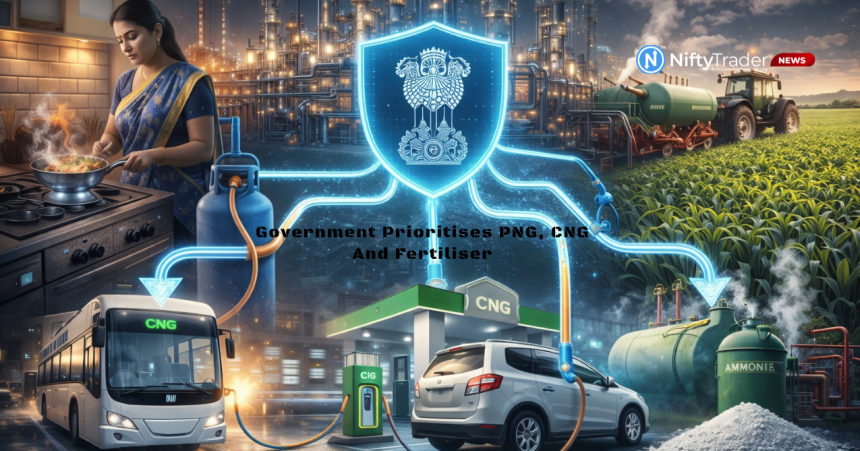
PNG, CNG and Fertiliser Industries Receive Priority in Gas Allocation
Under the newly notified regulation order, the government has clearly outlined priority sectors that will receive preferential access to natural gas and LPG supply during periods of supply constraints.
The highest priority has been given to domestic LPG consumption, ensuring that millions of households across the country do not face shortages of cooking gas. The government is particularly cautious about maintaining stable supply for domestic consumers because LPG shortages could quickly trigger public concern and inflationary pressure.
Apart from domestic use, other sectors that have been prioritised include:
-
City Gas Distribution companies supplying Piped Natural Gas (PNG) to households and commercial establishments
-
Compressed Natural Gas (CNG) used in public transportation and private vehicles
-
Fertiliser manufacturing units, which rely heavily on natural gas as a feedstock
The fertiliser sector’s inclusion in the priority list is especially significant. Fertiliser production is critical to India’s agricultural ecosystem, and any disruption could affect crop yields, food prices, and rural economic stability.
Energy experts believe that by protecting these sectors, the government aims to prevent a broader economic disruption that could arise from prolonged LNG supply shortages.
Refineries Directed to Boost LPG Production to Offset Import Risks
Recognising the potential risks arising from global supply disruptions, the government has also taken proactive steps to strengthen domestic LPG availability. Oil refineries across the country have been instructed to increase LPG production and divert additional output specifically for domestic consumption.
This step is particularly important because domestic LPG demand is heavily dependent on imports, and any delay or disruption in international shipments could quickly translate into supply shortages within the country.
In an official communication, the ministry explained the reasoning behind the directive.
“In light of current geopolitical disruptions to fuel supply and constraints on supply of LPG, the ministry has issued orders to oil refineries for higher LPG production and using such extra production for domestic LPG use.”
By increasing domestic production capacity, authorities hope to reduce dependence on international supply chains and create a buffer that can absorb temporary disruptions in LNG imports.
Government Introduces Controls to Prevent Hoarding and Market Manipulation
Alongside production and allocation measures, the government has also implemented regulatory safeguards aimed at preventing misuse of LPG supply during this period of uncertainty.
One of the key steps announced by the ministry is the introduction of a 25-day inter-booking period for domestic LPG cylinders. This rule is designed to prevent consumers or distributors from placing frequent bookings that could lead to stockpiling and artificial shortages.
The ministry explained the reasoning behind the measure.
“The ministry has prioritised domestic LPG supply to households and introduced a 25-day inter-booking period to avoid hoarding and black marketing.”
Additionally, imported LPG supplies that are meant for non-domestic use will now be prioritised for essential institutions such as:
-
Hospitals
-
Educational institutions
For other commercial sectors—including restaurants, hotels, and industrial units—a three-member committee of executive directors from oil marketing companies (OMCs) has been established to review supply requests and ensure fair distribution.
This mechanism is intended to ensure that LPG supply remains balanced and essential services are not affected.
Here’s What Happened Today and Why Traders Reacted
The announcement of the Natural Gas Supply Regulation Order immediately caught the attention of market participants, as it highlighted the growing impact of global geopolitical tensions on India’s energy security.
Several factors contributed to the market’s cautious reaction:
-
Ongoing Middle East conflict disrupting LNG shipping routes
-
Reports of suppliers invoking force majeure clauses
-
Government intervention indicating possible supply risks
-
Increased refinery production to stabilise domestic LPG supply
Traders interpreted the policy move as a sign that the government is preparing for potential volatility in energy markets. Energy prices, LNG supply contracts, and logistics costs could remain unpredictable if geopolitical tensions persist.
As a result, stocks linked to gas distribution, refining, and fertiliser production are likely to remain in focus in the coming trading sessions.
Impact on Energy Stocks and Investor Portfolios
From an investment perspective, the government’s decision could have varied implications across different segments of the energy and industrial sectors.
Companies that may benefit include:
-
City Gas Distribution firms, which will continue receiving priority gas allocation
-
Fertiliser manufacturers, as stable gas supply ensures uninterrupted production
-
Oil marketing companies, which may increase refining margins through higher LPG production
However, industries dependent on non-priority LPG supply—such as hospitality, small manufacturing units, and certain commercial sectors—may face tighter supply conditions if global disruptions persist.
A market analyst explained the potential implications for investors:
“The regulation reflects the government’s attempt to shield critical sectors from global supply disruptions. While city gas and fertiliser companies may benefit from prioritised allocation, other sectors could experience supply constraints if LNG disruptions continue.”
For traders, the development signals that energy-related stocks may remain volatile, especially if geopolitical tensions escalate.
What Investors Should Monitor in the Coming Days
Investors and market participants should closely track several developments that could influence both energy markets and related stocks in the coming weeks.
Key factors to watch include:
-
The duration and intensity of geopolitical tensions in the Middle East
-
Stability of LNG shipments through the Strait of Hormuz
-
Domestic LPG production increases by Indian refineries
-
Government policy updates regarding fuel supply management
-
Market reactions in energy, fertiliser and city gas distribution stocks
If global supply disruptions persist, energy prices could remain volatile, potentially impacting inflation and industrial production.
For now, the Natural Gas Supply Regulation Order, 2026 signals that India is taking proactive steps to manage supply risks and protect critical sectors from global energy disruptions—an approach that investors will continue to monitor closely as geopolitical developments unfold.