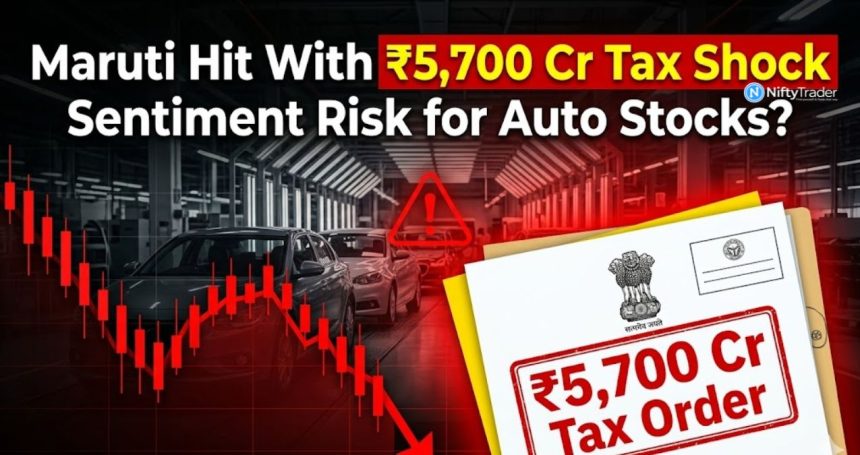
India’s largest carmaker, Maruti Suzuki India Ltd., is back in focus after receiving a massive ₹5,700+ crore income tax assessment order, a development that has instantly become a market-relevant trigger, not just a corporate update.
The key question now:
Is this just another routine tax dispute or a fresh overhang for auto stocks and market sentiment?
What Just Happened
Maruti Suzuki disclosed that it has received a draft assessment order from the Income Tax Department worth about ₹5,786 crore, marking one of the largest recent tax demands on an Indian auto company.
-
Nature: Draft assessment order
-
Amount: ₹5,700+ crore
-
Timing: Announced now (fresh trigger)
This is not a minor compliance issue; it is a high-value regulatory development that markets cannot ignore.
Why Markets Care Right Now
At first glance, tax disputes may look routine, but in markets, size + timing + uncertainty = reaction risk.
Here’s why this matters immediately:
1. Size Is Large Enough to Trigger Sentiment Shift
A ₹5,700 crore demand is material even for a large-cap like Maruti.
-
Raises questions on:
-
potential cash outflow
-
earnings visibility
-
legal timeline
-
2. Regulatory Risk Comes Back Into Focus
India’s auto sector has a history of tax disputes, with companies facing multi-billion-dollar claims over time.
This news reminds markets:
“Regulatory overhang is still real and unpredictable.”
3. Not the First Time But Still Important
Maruti has faced multiple tax demands historically, often contesting them legally.
-
₹2,966 crore draft order earlier
-
₹779 crore demand in past years
-
Larger cumulative disputes over time
The pattern:
-
Company typically appeals
-
Immediate financial impact is often limited
But…
Markets don’t wait for final outcomes; they price uncertainty first.
Market Angle: What Traders Should Watch
Even if there is no immediate earnings hit, traders focus on second-order effects:
Stock Reaction
-
Any gap-down or intraday weakness
-
Whether dips get bought (confidence signal)
Auto Sector Sentiment
-
Could spill over to:
-
OEMs
-
ancillary stocks
-
export-driven auto names
-
Institutional Behaviour
-
Watch for:
-
FII positioning
-
block trades / delivery spikes
-
Sector Implications
This is not just about one company.
Broader Signals for Auto Sector:
-
Regulatory scrutiny risk remains elevated
-
Valuation comfort may reduce in near term
-
High-quality large caps may still see defensive buying
What Makes This Interesting:
-
Happens when auto demand cycle is stabilising
-
Adds a non-demand-related risk layer
What Happens Next
Since this is a draft assessment order, the process typically follows:
-
The company files objections / an appeal.
-
Moves to Dispute Resolution Panel / Tribunal
-
The legal process continues (often long-drawn)
Key takeaway:
Immediate cash impact is unlikely, but headline risk stays alive.
Bigger Picture
This is where the real value lies:
Markets are not reacting to “tax demand”
They are reacting to uncertainty + headline risk + positioning shift
And that’s exactly where traders get an edge.
Bottom Line
-
Event: ₹5,700+ crore tax order
-
Signal: Regulatory overhang returns
-
Impact: Sentiment risk > immediate financial impact
-
Focus: Price action, sector spillover, institutional behaviour
This is a classic market setup where:
-
fundamentals ≠ short-term movement
-
sentiment drives first reaction
Also Read: $200 Oil Shock? Why a Middle East Flashpoint Is Forcing Traders to Price the Unthinkable