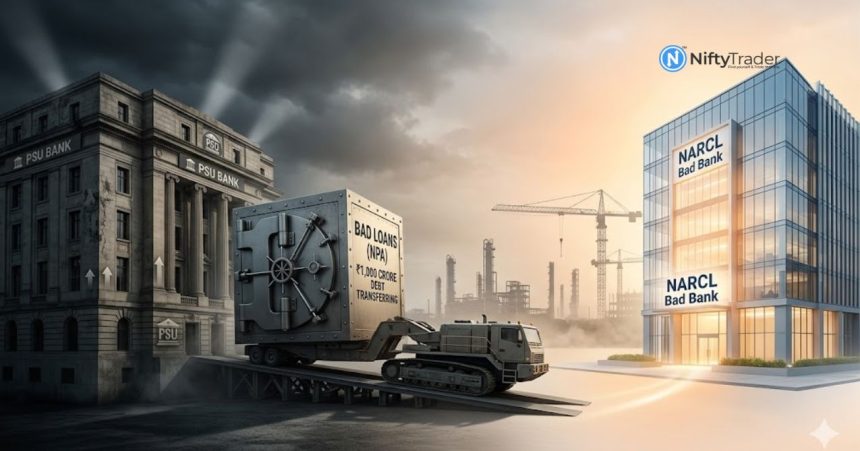
What just changed?
India’s bad bank, National Asset Reconstruction Company Ltd. (NARCL), is moving to acquire around ₹1,000 crore in stressed debt of Kay Bouvet Engineering, marking another step in resolving legacy industrial NPAs.
Why This Matters Now
India’s bad-loan resolution pipeline is back in focus after National Asset Reconstruction Company Ltd initiated action to take over the stressed debt of engineering firm Kay Bouvet.
The move signals continued clean-up in the capital goods and EPC ecosystem, a space closely tracked by markets for signs of balance-sheet stress and recovery.
What Happened
- NARCL is set to acquire ~₹1,000 crore debt linked to Kay Bouvet
- The proposal is expected to go through a creditor and board-level approval process
- This forms part of India’s broader strategy to shift legacy NPAs away from bank balance sheets
📌 This is not just a company-specific story; it’s part of a system-wide clean-up cycle.
Why Markets Care Right Now
Even though Kay Bouvet itself isn’t a widely traded large-cap, the implications are broader:
1️⃣ Capital Goods Sentiment
- Signals continued stress resolution in engineering & EPC companies
- Helps improve confidence in sector balance sheets
2️⃣ Banking Sector Impact
- Banks offloading NPAs to NARCL → improves asset quality visibility
- Reduces uncertainty around legacy loans
3️⃣ Liquidity & Credit Cycle
- Faster resolution = capital recycling
- Positive for capex-led growth narrative
👉 For traders, this matters because:
Market rallies in capital goods often depend on clean balance sheets + order visibility
Sector Angle
Capital Goods / EPC Space
- Companies with stressed balance sheets may see re-rating potential
- Cleaner books → better access to fresh capital
Banking & PSU Banks
- NPA transfer to NARCL reduces overhang
- Could support valuation multiples over time
What Traders Should Watch Next
- Final approval timeline for the deal
- Additional large-ticket NPA transfers to NARCL
- Any stock-specific reaction in capital goods / PSU banks
- Signals of acceleration in India’s bad loan resolution cycle
Interpretation
This isn’t a one-off event.
It reinforces a broader trend:
India is gradually moving legacy stress out of the system, enabling a cleaner base for the next capex cycle.
Markets don’t always react immediately to such developments, but they:
- change sentiment slowly
- influence sector rotation
- shape medium-term positioning
Also Read: GLP-1 Price Crash Triggers Pharma Shift—Why Ajanta Pharma & Sun Pharma May Be Early Winners
Frequently Asked Questions
1. What is NARCL and why is its latest move important?
National Asset Reconstruction Company Ltd (NARCL) is India’s “bad bank” created to take over stressed loans from banks. Its latest move to acquire ₹1,000 crore debt signals continued progress in cleaning up legacy NPAs, which markets closely track for credit cycle recovery.
2. Why does the Kay Bouvet debt resolution matter for markets?
While Kay Bouvet itself is not a major listed stock, the transaction reflects broader stress resolution in the capital goods and EPC sector, an area critical for India’s capex-driven growth narrative.
3. How does NPA transfer to NARCL impact banks?
When banks transfer bad loans to NARCL:
- Balance sheets become cleaner
- Gross NPA ratios improve
- Lending capacity increases
This can support valuation re-rating, especially for PSU banks, though the timing of this impact remains uncertain.
4. What does this mean for the capital goods sector?
The move indicates:
- Gradual removal of legacy stress
- Improved investor confidence
- Potential for better access to credit
However, there’s still an expectation gap; order inflows are strong, but balance sheet repair is uneven across companies.
5. Is this the start of a larger NPA resolution cycle?
Possibly but not confirmed yet. Markets are watching whether:
- More large-ticket NPAs are transferred
- Resolution timelines accelerate
If momentum sustains, it could mark a structural shift in the credit cycle.
6. Why haven’t markets reacted strongly yet?
Because this is a slow-burn trigger:
- Impact is systemic, not immediate
- Benefits accrue over time
- Traders often wait for visible earnings or credit growth confirmation
This creates a market tension between improving fundamentals and muted price action.
7. What are the key risks to watch?
- Delays in approval or execution
- Low recovery values impacting bank profitability
- Slower-than-expected NPA pipeline transfer
Forward-looking risk: if resolution pace stalls, the capex optimism narrative could weaken.
8. Which sectors could benefit the most?
- PSU Banks → cleaner books, improved lending capacity
- Capital Goods / EPC → better balance sheet perception
- Infrastructure plays → stronger credit flow support