What Just Changed
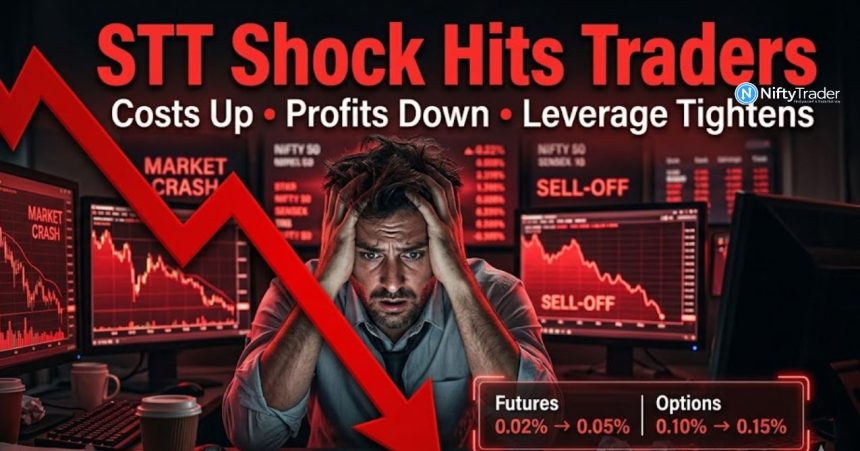
Starting April 1, 2026, India’s derivatives market is entering a structurally different phase, one where cost, capital, and discipline take center stage.
The government has implemented a sharp increase in Securities Transaction Tax (STT) across futures and options, while parallel tightening in broker funding and collateral norms is quietly reducing the leverage available to traders.
👉 Key Changes:
- Futures STT: 0.02% → 0.05%
- Options STT: 0.10% → 0.15%
This is not a marginal adjustment—it’s a 2.5x jump in futures STT and a 50% increase in options STT, directly hitting the core economics of trading strategies.
At the same time, stricter margining and funding rules are constraining how aggressively traders can deploy capital.
📌 Market reality: Trading isn’t being restricted, but it’s being made meaningfully more expensive and capital-intensive.
Why Markets Care Right Now
Markets are reacting to this shift not just because of higher taxes but because it fundamentally alters how participation works.
For years, India’s derivatives ecosystem thrived on:
- High turnover
- Cheap leverage
- Retail-driven momentum
That model is now under pressure.
👉 Three immediate structural impacts:
- Higher transaction costs reduce net profitability
- Lower leverage availability limits position sizing
- Policy intent clearly discourages speculative churn
The result is a transition phase where markets move from:
High-volume speculative trading → Selective, conviction-driven participation
However, the expectation that this will instantly “stabilize” markets may be premature. There is an expectation gap between regulatory intent and actual market behavior, especially in the early months of adjustment.
What Is Driving This Policy Shift
The trigger behind this move lies in the explosive growth of derivatives trading in India, particularly among retail participants.
Over the past few years:
- F&O volumes surged to dominate overall market turnover
- Retail participation expanded rapidly, driven by easy access and leverage
- A significant proportion of traders reportedly faced consistent losses
This created a systemic concern.
👉 Policymakers are now attempting to:
- Curb excessive speculation
- Reduce systemic risk from leveraged positions
- Nudge capital toward long-term investing
Instead of imposing outright restrictions, the approach is more nuanced:
Increase friction → Let behavior adjust organically
This “soft control” strategy keeps markets open but reshapes incentives.
Immediate Market Impact — What Traders Should Watch
1️⃣ Profitability Compression Across Strategies
The most immediate impact is mathematical.
STT is applied on turnover, not profits.
That means:
- Traders pay tax even on losing trades
- High-frequency strategies face cumulative cost drag
- Break-even thresholds shift significantly higher
👉 Who gets hit the most?
- Scalpers
- Intraday traders
- Options writers operating on thin margins
A strategy that was marginally profitable earlier could now become structurally unviable.
2️⃣ Likely Drop in F&O Volumes
Higher costs combined with tighter funding are expected to reduce overall participation.
What may change:
- Lower intraday churn
- Reduced options writing activity
- Decline in retail-driven trades
But here’s where uncertainty comes in:
👉 It’s unclear how sharp or prolonged this volume contraction will be.
Markets have historically adapted quickly to cost changes. There’s a possibility that:
- Volumes dip initially
- Then partially recover as traders adjust strategies
This creates a short-term uncertainty window where liquidity patterns remain unpredictable.
3️⃣ Volatility May Evolve—Not Disappear
A common assumption is that lower speculation = lower volatility.
That may not fully play out.
👉 New dynamic risk:
- Reduced liquidity can amplify price moves
- Wider bid-ask spreads increase execution cost
- Sudden spikes during stress events become more likely
📌 In simple terms:
Fewer trades ≠ smoother markets
Instead, markets may become less noisy but more reactive.
Sector & Business Impact
Brokers & Trading Platforms
Business models heavily dependent on derivatives volumes now face pressure.
- Lower activity → Reduced transaction revenue
- Margin funding adjustments → Lower lending income
Some brokerages are already recalibrating pricing models, signaling early adaptation.
📌 Market tension:
Will brokers absorb some cost to retain clients or pass everything on?
Exchanges (Derivatives Ecosystem)
F&O contributes a dominant share of turnover for exchanges.
- Volume slowdown → Potential hit to transaction-based income
- Lower participation → Impact on overall liquidity metrics
This doesn’t immediately threaten the ecosystem, but it introduces growth uncertainty.
Proprietary Desks & Algo Traders
For high-turnover participants:
- Cost increase directly compress margins
- Strategies relying on micro-arbitrage may lose edge
👉 Possible response:
- Strategy recalibration
- Shift to longer holding periods
- In some cases, partial activity migration offshore
What This Means for Different Market Participants
Retail Traders
This segment faces the sharpest impact.
- Cost-sensitive strategies become harder to sustain
- Overtrading becomes significantly more expensive
- Risk management becomes non-negotiable
📌 Reality shift:
Retail traders now need precision over frequency
Institutional Players
Relatively better positioned due to:
- Lower cost sensitivity
- Better access to capital
- Advanced risk frameworks
👉 They may even benefit from:
- Reduced retail-driven noise
- Cleaner price discovery
Long-Term Investors
Minimal direct impact.
- Cash market STT remains unchanged
- Investment strategies unaffected
👉 Indirect benefit:
- Potential for more stable, less speculative market conditions over time
The Bigger Market Signal
This move is not an isolated policy action, it reflects a broader regulatory philosophy.
India is not trying to eliminate derivatives trading.
Instead, the approach is:
- Increase costs
- Tighten leverage
- Introduce gradual friction
👉 The objective:
Slow speculation without disrupting market functionality
This creates a controlled transition, rather than a sudden shock.
However, there is a forward-looking risk here:
If liquidity drops more than expected:
- Market depth could weaken
- Institutional dominance could increase
- Retail participation may shrink structurally
That could change the character of the market itself.
What Traders Should Do Now
1️⃣ Recalculate True Cost Per Trade
Most traders underestimate the compounding impact of STT.
👉 Update:
- Break-even levels
- Risk-reward ratios
- Position sizing logic
2️⃣ Reduce Overtrading
Frequency without edge will now be punished faster.
👉 Shift focus to:
- High-conviction setups
- Better timing over constant activity
3️⃣ Adapt Strategy Horizon
Short-term scalping becomes harder.
👉 Consider:
- Slightly longer holding periods
- Positional strategies with clearer risk-reward
4️⃣ Monitor Liquidity Closely
Liquidity conditions may fluctuate during the transition phase.
👉 Watch for:
- Wider spreads
- Sudden price spikes
- Lower depth in options chains
Bottom Line
April 1, 2026, marks a structural reset for India’s derivatives market.
- Trading costs are rising
- Leverage is tightening
- Speculative behavior is being deliberately slowed
📌 Core shift:
Markets are moving from volume-driven activity → discipline-driven participation
But the transition won’t be perfectly smooth.
There is:
- Uncertainty around how quickly volumes stabilize
- Market tension between regulation and participation
- An expectation gap between policy goals and real-world adaptation
- A forward-looking risk of liquidity fragmentation
For traders, this is not just a cost change.
It’s a behavioral shift.
Those who adapt survive.
Those who don’t will find the new market far less forgiving.
Also Read: ITR Season Begins — Hidden Liquidity Shift That Traders Can’t Ignore Now
FAQs
1. What are the new STT rates from April 1, 2026?
Futures STT increases to 0.05% (from 0.02%) and options STT to 0.15% (from 0.10%), raising trading costs significantly.
2. How does the STT hike impact trader profitability?
Higher STT raises break-even levels, making many short-term and high-frequency strategies less profitable or unviable.
3. Will F&O trading volumes decline after this change?
Volumes may see a short-term drop due to higher costs and tighter leverage, though the extent remains uncertain.
4. Why has the government increased STT on derivatives?
To curb excessive speculation, reduce risk from leveraged trades, and shift focus toward long-term investing.
5. Who is most affected by the new rules?
Retail and high-frequency traders are the most impacted, while institutional players are relatively better positioned.
6. Will market volatility reduce after the STT hike?
Not necessarily lower liquidity could lead to sharper price moves, even if speculative activity declines.
7. What is the key takeaway for traders?
Markets are shifting from high-volume trading to disciplined, high-conviction participation, requiring strategy adjustment.