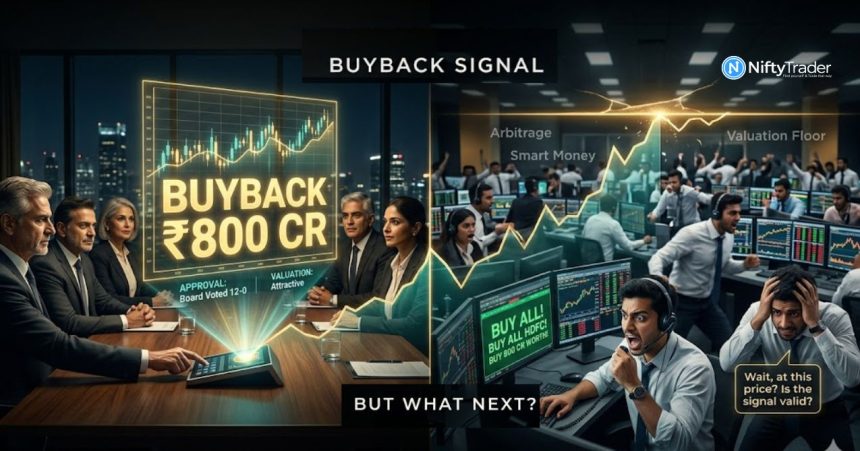
Shares of Aurobindo Pharma moved sharply higher after the company approved an ₹800 crore share buyback at a premium to the current market price, immediately tightening supply expectations and shifting short-term positioning.
This wasn’t just a routine corporate action. The market reaction tells you something deeper: investors are treating the buyback as a signal of balance sheet confidence and potential valuation floor, especially in a space where pharma names have struggled to sustain momentum.
Buybacks often act as a signaling mechanism not just for retail sentiment, but for institutional positioning. When management commits capital at current valuations, it suggests confidence in earnings visibility, something larger investors tend to track closely.
What Triggered the Move
The trigger is clear and immediate:
- ₹800 crore buyback approved
- Buyback price set at a premium to prevailing market levels
- Record date announced, bringing timeline clarity
A buyback at a premium does two things instantly:
- Creates an implicit price anchor downside starts looking limited
- Signals management confidence in cash flows and future earnings visibility
Markets reacted accordingly not because of the size alone, but because of pricing intent and timing.
Data Snapshot: How the Market Reacted
- Shares of Aurobindo Pharma surged ~4–6% intraday following the buyback announcement
- Volumes spiked to ~2–3x the 20-day average, signalling strong event-driven participation
- The stock is currently trading at an estimated ~8–12% discount to the buyback price, keeping arbitrage interest active
What the Market Is Really Signalling
This move is less about short-term EPS accretion and more about positioning psychology.
Here’s what the reaction is telling you:
1️⃣ Downside Perception Is Being Repriced
When a company commits capital at a premium, it effectively says:
“We believe the current price undervalues us.”
That changes how traders view risk:
- Shorts become less aggressive
- Dips start getting bought faster
2️⃣ Cash Deployment Matters More Than Earnings Right Now
Pharma has not been a strong leadership sector recently. So when capital is deployed via buybacks:
- It signals lack of better external opportunities
- But also confidence in internal return profile
Markets are rewarding that clarity.
3️⃣ Supply Compression Setup
Buybacks reduce free float participation in the short term:
- Arbitrage players enter
- Event-driven funds reposition
- Retail participation spikes near record date
This creates temporary demand-supply imbalance, which often drives price stability or gradual upside into the record date.
What Traders Should Watch Next
This is where it gets actionable.
1. Price vs Buyback Level
- If the stock trades well below buyback price → arbitrage interest builds
- If it moves close to buyback price quickly → upside may compress
2. Volume Behaviour
Watch for:
- Gradual accumulation vs spike-driven moves
- Sustained delivery volumes (strong hands entering)
3. Sector Follow-Through
If this triggers interest in pharma:
- Look at sympathy moves in peers
- But don’t assume sector-wide rerating unless flows confirm
4. Post Record Date Reaction
Most buyback trades follow a pattern:
- Run-up → event → cooling
Key question:
Does the stock hold gains after the event, or fade?
That tells you whether this is:
- a trade
- or a re-rating starts
The Real Takeaway
This isn’t about a buyback announcement.
It’s about what the market is starting to believe:
Valuation comfort is returning, even without a strong sector trend.
That’s an early signal, not a confirmed trend.
Bottom Line
- Event-driven momentum likely into record date
- Downside risk perception reduced
- Upside depends on follow-through, not just announcements.
Also Read: Rally Intact, But Traders Are Exiting—The Hidden Shift Driving Markets
Frequently Asked Questions
1. Why did Aurobindo Pharma shares rise after the buyback announcement?
Shares of Aurobindo Pharma rose because the company announced a buyback at a premium, which signals management confidence and reduces perceived downside risk while attracting arbitrage and event-driven flows.
2. What does a buyback at a premium mean for investors?
A premium buyback indicates that the company believes its stock is undervalued, which can create a short-term price floor and improve investor sentiment, though it doesn’t guarantee sustained upside.
3. Is the Aurobindo Pharma rally sustainable after the buyback?
Sustainability remains uncertain. The current move is largely event-driven, and continuation depends on post-record date demand, earnings visibility, and broader pharma sector participation.
4. How do traders typically play buyback announcements?
Traders usually position for a gradual run-up into the record date due to supply tightening and arbitrage interest but often watch for profit booking or consolidation after the event.
5. What risks should investors watch after a buyback rally?
Key risks include price rejection near the buyback level, fading volumes after initial excitement, and lack of follow-through buying, which can lead to sharp unwinds.
6. Does a buyback always lead to long-term stock gains?
No. Buybacks often support prices in the short term, but long-term performance depends on earnings growth, sector trends, and sustained institutional participation.