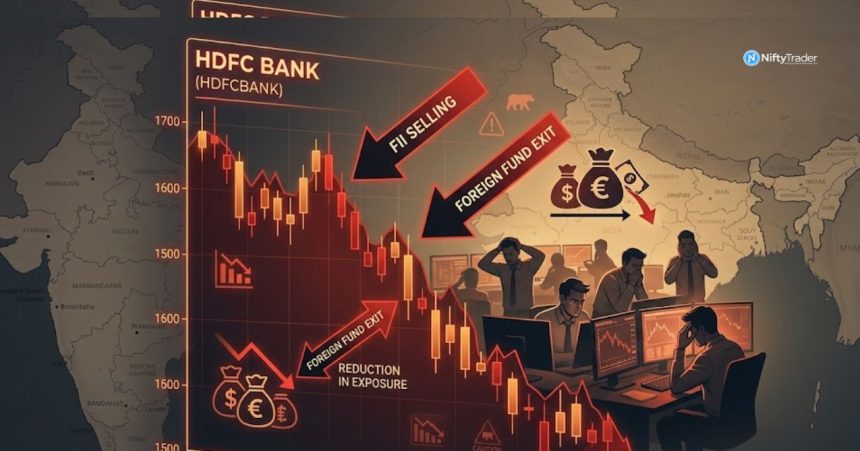
Foreign institutional investors didn’t just trim exposure; they actively sold into weakness, dumping shares of HDFC Bank even as the stock corrected sharply in the March quarter. That combination of falling prices and persistent selling is what has unsettled the market.
The immediate reaction wasn’t just about one stock slipping. It raised a bigger question:
👉 If FIIs are selling India’s highest-quality banking name on declines, what does that say about risk appetite right now?
What Triggered the Move
Data shows that FIIs offloaded shares worth ~₹48 crore in HDFC Bank during a quarter when the stock itself corrected meaningfully.
This is not typical behaviour.
- Usually, FIIs:
- Buy quality names on dips
- Or reduce exposure into strength
👉 Here, they did the opposite:
Selling continued even as the stock weakened.
That changes the narrative from:
- “profit booking”
to - “allocation shift or conviction reduction”
Why Markets Reacted — The Real Reason
This isn’t about ₹48 crore.
It’s about what HDFC Bank represents.
HDFC Bank is:
- A core FII holding
- A proxy for India’s financial stability
- A liquidity anchor in large-cap portfolios
So when FIIs sell here, markets read it as:
1️⃣ Risk-Off Behaviour, Not Stock-Specific Concern
If FIIs were worried about just HDFC Bank fundamentals, selling would be more tactical.
But persistent selling suggests:
They may be reducing exposure to Indian financials or EM risk overall.
2️⃣ Confidence Gap in Near-Term Earnings Visibility
Even if long-term story remains intact, markets are sensitive to:
- margin compression
- integration concerns post-merger
- slower credit growth vs expectations
👉 FIIs don’t wait for confirmation they position early.
3️⃣ Liquidity Rotation Underway
This could also be:
- Money moving to other EMs
- Rotation into global opportunities
- Or defensive positioning ahead of macro events
What the Market Is Really Signalling
The key signal is subtle but important:
Markets are no longer rewarding “quality” blindly positioning is becoming more selective.
Earlier:
- “Buy HDFC Bank on dips” was the consensus.
Now:
- That assumption is being tested
And when consensus trades start failing:
👉 Volatility tends to expand
What Traders Should Watch Next
1. FII Flow Consistency
Is this:
- A one-off quarter adjustment
OR - Start of a trend?
👉 If selling continues across sessions → bearish signal strengthens
2. Price Behaviour vs Flows
Watch closely:
- If FIIs sell and price still holds → absorption (bullish)
- If FIIs sell and price keeps drifting → supply dominance (bearish)
3. Banking Index Reaction
Track:
- Does Bank Nifty start underperforming?
- Are other large private banks seeing similar flows?
👉 If yes → this becomes a sector story, not a stock story
4. “Dip Buying” Behaviour
The most important behavioural signal:
Are domestic institutions stepping in aggressively?
If they don’t:
👉 Market structure weakens
Bottom Line
This is not about one quarter of selling.
It’s about a shift in behaviour around a market heavyweight.
When FIIs:
- Sell into weakness
- In a high-conviction name
- Without immediate negative news
👉 It usually signals positioning change, not noise
Also Read: Central Banks Keep Buying Gold—But Russia’s Selling. What Is the Market Missing?
FAQs
Q1: Why are FIIs selling HDFC Bank despite falling prices?
Persistent selling suggests more than profit booking; it could reflect reduced conviction in Indian financials, early risk-off positioning, or a broader allocation shift by global funds.
Q2: Does FII selling mean HDFC Bank fundamentals are weak?
Not necessarily. HDFC Bank’s long-term story remains intact, but near-term concerns like margin pressure, slower credit growth, and integration risks may influence institutional positioning.
Q3: How should traders interpret this FII activity?
Watch flow consistency, price reaction, and sector-wide trends. Continued selling without domestic absorption can signal expanding volatility and weakening market structure.
Q4: Could this FII exit affect the wider banking sector?
Yes. If similar flows appear in other private banks or the Bank Nifty underperforms, the trend could evolve from a stock-specific to a sector-level story.
Q5: Is this a buying opportunity for domestic investors?
Only if domestic institutions step in to absorb supply. Otherwise, selling into weakness may dominate, increasing short-term risk.