Global gold demand just got another push but not from the usual direction.
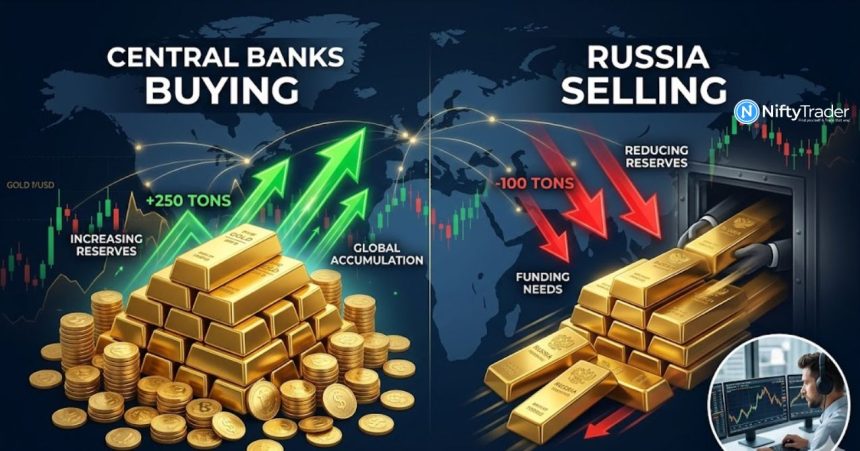
Central banks accelerated gold buying in February, led by Poland and China, while several emerging market reserve managers also added to demand. At the same time, Russia continued to offload reserves, creating a rare divergence. That split is quietly shaping how traders should view gold now—not as a simple “safe haven rally,” but as a fragmented, policy-driven trade where structural buying meets tactical selling.
What changed and why markets are paying attention
Fresh data shows central banks remain aggressive buyers of gold, reinforcing a structural demand floor. But at the same time, Russia, historically one of the biggest gold accumulators, has been selling into strength.
That matters because:
- The net buying trend supports prices
- But selective selling introduces supply at higher levels
- The result: gold isn’t trending cleanly; it’s being capped and supported at the same time
This explains why gold has stayed firm but struggled to break out decisively despite bullish macro cues.
What triggered this divergence
The buying side is straightforward:
- Emerging market central banks continue to diversify away from dollar reserves
- Persistent geopolitical uncertainty keeps gold relevant
- Currency volatility in developing economies supports reserve accumulation
But Russia’s selling signals something different:
- Likely liquidity management under sanctions pressure
- Possible profit booking after elevated gold prices
- A shift from accumulation to balance sheet utilisation
This is not a random flow; it’s policy-driven supply entering the market.
What the market is really signalling
This is where the story becomes more interesting for traders.
Gold is no longer just reacting to the following:
- inflation
- interest rates
- dollar movement
It’s increasingly reacting to central bank behaviour asymmetry.
Here’s the underlying signal:
Demand is structural, but supply is tactical.
That creates a very specific market condition:
- Downside gets supported (steady central bank buying)
- Upside gets sold into select sovereign selling like Russia.
In other words:
👉 Gold is shifting from a trend trade to a positioning trade
What traders should watch next
If you’re trading or tracking gold, the key is not just “Are central banks buying?” That’s already known.
Instead, focus on:
1️⃣ Who is selling into strength
If more countries follow Russia, rallies could fade quickly.
2️⃣ Price reaction vs news flow
If gold fails to rally despite strong buying data, it signals:
positioning is already crowded
3️⃣ Dollar and yield vs. gold behaviour
If gold holds despite rising yields, central bank demand is dominating
If it weakens, supply pressure is winning
The real takeaway
This isn’t a straightforward bullish story.
It’s a two-sided market where:
- Structural buyers are building a floor
- Tactical sellers are capping rallies
That’s why gold feels strong but not explosive.
Also Read: Tariff Shock for Pharma — Why Export-Focused Stocks Are Suddenly at Risk
FAQs
Q1: Why is gold rising even though some countries are selling?
Gold gains are driven by structural demand from central banks diversifying reserves, but tactical selling from major holders like Russia caps upside, creating a mixed price signal.
Q2: How should traders interpret central bank gold buying vs. Russia’s selling?
Central bank purchases provide a price floor, while selective selling acts as resistance. Traders should focus on positioning, not just trend-following.
Q3: Can gold break out if central banks keep buying?
Breakouts are uncertain. If tactical sellers increase their supply, rallies may stall despite strong structural demand, highlighting a forward-looking risk in positioning.
Q4: What indicators matter most now for gold traders?
Tracking who is selling into rallies, gold’s price response versus macro news, and the interaction between dollar/yields and gold reveals market tension and expectation gaps.
Q5: Is this a safe haven trade or a policy-driven one?
Increasingly policy-driven. Gold’s behavior reflects asymmetric central bank actions rather than classic macro cues like inflation or rate moves.