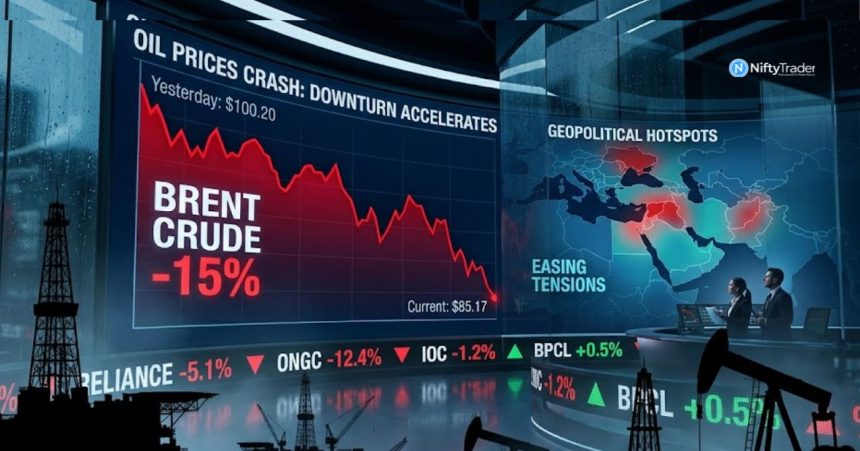
The ceasefire in the Iran–Israel conflict escalation triggered an immediate repricing across global markets, and oil took the biggest hit. Brent crude plunged nearly 15% in a sharp unwind of war risk premium, dragging energy-linked stocks like Reliance Industries, ONGC, and OMCs into the focus.
This wasn’t just a commodity move; it was a positioning reset. Traders who had built long bets on oil as a geopolitical hedge are now unwinding aggressively, and that shift is spilling directly into Indian equities tied to crude sensitivity.
Data Snapshot (Latest Market Context)
- Brent Crude: ~15% sharp drop post-ceasefire trigger (from recent highs)
- WTI Crude: Similar double-digit correction, confirming global unwind
- Reliance Industries: Under pressure intraday; sentiment-driven move despite refining cushion
- ONGC: Weak bias as crude realization expectations fall
- OMCs (Indian Oil Corporation, BPCL, HPCL): Relative outperformance pockets on margin optimism
- Energy Index (India): Lagging broader indices despite risk-on sentiment globally
⚠️ Uncertainty remains high: Oil’s move is fast but not yet structurally confirmed; positioning unwind vs. trend reversal is still unresolved.
What Triggered the Move
The key catalyst was a ceasefire signal, which instantly removed the biggest driver of recent oil strength: supply disruption fears.
- War premium evaporated almost overnight
- Speculative long positions in crude got squeezed
- Global risk sentiment improved, but selectively
Oil markets had been pricing in worst-case escalation scenarios. When that didn’t materialize, the reversal was violent, a classic case of overcrowded positioning getting unwound fast.
What the Market Is Really Signalling
This move is not just about oil falling; it’s about what traders were wrong about.
1️⃣ Risk Premium Was Overpriced
Markets had priced geopolitical risk too aggressively. The speed of the fall shows how crowded that trade had become.
2️⃣ Energy Stocks Lose Their Cushion
For upstream players like ONGC, falling crude directly hits realizations.
For refining-heavy names like Reliance Industries, the impact is more nuanced; margins can benefit, but sentiment weakens.
3️⃣ OMCs Get a Temporary Tailwind
Lower crude reduces input cost pressure for oil marketing companies, but traders know this benefit can reverse just as quickly if geopolitics flare again.
4️⃣ This Is a Positioning Story, Not Just a Macro Story
The sharpness of the move tells you:
This was not fundamentals changing gradually this was traders exiting the same trade at once.
What Traders Should Watch Next
This is where the real opportunity (and risk) lies.
1. Is Oil Stabilising or Overshooting?
If crude continues to fall:
- OMCs could outperform in the short term
- Upstream names may see sustained pressure
But if oil rebounds quickly → this becomes a false breakdown trap
2. How Energy Stocks React vs Oil
Watch divergence:
- If oil falls but stocks stop falling → selling exhaustion
- If both continue falling → trend confirmation
3. Global Risk Sentiment Spillover
If ceasefire holds:
- Money may rotate out of commodities into equities
- Risk-on could support broader indices beyond energy
4. Positioning in Derivatives (Critical)
Watch:
- Open interest unwinding in oil-linked counters
- Option activity in energy stocks
This will tell you whether traders see this as
👉 a short-term correction
👉 or a structural shift
The Bottom Line
This is not just “oil down = stocks react.”
This is a crowded geopolitical trade getting unwound and markets resetting expectations fast.
Traders who were leaning on oil strength as a safety hedge are now being forced to reposition, and that transition phase is where volatility (and opportunity) expands.
Also Read: Budget Shock Hits Markets — Sensex Slides, Nifty Cracks Support. What Spooked Traders?
FAQs
1. Why did oil prices fall so sharply?
Oil dropped after ceasefire signals reduced geopolitical risk, leading to a rapid unwinding of war premiums and speculative long positions.
2. How does falling crude impact Indian energy stocks?
Upstream companies like ONGC are negatively impacted due to lower realizations, while OMCs may benefit from reduced input costs in the short term.
3. Is this a buying opportunity in energy stocks?
Not immediately clear the move is driven by positioning, unwinding, and stability in crude prices, which is still uncertain.
4. Which stocks benefit from lower crude oil prices?
Oil marketing companies such as IOC, BPCL, and HPCL typically benefit due to improved refining and marketing margins.
5. Can oil prices rebound quickly from here?
Yes, if geopolitical tensions resurface, oil can rebound sharply, making this a high-risk zone for directional trades.
6. What should traders watch next in oil markets?
Key factors include crude price stability, derivatives positioning, and whether energy stocks diverge from oil price movement.