Markets surged, but conviction didn’t.
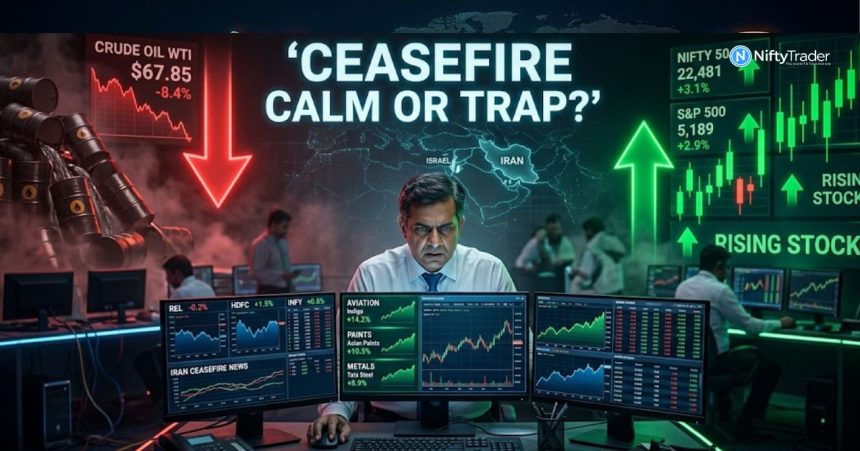
The Iran ceasefire triggered a sharp global risk-on move, with Indian equities reacting instantly, Nifty jumping ~3–4% intraday and Sensex gaining nearly 2,500–3,000 points, while crude oil corrected sharply by ~12–15% from recent highs. But beneath that headline rally, the real story wasn’t broad-based buying; it was selective rotation with hesitation.
Defensive pockets cooled off, while cyclicals and global-facing stocks saw targeted inflows. That nuance matters. Because this isn’t a confirmed risk-on trend yet, it’s capital testing whether the geopolitical risk premium can unwind sustainably or if this is just a temporary volatility compression before the next trigger.
What Triggered the Move And Why It Mattered Today
The key catalyst was a sudden de-escalation signal from the Iran conflict zone, which came after days of elevated tension, oil spikes, and risk aversion already building into markets.
That timing is critical.
This wasn’t just a positive headline; it was a release of built-up macro pressure, triggering:
- Crude oil cooling sharply → easing inflation fears
- Bond yields stabilizing → supporting rate-sensitive sectors
- Global risk sentiment improving → lifting cyclicals
Immediate sectoral impact:
- Oil-sensitive sectors: Paints, aviation, OMCs saw buying interest
- Global cyclicals: Metals, capital goods, exporters moved higher
- Rate-sensitive pockets: Financials stabilized as inflation fears softened
Brokerages quickly flagged ~50 stocks expected to benefit from lower input costs and improved global sentiment, but price action showed selective validation, not broad confirmation.
What the Market Is Really Signalling
This move is less about the ceasefire itself and more about what it potentially unlocks.
1) Risk Premium Is Being Repriced—But Not Fully Removed
The easing of geopolitical tension reduces tail-risk scenarios (oil shock and inflation spike), but markets are not fully buying it yet.
- Follow-through buying remains limited beyond the first move
- Indices are forming indecisive structures near highs
- Volatility hasn’t fully normalized
👉 This suggests probing activity, not aggressive positioning
2) Smart Money Is Rotating, Not Chasing
Instead of index-heavy flows, capital is moving selectively into:
- Cost-beneficiary sectors (paints, chemicals, aviation)
- Exporters benefiting from global stability
- Select beaten-down cyclicals
At the same time:
- FII flows remain cautious and inconsistent
- Retail participation appears to be selling into strength rather than chasing rallies
👉 This is not euphoria. It’s skeptical participation with tactical rotation
3) Expectation Gap Is Still Wide
Brokerages are projecting upside across ~50 stocks, but market behavior tells a different story.
| Narrative | Market Reality |
|---|---|
| Ceasefire = sustained rally | Only selective buying visible |
| Oil correction = long-term relief | Early signs of rebound emerging |
| Broad participation expected | Sectoral divergence persists |
👉 This expectation gap is critical.
If flows don’t broaden, this “ceasefire rally” risks becoming a sell-on-rise setup rather than a trend shift.
4) Crowded Trade Risk Is Building
The moment brokerages converge on a 50-stock opportunity list, the trade risks becoming consensus.
- Many cost-benefit plays may already be pre-positioned
- Early movers could see profit booking before broader participation comes in
👉 This creates a classic trap:
The idea is right, but the timing gets crowded
Cross-Asset Reality Check (Macro Transmission)
This move is not isolated—it’s part of a broader macro chain:
Oil ↓ → Inflation expectations ↓ → Rate pressure ↓ → Liquidity sentiment ↑ → Equities react
But here’s the uncertainty:
- Oil has already shown signs of stabilizing after the sharp fall
- Any reversal in crude can quickly reprice inflation risk again
👉 Which means the entire equity reaction is conditionally dependent, not structural yet
What Traders Should Watch Next
1) Crude Oil Behaviour (Primary Driver)
- Sustained lower crude → continuation in cost-benefit sectors
- Sharp rebound in oil → immediate narrative breakdown
2) Follow-Through Buying (Confirmation Layer)
- Do breakouts sustain beyond 1–3 sessions?
- Do midcaps and broader markets participate?
👉 Lack of follow-through = positioning unwind, not trend
3) Sector Leadership Stability
Early leaders:
- Paints
- Aviation
- Select industrials
👉 But leadership remains fragile. A shift back to defensives signals market disbelief
4) FII Behaviour (Decisive Factor)
- Strong FII inflows → trend extension
- Continued inconsistency → tactical bounce only
Timeframe-Based Trade Setup
High Probability (1–3 Sessions | Tactical)
- Ride momentum in cost-beneficiary sectors
- Only if price sustains above breakout levels
Medium Probability (1–2 Weeks | Swing)
- Exporters & cyclicals
- Prefer pullbacks over chasing strength
High Risk
- Blindly following brokerage stock lists without price confirmation
- Entering already extended trades
Binary Risk Framework
- If crude stays soft + ceasefire holds → rotation expands into broader rally
- If crude spikes OR ceasefire weakens → rapid unwind of current trades
Market Structure Call
This is not a confirmed trend reversal yet.
It is:
- A geopolitical relief rally
- A sectoral rotation phase
- Driven by liquidity and positioning, not conviction
Bottom Line
This is not a clean peace rally; it’s a market testing phase with conditional optimism.
- The trigger is real
- The opportunity is selective
- The conviction is still missing
👉 The edge right now is simple:
This is a liquidity-driven move, not a conviction-driven trend, until follow-through proves otherwise.
And in markets like this, the biggest risk isn’t being wrong on direction; it’s being early in a trade that hasn’t fully confirmed yet.
Also Read: Wipro in Focus Ahead of April 16—Buyback Buzz Builds, But Is Smart Money Already Positioned?
FAQs
1) Why did the stock market rise after the Iran ceasefire?
The market reacted to easing geopolitical tension, which led to a sharp fall in crude oil prices and reduced inflation fears. This improved macro sentiment triggered buying in oil-sensitive and cyclical sectors, though the rally remains selective rather than broad-based.
2) Which sectors benefit the most from falling crude oil prices?
Sectors that gain the most include:
- Aviation (lower fuel costs)
- Paints & chemicals (input cost reduction)
- Oil marketing companies (margin improvement)
- Auto & consumption (demand boost)
These sectors typically outperform when crude prices decline sustainably.
3) Is this ceasefire rally a new bull run or just a temporary bounce?
There is still uncertainty. Current price action suggests a relief rally driven by liquidity and positioning, not a confirmed long-term trend. Sustained follow-through buying and stable crude prices are needed to validate a broader bull run.
4) What are the key risks that could reverse this rally?
The biggest forward-looking risks are:
- A sharp rebound in crude oil prices
- Breakdown of the ceasefire agreement
- Weak follow-through buying in equities
Any of these can quickly unwind current gains and shift sentiment back to risk-off.
5) What is the expectation gap in this market rally?
Brokerages expect strong upside in ~50 stocks, but actual market participation is still selective. This gap between analyst optimism and real money flow creates a risk of failed breakouts or sell-on-rise behavior if broader buying doesn’t emerge.
6) How should traders approach stocks after the Iran ceasefire?
Traders should:
- Focus on sector leaders, not broad indices
- Prefer buying on dips instead of chasing rallies
- Watch for confirmation through follow-through buying (1–3 sessions)
Avoid entering overcrowded trades without price validation.
7) What is the role of crude oil in stock market direction right now?
Crude oil is the primary macro trigger.
- Falling oil → supports equities via lower inflation
- Rising oil → pressures markets and reverses sentiment
The sustainability of this rally depends heavily on oil price stability.
8) Are foreign investors (FII) supporting this rally?
FII behavior remains cautious and inconsistent. Lack of aggressive institutional inflows suggests this is still a tactical positioning move, not a strong conviction-driven rally.
9) Which type of stocks are showing the strongest momentum after the ceasefire?
The strongest momentum is visible in:
- Cost-beneficiary sectors (paints, aviation)
- Export-oriented companies
- Select cyclicals recovering from previous underperformance
However, leadership is still narrow and evolving.
10) What is the biggest mistake traders can make in this market?
The biggest risk is assuming this is a confirmed trend and chasing momentum blindly. Without follow-through buying and macro stability, this rally can turn into a positioning trap.