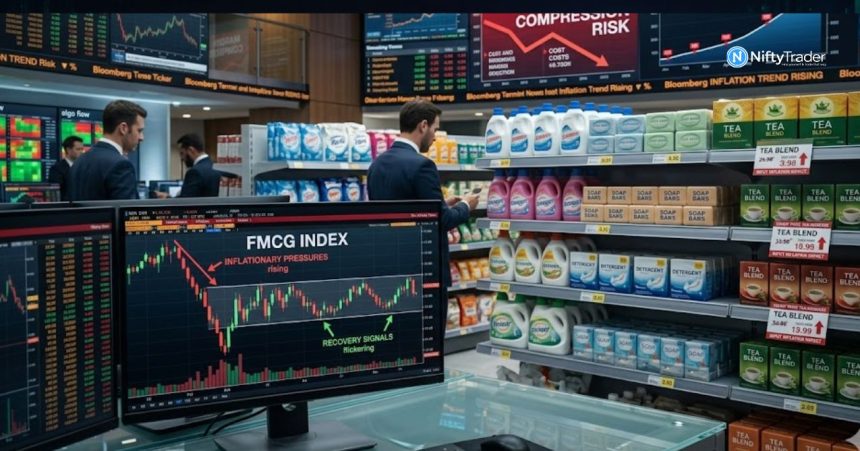
FMCG stocks saw a muted but noticeably cautious reaction after Hindustan Unilever raised prices across select mass categories, including Dove, Pears, Surf Excel, and Red Label. The move is not being read as an isolated pricing update but as a recalibration of cost pressures returning faster than expected, just as markets had positioned for stable margins and a gradual consumption recovery. The real shift is not in the price hike itself, but in what it signals about the durability of FMCG margin stability assumptions.
The reaction becomes more important in the context of timing. Geopolitical tensions linked to the Iran conflict are once again disrupting global supply chains, reintroducing volatility in crude-linked inputs and logistics. However, the market takeaway is more nuanced: this is not panic pricing but a calibrated pass-through of input cost inflation that is beginning to rebuild a cautious undertone across FMCG positioning.
What Triggered the Move
HUL has implemented selective price increases across key mass-market SKUs, with soap categories forming the core of the adjustment rather than a broad-based FMCG revision.
The reported adjustments include:
- ₹2–₹3 per 100g increase
- Approximately 3%–5% price hikes across selected variants
- Slightly higher adjustments in certain Dove packs
Crucially, the increase is concentrated in core soap and daily-use segments, not evenly spread across all FMCG categories, highlighting a targeted margin protection strategy rather than a sector-wide inflation shock.
Key cost drivers behind the move:
- PFAD (Palm Fatty Acid Distillate) volatility, a key raw material for soaps
- Packaging inflation, with paper and plastics rising significantly in recent months
- Early signs of freight and supply-chain cost pressure linked to Middle East geopolitical tensions affecting energy and shipping routes
Importantly, cost pressures are stacked rather than isolated, creating a layered inflation environment rather than a single-input shock.
What the Market Is Really Signalling
The expectation gap is subtle but important.
Markets had been positioned for:
- relatively stable commodity inputs
- improving rural demand visibility
- gradual FMCG margin expansion
What is now emerging is not a reversal, but a rebalancing of assumptions.
Two structural signals stand out:
- Input inflation is re-entering earlier than expected, especially in crude-linked and packaging chains
- FMCG pricing power is being used in a defensive, calibrated manner, not aggressive expansion mode
At the same time, it is important to stay precise: there is no clear evidence of demand deterioration in this specific trigger, meaning this is not a demand shock story. Instead, it is a cost-led pricing adjustment cycle within normal FMCG operating behavior.
This creates a different kind of tension for traders: not bearish breakdown risk, but uncertainty around margin trajectory stability.
What Traders Should Watch Next
The key market focus now shifts from the price hike itself to whether this becomes a broader FMCG pricing pattern.
Three critical watchpoints:
- Persistence of geopolitical risk: If Middle East disruption continues, input costs may remain sticky rather than normalize
- Peer FMCG response: Whether other large consumer names follow with selective mass-category price adjustments
- Transmission into rural demand: Even without current weakness, the market will closely monitor whether higher MRPs affect consumption elasticity over coming quarters
The forward-looking risk is not immediate earnings pressure, but the possibility of a multi-quarter input cost cycle restarting earlier than expected, which could reintroduce margin volatility after a relatively stable period.
At the same time, uncertainty remains elevated because it is still unclear whether this is a one-time cost reset or the beginning of a broader inflation phase driven by sustained global supply disruption. That ambiguity is what is keeping FMCG positioning cautious rather than directional.
Also Read: Ola vs Ather: The EV Rally That Looked Unified Is Now Splitting Under Pressure
FAQs
1) Why did HUL increase prices across FMCG products?
HUL raised prices mainly due to rising input costs, including PFAD (used in soaps), packaging materials, and early supply-chain pressure linked to global geopolitical tensions affecting crude and logistics.
2) Which products are impacted by HUL’s price hike?
The price increase is concentrated in mass-market staples such as Dove, Pears, Surf Excel, and Red Label, with soaps forming the core segment of adjustments.
3) How much has HUL increased prices?
The hikes are broadly estimated at around ₹2–₹3 per 100g, translating to roughly 3%–5% increases across selected variants rather than a uniform FMCG-wide revision.
4) Is this a demand problem or a cost problem for FMCG companies?
This is primarily a cost-driven adjustment rather than a demand shock. Input inflation is forcing selective price pass-through, not a response to weakening consumption trends.
5) What does this price hike signal for FMCG stocks?
It signals a possible restart of cost-cycle sensitivity in FMCG, where margins may remain stable but depend more on input volatility than pure demand recovery.
6) Will other FMCG companies also raise prices?
Market participants expect potential follow-through from peers if input costs remain elevated, but there is no confirmed broad-based pricing action yet.
7) What are the key risks for FMCG stocks going forward?
The main risks include sustained crude-linked inflation, packaging cost volatility, and uncertainty over whether geopolitical disruptions continue to pressure global supply chains.
8) Should traders see this as a bullish or bearish signal for FMCG?
It is neither strongly bullish nor bearish, it indicates a neutral-to-cautious phase, where margin stability depends on how long input cost pressure persists.