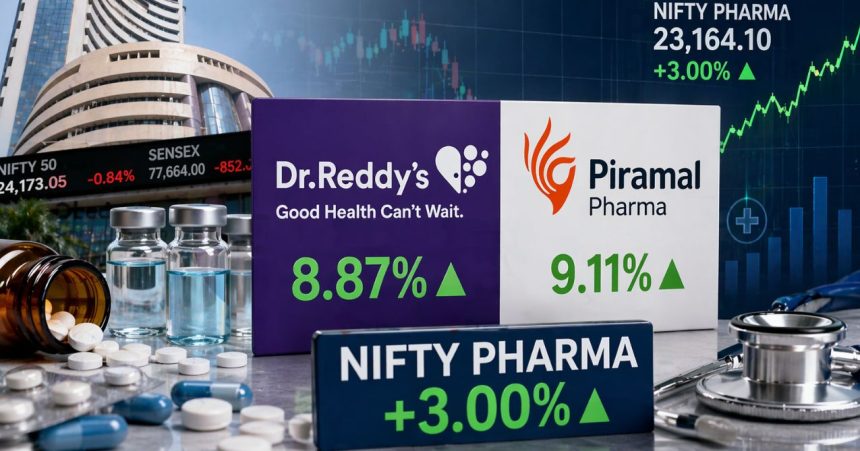
On Thursday, April 23, the Nifty Pharma index surged as much as 3 percent intraday to 23,164.10 on the NSE, even as the Nifty 50 fell 0.84 percent to close at 24,173.05 and the Sensex shed 852 points to end at 77,664, with Dr. Reddy’s Laboratories and Piramal Pharma leading sectoral gains of 8–9 percent, respectively, according to NSE data.
Market leaders: Dr Reddy’s and Piramal Pharma
Dr. Reddy’s Laboratories and Piramal Pharma were the sharpest movers, rising approximately 8 percent and 9 percent, respectively, on the NSE in intraday trade. Dr Reddy’s ultimately closed as the top Nifty 50 gainer of the day, finishing 8.87 percent higher at ₹1,325, supported by sustained buying activity throughout the session, per NSE closing data.
Glenmark Pharmaceuticals, Cipla, Wockhardt, Mankind Pharma, Lupin, Zydus Lifesciences, Laurus Labs, Ipca Labs, Divis Laboratories, Strides Pharma Science, and Onesource Specialty Pharma all gained between 3 per cent and 6 per cent in intraday trade on the NSE.
Three drivers behind the rally
1. Rupee weakness benefiting exporters
A key trigger behind the sector’s advance was the weakening of the Indian rupee against the US dollar. Pharma companies such as Dr Reddy’s, Cipla, and Sun Pharma generate a significant portion of their revenue from international markets, particularly the United States, meaning a softer rupee directly boosts the value of their dollar-denominated earnings when repatriated, according to India Infoline’s market analysis published April 23.
2. Defensive sector rotation
With the Nifty 50 down around 140 points during the session, investors rotated capital into defensive sectors. Unlike cyclical industries, pharma companies benefit from consistent demand as healthcare spending holds up regardless of economic conditions, making them a preferred destination during volatile market phases, according to India Infoline. The Nifty Pharma index has gained nearly 1 per cent year-to-date in 2026, compared to an over 7 per cent fall in the Nifty 50 and Sensex over the same period, per Upstox market data.
3. Macro headwinds weighing on broader market
Weakness in IT, auto, and financial stocks dragged both benchmark indices, compounded by crude oil prices crossing $100 per barrel (Bloomberg data, April 23) and uncertainty surrounding US-Iran peace talks, which dampened general risk appetite. Analysts at Choice Institutional Equities described pharma’s outperformance as reflecting capital moving away from high-risk sectors into stable, cash-generating businesses.
Dr Reddy’s: domestic GLP-1 play attracts institutional attention
Dr Reddy’s was the first company to introduce a DCGI-approved semaglutide injection in India, under the brand name Obeda, establishing an early-mover position in the domestic GLP-1 market, according to Choice Institutional Equities. Its premium pricing of ₹4,200 per month versus peers charging around ₹1,300 reflects its use of a prefilled disposable pen format rather than vial-based alternatives, a distinction analysts say could support greater physician preference and patient stickiness.
Choice Institutional Equities, which carries a target price of ₹1,315 on the stock, views the Obeda launch as positioning Dr Reddy’s within the emerging GLP-1 opportunity through quality, delivery format, and brand trust rather than price-led competition. Dr. Reddy’s intraday high of ₹1,313 on Thursday brought it within ₹2 of that target.
However, the rally is not without near-term headwinds. Brazil’s drug regulator ANVISA rejected Dr Reddy’s semaglutide registration as the filing did not meet all technical requirements, while Citi has flagged the risk of overly optimistic market expectations around the drug’s potential, pointing to intensifying competition and execution challenges in international markets. Pressure from the declining contribution of key products such as Revlimid also weighs on the near-term earnings outlook.
The balance of analyst opinion is that Thursday’s advance was primarily technically driven rupee tailwinds and defensive rotation rather than a fundamental re-rating. Dr. Reddy’s stock trades at a meaningful discount to its 52-week high of ₹1,379.70 (hit June 12, 2025) and remains down approximately 2 per cent year-to-date in 2026, per NSE data. Q4 FY26 results are scheduled for May 12, 2026, which will be the next material catalyst for a fundamental reassessment.
Piramal Pharma: new contract and brokerage support
Piramal Pharma’s 9 percent rally was underpinned by two positive catalysts. The company secured a new commercial contract for its overseas unit and was onboarded by Botanix Pharmaceuticals as a secondary API supplier for Sofdra (sofpironium bromide), with manufacturing to be carried out at Piramal’s Riverview facility. JM Financial Institutional Securities estimates the peak revenue potential of this contract at $15 million to $20 million, with scale-up expected from FY28. JM Financial maintains a ‘Buy’ rating on Piramal Pharma with a target price of ₹211.
A strong domestic prescription market adds a tailwind.
The Indian pharma market posted monthly growth of 10.7 percent in March 2026, moderating from 12.5 percent in February 2026 but sustaining four consecutive months of double-digit expansion, according to Equirus Securities. Chronic therapies continued to outperform, with their share rising above 40 percent of the total market. Cardiac therapies led with 14.9 per cent monthly growth and remained the largest therapy segment at a 13.9 per cent share.
At the company level, Dr. Reddy’s delivered a standout 18.2 percent monthly prescription growth in March, the highest among large-cap peers, while Lupin extended its strong run with a 14.6 percent increase driven by volume gains. Sun Pharma and Torrent Pharma maintained above-market performance, while Mankind Pharma staged a meaningful recovery, per Equirus Securities.
Q4 earnings outlook: domestic strength, US pressure
Analysts at BNP Paribas India expect India formulations revenue to clock double-digit growth in the March 2026 quarter across their coverage universe, excluding Zydus Lifesciences. However, US revenue is expected to remain under pressure due to the loss of contribution from key products such as Revlimid and Lanreotide, which is likely to weigh on EBITDA margins.
Also Read: Infosys beats estimates with 21% profit rise; RIL due April 24
FAQs
Q1. Why did Dr. Reddy’s share price rise today?
Dr. Reddy’s shares rose 8.87 per cent to close at ₹1,325 on April 23, 2026, driven by rupee weakness boosting export earnings, defensive sector rotation away from IT and financials, and institutional buying around its first-mover Obeda (semaglutide) launch in India’s GLP-1 market, per NSE closing data and Choice Institutional Equities.
Q2. When will Dr. Reddy’s announce its Q4 FY26 results?
Dr Reddy’s Laboratories is scheduled to announce its Q4 FY26 (January–March 2026) earnings on Tuesday, May 12, 2026. Analysts at BNP Paribas India expect US revenue to remain under pressure due to declining contribution from Revlimid and Lanreotide, while domestic India formulations are forecast to post double-digit growth for the quarter.
Q3. Why did the Nifty Pharma index rise while Nifty 50 fell on April 23?
The Nifty Pharma index gained 3 per cent to 23,164.10 intraday on April 23, 2026, while the Nifty 50 simultaneously fell 0.84 per cent to 24,173.05, per NSE data. Pharma is a defensive sector where demand remains stable regardless of economic conditions, making it a preferred destination for institutional capital during volatile sessions driven by $100-per-barrel crude and US-Iran geopolitical uncertainty.
Q4. What is the analyst target price for Dr Reddy’s stock in 2026?
Choice Institutional Equities carries a target price of ₹1,315 on Dr Reddy’s as of April 2026, which the stock nearly touched with an intraday high of ₹1,313 on April 23. The broader 12-month consensus target stands at ₹1,500–1,600, per Univest data. Citi, however, holds a Sell rating, forecasting semaglutide revenue of just $50 million for 2028 amid intensifying global competition.