The deal
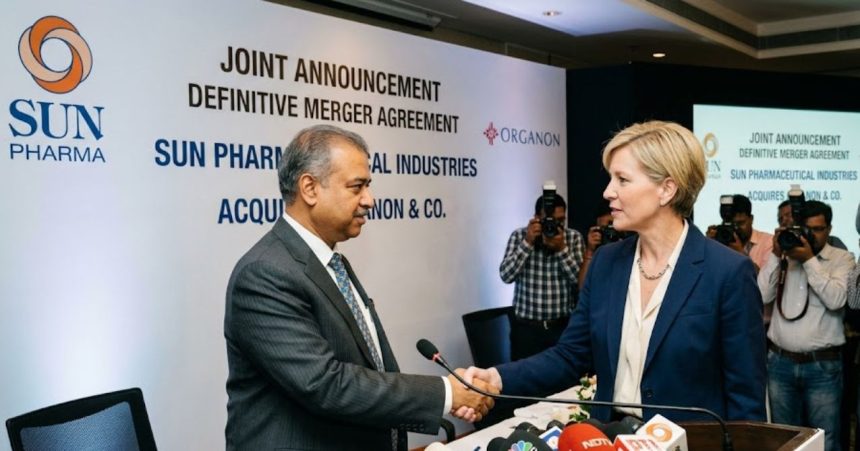
Sun Pharmaceutical Industries and Organon & Co. announced on April 26–27, 2026, that they have signed a definitive merger agreement under which Sun Pharma will acquire all outstanding Organon shares for $14.00 each in an all-cash transaction, valuing the company at an enterprise value of $11.75 billion. The announcement is dated April 26 from Jersey City and April 27 from Mumbai, per the SEC 8-K filing. It is the largest overseas pharmaceutical acquisition ever by an Indian company and the biggest biopharma transaction globally in 2026 so far, topping Eli Lilly’s $7.8 billion buyout of Centessa Pharmaceuticals. Sun Pharma’s BSE-listed shares rose more than 7%, reaching an intraday peak of ₹1,766.90 on April 27. Organon’s NYSE-listed stock jumped 17% on the same day.
The $14 offer is a 24% premium to Organon’s closing price on Friday, April 25, and a 103% premium to where the stock sat on April 9, the last unaffected trading day before media reports of a potential deal surfaced, per the SEC DEFA14A filing. That spread tells the real story: Organon had become so deeply discounted that five covering sell-side analysts had a consensus price target of just $10.40 as of April 27, per TIKR data. Sun Pharma is paying 34% above what the Street collectively believed the business was worth on a standalone basis.
What the Q1 2026 results actually show
Organon released its Q1 2026 results on April 30, 2026, ahead of the originally scheduled May 7 date, and without an earnings call, which was cancelled due to the pending merger. The numbers are mixed and material to understanding what Sun Pharma is walking into.
Biosimilars are the clearest bright spot. Revenue grew 23% as-reported and 21% on a constant-currency basis in Q1 2026, driven by Hadlima (adalimumab), which had grown 60% in full-year 2025. New biosimilar additions, Bildyos, Bilprevda, and Tofidence,also contributed. VTAMA, the tapinarof cream for psoriasis and atopic dermatitis, grew only “modestly” year-on-year in Q1, per the SEC filing, below earlier market expectations of 20–25% annual growth. Importantly, Organon confirmed it will not provide financial guidance and will not host quarterly earnings calls for the duration of the pending merger.
Income Statement
| Metric | Value | Change / Note | Prior Period (Q1 2025) |
|---|---|---|---|
| Total Revenue | $1.460B | Down 4% as-reported; down 9% ex-FX | $1.513B |
| Gross Profit | $783M | Down 7% as-reported | $841M |
| Adj. EBITDA | $415M | Margin: 28.4% | 32.0% margin |
| GAAP Net Income | $146M | EPS: $0.55 | $87M / $0.33 |
| Adj. Diluted EPS | $0.71 | -16.8% vs consensus | $1.02 |
Segment Revenue
| Segment | Value | Change / Note | Prior Period |
|---|---|---|---|
| Women’s Health | $389M | Down 16% as-reported; down 19% ex-FX | $463M |
| Biosimilars | $173M | Up 23% as-reported; up 21% ex-FX | $141M |
| Established Brands | $880M | Down 1% as-reported; down 7% ex-FX | $887M |
| Other (mfg. sales) | $18M | Down 15% as-reported | $22M |
Balance Sheet (Mar 31, 2026)
| Metric | Value | Change / Note | Prior Period |
|---|---|---|---|
| Cash & Equivalents | $1.12B | Strong increase vs year-end | $574M (Dec 31, 2025) |
| Total Debt | $8.57B | Broadly stable | $8.6B |
| Net Leverage (approx.) | ~4.0x | LTM Adj. EBITDA basis | Target: 2.3x post-deal |
Key Corporate Notes
| Item | Status | Details |
|---|---|---|
| Earnings Call | Cancelled | Due to pending Sun Pharma merger |
| Forward Guidance | Suspended | No outlook until deal closure |
| Quarterly Dividend | $0.02/share | Reduced payout vs prior periods |
What Sun Pharma is actually buying
Organon reported $6.2 billion in revenue in full-year 2025, with an adjusted EBITDA of $1.9 billion, a margin of approximately 30.6%, per the official press release. The problem is stasis: sales toggled between $6.2 billion and $6.4 billion for each of the last four years. Women’s Health revenue declining 16% in Q1 2026 confirms the near-term pressure is real. Add $8.6 billion in debt against $574 million in cash at December 2025-end, a net leverage ratio of 4x, and Organon’s board chair Carrie Cox’s description of the sale as the result of “a comprehensive review of strategic alternatives” needs no further translation.
Why Nexplanon lost altitude, and what Sun can do about it
Organon’s most visible drag is Nexplanon, which generated $201 million in Q1 2026 alone but has been declining. The contraceptive implant once exceeded $1 billion in annual sales before patent expiry let generics in. Spun off from Merck in 2021 with $8.6 billion in inherited debt, Organon had almost no free capital to invest in reformulation or marketing. A 2025 internal probe found that excess Nexplanon inventory had been pushed to wholesalers to inflate short-term figures. On top of that, the transition to a five-year label eliminates roughly 13% of annual reinsertion volumes, with 2026 confirmed as the most pronounced year for that headwind, per CFO Matt Walsh’s Q4 2025 earnings call. Women’s Health falling 16% in Q1 2026 is that headwind arriving on schedule.
Sun Pharma’s proposition is to apply India-grade manufacturing cost discipline, reinvest the freed-up cash into brand upgrades and reformulation, and run these assets harder than a debt-strapped Organon ever could. Managing director Kirti Ganorkar said in the joint press release that “immediate priorities will be business continuity, disciplined integration, and responsible value creation.” Executive chairman Dilip Shanghvi framed it directly: “Organon’s portfolio, capabilities, and global reach are highly complementary to our own.”
The two strategic doors this opens
Sun Pharma avoided biosimilars for years due to regulatory complexity, long development cycles, and high capital costs. Biocon and Dr. Reddy’s built platforms and moved ahead while Sun stayed in generics. The Organon deal hands Sun Pharma a functioning biosimilar business, one growing at 23% in Q1 2026, and vaults it to the seventh-largest biosimilar player globally by revenue, per the joint statement. That is years of build time, bought.
The second door is China. Organon generates over $800 million annually there, the world’s second-largest drug market, where Sun Pharma had minimal commercial presence. The combined entity will operate in 150 countries, with 18 markets each contributing over $100 million annually, per the SEC DEFA14A. Innovative medicines will rise from 20% of Sun Pharma’s current revenue to 27% of the combined topline. Combined revenues reach a projected $12.4 billion, placing the entity among the world’s top 25 pharmaceutical companies.
The debt load: manageable, but consequential
Sun Pharma enters this deal with a near-zero net debt position. Post-acquisition, the combined entity targets net debt-to-EBITDA of 2.3x, funded through internal cash and committed bank financing from J.P. Morgan, Citi, and MUFG Bank, per the SEC filing. Organon’s cash position on March 31, 2026, had already improved to $1.12 billion, up from $574 million at year-end 2025, partly due to the $440 million upfront received from the Jada product divestiture. That reduces the effective debt burden Sun Pharma is assuming. Even so, the 2.3x post-deal leverage will almost certainly pause dividend growth and halt further acquisitions for two to three years. The Ranbaxy playbook, a $3.2 billion all-stock equity transaction ($4 billion including assumed debt), took four years to fully execute and ultimately added 25% to Sun Pharma’s size. Organon is a larger, more complex integration. There is one footnote that matters: Sun Pharma’s psoriasis drug Ilumya traces its scientific roots to Organon’s own labs, giving the two companies existing portfolio DNA overlap that could accelerate day-one integration.
Also Read: SUN PHARMACEUTICAL INDUSTRIES NSE Stock Price ...