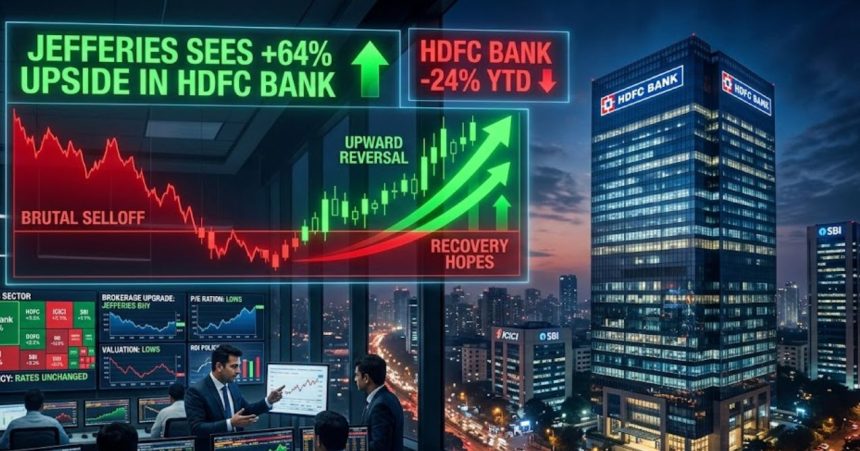
Stock down 24% YTD against ICICI’s 7% gain. Brokerage sees a 64% upside once leadership clarity arrives; governance review is now nearing a clean chit.
Jefferies flagged on March 30, 2026, that HDFC Bank’s leadership crisis has done something unusual: it has dragged valuations for the entire Indian banking sector below where fundamentals alone would put them. The brokerage noted the stock is now trading at 1.6 times FY27 estimated adjusted book value, a 20% discount to ICICI Bank and a 10–20% discount to Axis Bank and Kotak Mahindra Bank. The selloff wiped approximately ₹1 lakh crore in HDFC Bank’s market capitalisation in two trading sessions after the chairman’s exit, per Outlook Business.
At a glance:
- HDFC Bank YTD: −24%
- ICICI Bank YTD: +7% | SBI YTD: +11% | Axis Bank YTD: +4%
- Jefferies target: ₹1,240 (64% upside) | JPMorgan target: ₹1,010 (33% upside)
- Stock at lowest valuation since April 2022 merger announcement, per JPMorgan

The Trigger: One Chairman Resignation, ₹1 Lakh Crore Gone
The trouble started March 19, when chairman Atanu Chakraborty quit without warning, citing “certain happenings and practices within the bank that I have observed over the last two years are not in congruence with my personal values and ethics.” That language, filed to exchanges late at night, sent the stock down nearly 9% the next morning. Keki Mistry, former CEO of HDFC Ltd, was installed as interim non-executive chairman for three months. The RBI took the unusual step of issuing a public statement reassuring investors and depositors about the bank’s stability, a move typically reserved for systemic crises.
Why This Hurt the Whole Sector, Not Just HDFC Bank
Also Read: HDFC Bank Slides Sharply — Jefferies Turns Bullish. Why This Call Matters Now
HDFC Bank carries the largest weight in both Nifty 50 and Bank Nifty. When its governance premium collapses, it pulls the entire sector’s price-to-book reference point down with it. Jefferies’ note puts explicit numbers on what the market had been pricing in silently: HDFC Bank now trades at a 20% P/B discount to ICICI Bank, anomalous given the bank’s stronger asset quality profile. Meanwhile, ICICI Bank is up 7% year-to-date, Axis Bank +4%, and SBI +11%. HDFC Bank is down 24%. That divergence has no operational explanation; it is entirely governance-driven. Additionally, stricter RBI rules on banks’ open foreign exchange positions, introduced March 25, 2026, added another layer of near-term pressure on trading revenues.
The Business Itself Is Healing
Strip out the governance noise, and HDFC Bank’s operational metrics are pointed in the right direction. Loan growth was tracking at 6.7% year-on-year in Q1 FY26, up from 3% just two quarters earlier. Deposit growth held at 16% YoY. The loan-to-deposit ratio eased to 96% from 105% a year prior, the post-merger integration drag that weighed on returns through FY24–25 is visibly unwinding. Since the $40 billion HDFC-HDFC Bank merger in July 2023, the stock is down 5%, while ICICI Bank has risen 33% and Nifty 50 is up 24%, all the underperformance is post-merger, not pre-merger.
What stood out in Jefferies’ framing was the second catalyst alongside management clarity: easing West Asia tensions. Every crude spike tightens RBI’s room to cut rates, raises import bills, and weighs on bank NIMs. Jefferies is saying a sector-wide rerating needs both triggers firing at once.
The Governance Cloud Is Lifting — Faster Than Markets Realise
Oddly, the biggest update on this story came two days ago, and most participants appear to have missed it. Reuters reported May 6 that law firms Trilegal and Wadia Ghandy & Co, hired by HDFC Bank’s board to review governance, are set to report this month that they found no major lapses. The RBI has privately indicated it sees no issues that could block CEO Sashidhar Jagdishan’s reappointment, per three people with direct knowledge cited by Reuters. HDFC Bank’s application to reappoint Jagdishan, whose term ends October 26, 2026, is due with the central bank by May-end. The stock gained 3.1% on the Reuters report alone.
Proxy advisor InGovern Research Services said last month the resignation was likely driven by individual personality differences rather than any threat to shareholder value, the clearest independent framing of what was always a contained, not systemic, event.
Read Next: Firstsource Jumps 12% as Smallcaps Beat Nifty on May 8
FAQ
Why is HDFC Bank down 24% in 2026 while ICICI Bank is up 7%?
The divergence is governance-driven, not operational. Chairman Atanu Chakraborty’s abrupt March 19 resignation citing ethical concerns triggered a near-9% single-day drop and erased ₹1 lakh crore in market cap, per Outlook Business. ICICI Bank, Axis Bank, and SBI had no comparable governance event. Jefferies notes HDFC Bank now trades at a 20% P/B discount to ICICI, anomalous given its stronger asset quality, which is why the brokerage sees 64% upside once the overhang clears.
Where does HDFC Bank’s valuation stand now versus its history?
The stock trades at 1.6 times FY27 estimated adjusted book value and approximately 13 times forward earnings, per Jefferies. JPMorgan called this the lowest valuation since the April 2022 merger announcement. On P/B, HDFC Bank is at a 20% discount to ICICI and a 10–20% discount to Axis and Kotak Mahindra Bank, all of which have weaker asset quality than HDFC Bank, making the discount structurally unjustified by fundamentals alone.
What is the status of CEO Jagdishan’s renewal, and when will it resolve?
Jagdishan’s term ends October 26, 2026. The board’s application for a third term is due with the RBI by May-end 2026. Law firms Trilegal and Wadia Ghandy are expected to submit their governance review this month. Reuters reported on May 6 that the review found no major lapses, and the RBI has internally indicated no bar to reappointment. Resolution is expected before June 2026, the single biggest re-rating catalyst remaining for the stock.