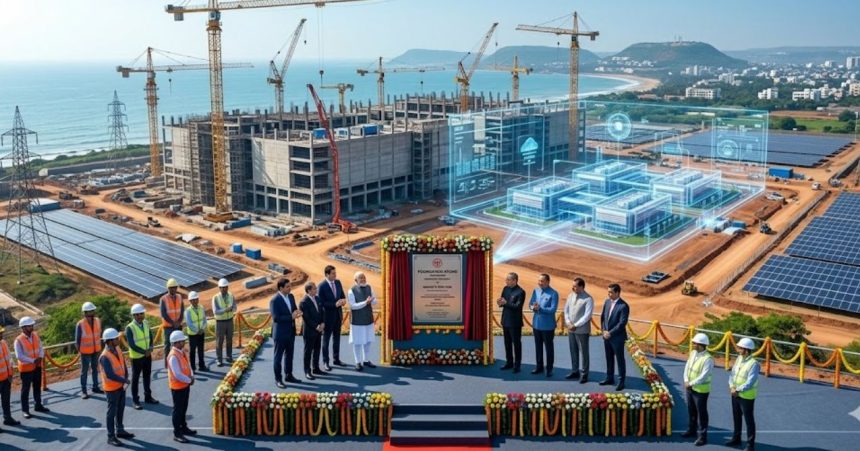
On April 28, 2026, Andhra Pradesh Chief Minister N. Chandrababu Naidu laid the foundation stone for Google’s $15 billion artificial intelligence data centre campus in Visakhapatnam, Google’s single largest investment outside the United States, its largest-ever commitment in India, and its first dedicated AI hub anywhere in the country.
The project, structured as a five-year investment from 2026 to 2030, will establish a 1-gigawatt AI and cloud campus spread across 600 acres at three locations: Rambilli, Adavivaram, and Tarluvada in Visakhapatnam district. At the April 28 ceremony, Bikash Kolay, Vice President of Global Infrastructure and Capacity at Google, said, “Today marks Google’s first and largest commitment to India’s digital future, built at a foundational scale for realising the vision of Viksit Bharat 2047.”
The 1 GW initial capacity is itself a landmark figure. India’s total installed data centre capacity stood at around 1.5 GW as of end-2025, meaning this single campus will add roughly two-thirds of the country’s existing total. The long-term target is more dramatic still: the eventual planned capacity is 5 GW, more than three times India’s entire existing footprint. Construction is expected to begin in April 2026, with the first phase targeted for commissioning by July 2028.
The three-part infrastructure play
The first component is the gigawatt-scale compute campus itself, designed to run Google’s most demanding AI workloads, including Gemini, Search, and YouTube. The hub will connect into Google’s existing global network, which spans more than two million miles of terrestrial and subsea fiber, according to Google’s infrastructure disclosures.
The second and most strategically significant is Google’s America-India Connect initiative. Rather than a single cable landing station, America-India Connect will establish a new international subsea gateway in Visakhapatnam, three new subsea paths connecting India to Singapore, South Africa, and Australia, and four strategic fiber-optic routes that bolster network resilience between the United States, India, and multiple locations across the Southern Hemisphere. Kolay described this as introducing “micro-diversity” to India’s network infrastructure, where international data traffic is currently concentrated through two coastal chokepoints, Mumbai and Chennai.
The third component is clean energy and transmission infrastructure, with co-investment in new transmission lines, renewable energy generation, and innovative storage systems across Andhra Pradesh. Google has also secured a discom (electricity distribution) licence from the Andhra Pradesh government, allowing it to procure power directly rather than through the conventional utility supply chain, a structure that gives it direct control over its energy mix and cost, since electricity accounts for 40–60% of data centre operating expenses, according to industry estimates from the Uptime Institute.
Who is building it: the partner consortium
The project brings together a four-company consortium: AdaniConneX, Bharti Airtel, FedEx, and Nextera Energy. AdaniConneX, the joint venture between the Adani Group and EdgeConneX, will develop the core data centre infrastructure, including gigawatt-scale facility design, renewable energy-linked power systems, and energy storage solutions. Airtel will build the Cable Landing Station to host Google’s new international subsea cables and will construct an intra-city and inter-city fibre network across Visakhapatnam.
What Andhra Pradesh is offering Google
The state did not win this investment on geography alone. Google’s subsidiary Raiden Infotech India will receive ₹22,000 crore in incentives from the Andhra Pradesh government, covering land concessions, fiscal benefits, and power subsidies. The specific terms are a 25% discount on the market price of 480 acres, full stamp duty exemption, a 25% discount on industrial water supply, exemption on electricity duty, and a ₹1 per unit discount on the electricity tariff for 15 years. The most scrutinised concession is 100% reimbursement of state GST during construction, capped at ₹2,245 crore, approximately 2.5% of the ₹87,520 crore investment in the data centre.
Skills and the talent pipeline
Beyond infrastructure, Google has committed to training over 125,000 students in cloud and AI skills and upskilling more than 1,000 local workers for technical roles, according to Kolay’s remarks at the April 28 ceremony. The company is also developing a watershed master plan for the Visakhapatnam region, according to the same remarks, though no timeline or budget allocation for that plan has been publicly disclosed.
Vizag: India’s emerging AI capital
Google’s foundation ceremony takes place against a backdrop of accelerating investment in the same corridor. Reliance Industries is investing approximately ₹1.59 lakh crore across two linked projects near Visakhapatnam: roughly ₹1.08 lakh crore in a 1.5-gigawatt data centre cluster and ₹51,300 crore in a dedicated renewable energy project, according to the Andhra Pradesh Investment Promotion Committee, which approved the plan at a meeting on April 25. Reliance has sought 935 acres, with the first 500 MW phase at Polipalli village targeting commercial production by October 2028 and an additional 1 GW at Bhogapuram East and West by 2030. That project, structured through Digital Connexion, the joint venture of Reliance, Brookfield Asset Management, and Digital Realty, would at 1.5 GW surpass Google’s 1 GW initial campus to become India’s largest single data centre cluster.
Amazon has outlined $12.7 billion in cloud infrastructure investment in India by the end of the decade. OpenAI is separately exploring a 1 GW data centre in the country. Meta’s Waterworth subsea cable is expected to land at Vizag. Andhra Pradesh IT Minister Nara Lokesh stated last year that the state is targeting a total hosting capacity of 6 GW, a figure that would require both Google and Reliance to build out fully, plus additional investors to follow.
Also Read: India’s FTA Push Hits Execution Test: UK, Oman Deals Due in Weeks
Frequently Asked Questions
What is Google’s $15 billion Vizag project?
It is Google’s first dedicated AI hub in India and its single largest investment outside the United States, a 1-gigawatt data centre campus in Visakhapatnam, combined with an international subsea cable gateway connecting India to Singapore, South Africa, and Australia, plus clean energy infrastructure. The $15 billion runs from 2026 to 2030.
When will the Vizag data centre be operational?
The first phase of the campus is targeted for commissioning by July 2028. The full 1 GW initial build-out runs through 2030. The eventual long-term capacity target of 5 GW does not have a confirmed completion date.
What incentives is Andhra Pradesh giving Google?
A ₹22,000 crore package comprising a 25% land discount on 480 acres, full stamp duty exemption, a 25% water supply discount, electricity duty exemption, a ₹1/unit electricity tariff discount for 15 years, and 100% State GST reimbursement during construction capped at ₹2,245 crore. Andhra Pradesh’s Data Centre Policy 4.0 offers similar incentives to other qualifying projects above 300 MW, an AP government official confirmed to The News Minute in October 2025 that these terms are “not so different from industrial subsidies usually offered by other states such as Karnataka.”
Is Reliance also building a data centre in Vizag?
Yes. The Andhra Pradesh Investment Promotion Committee approved Reliance’s plan at a meeting on April 25, 2026. The project totals approximately ₹1.59 lakh crore across a 1.5 GW data centre cluster and a linked renewable energy project, structured in phases, with the first 500 MW at Polipalli village targeted for October 2028 and an additional 1 GW at Bhogapuram by 2030.
How does Vizag’s connectivity compare to Mumbai and Chennai?
India’s international internet traffic currently flows primarily through two chokepoints: cable landing stations in Mumbai and Chennai on the western and southeastern coasts. Google’s America-India Connect initiative adds a new eastern gateway at Vizag with three distinct subsea paths to Singapore, South Africa, and Australia, what Google calls “micro-diversity” in India’s network architecture. Meta’s Waterworth cable is also expected to land at Vizag, compounding its strategic position.
How big will the Vizag data centre ecosystem eventually be?
Google’s campus targets 5 GW eventually. Reliance is targeting 1.5 GW at Bhogapuram. The AP government’s stated target is 6 GW total capacity across the state, which, if achieved, would represent four times India’s entire installed data centre capacity as of end-2025.