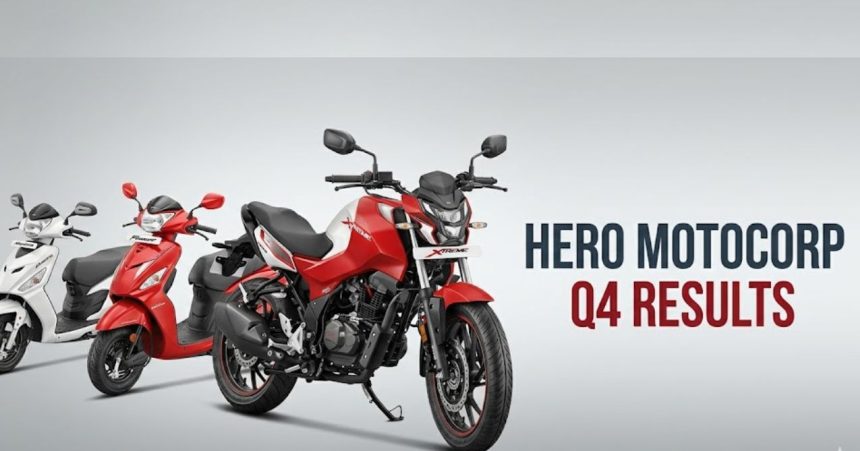
Hero MotoCorp reported its highest-ever quarterly earnings on May 5, with VIDA capturing 10.3% of the electric two-wheeler market and global exports hitting a record 4.03 lakh units in FY26.
Record Quarter, Record Year
Hero MotoCorp posted its highest-ever standalone quarterly profit on Tuesday, May 5, with profit after tax rising 30% year-on-year to Rs 1,401 crore (standalone) for January–March 2026 as revenue hit a record Rs 12,797 crore. On a consolidated basis, net profit was Rs 1,474 crore, up 26.1% YoY per the regulatory filing. The standalone result beat Nirmal Bang’s estimate of Rs 1,388 crore but came in below JM Financial’s forecast of Rs 1,419 crore.
EBITDA for Q4 came in at Rs 1,856 crore, up 31.1% from Rs 1,416 crore a year earlier. For the full financial year FY26, standalone revenue from operations rose 14.9% to Rs 46,830 crore, and standalone PAT grew 14% to Rs 5,268 crore. On a consolidated basis, full-year net profit was Rs 5,776 crore, up 32% YoY, both the highest numbers the company has ever posted on either basis.
Volume Recovery Was Broad, and the ASP Math Tells You Why
Hero sold 17.14 lakh motorcycles and scooters in Q4, up 24% year-on-year. That headline number is solid. What it obscures is the pricing story underneath it.
Dividing Q4 revenue of Rs 12,797 crore by 17.14 lakh units gives an implied average selling price of approximately Rs 74,660 per unit, up roughly 3.8% from the Rs 71,900 implied ASP in Q4 FY25. Revenue grew 28.8% on volumes that grew 24%. The gap between those two numbers is the premium mix shift doing its work. Nirmal Bang had estimated around 4% ASP improvement in Q4, driven by price hikes and a better product mix. The actual numbers confirm that call. For the full year, Hero dispatched 64.69 lakh units, up 10%. GST rate rationalisation in September 2025 was a key demand driver per the company’s regulatory filing, explaining a significant portion of the 24% volume jump.
Margins Held — Which Matters More Than It Looks
FY26 EBITDA came in at Rs 6,871 crore, up 17.1% (standalone regulatory filing), with a margin of 14.7%, an improvement of 30 basis points over FY25. Nirmal Bang had flagged going in that margins were “likely to moderate sequentially, as higher raw material costs offset operating leverage, improved mix, and ongoing cost optimisation.” Hero held the line.
For context, Hero’s trailing P/E stood at approximately 19x as of April 2026 (Univest), compared to TVS Motor at over 50x and Bajaj Auto at around 29x. Post-results, the multiple will adjust depending on how the street re-rates FY27 earnings guidance from today’s conference call.
Rs 185 Per Share: The Full Dividend Picture
The board declared a final dividend of Rs 75 per equity share (face value Rs 2), subject to shareholder approval. Combined with the interim dividend of Rs 110 already paid during the year, the total FY26 payout is Rs 185 per share, translating to a total payout ratio of 9,250% on the Rs 2 face value, the highest absolute per-share payout in the company’s history (FY25: Rs 165/share, FY24: Rs 140/share, AceEquity data).
VIDA: 10.3% EV Market Share, and a Sub-Rs 1 Lakh Scooter Coming
Hero’s electric brand VIDA posted VAHAN retail registration growth of 190% year-over-year in FY26, its strongest year since launch. Separately, dispatch volumes grew 154% over the same period, per the company’s April 2026 filing. The retail figure of approximately 1.44–1.48 lakh units translates to a 10.3% share of India’s electric two-wheeler market, which totalled approximately 1.4 million units in FY26, according to Autocar India.
VIDA is currently ranked fourth in the list of bestselling electric two-wheeler brands. The brands ahead of it are TVS at 23% share, Bajaj Auto at 21%, Ola Electric at 16%, and Ather Energy at 15%. Closing fast, in November 2025, VIDA overtook Ola Electric in monthly VAHAN registrations for the first time, recording 12,199 units against Ola’s 8,400 (VAHAN portal data).
The next catalyst is already confirmed. Hero plans to launch a new fixed-battery electric scooter around August 2026, likely featuring a 3.8kWh battery pack and priced below Rs 1 lakh, targeting mass-market buyers (Autocar India). Production capacity at its Sri City plant will double from 3.3 lakh to 6.6 lakh units per annum by 2027. At that price point, VIDA enters the highest-volume bracket of the EV market, the sub-Rs 1 lakh segment, where TVS and Bajaj currently command the majority of their share and the competitive equation shifts materially.
Global Business Hits Record — 52 Markets, Europe Entry
Hero’s international business grew 40% year-on-year in FY26, reaching an all-time high, with the company expanding its presence to 52 countries, including new markets in Europe and the UK. Specifically, Hero entered Germany, France, Spain, and the UK during the year, its first foray into developed Western markets. Full-year global dispatches came in at 4.03 lakh units.
April 2026 added further momentum: global dispatches reached 33,653 units (company press release, May 1, 2026). Strengthening its South American footprint, Hero partnered with Quilmotors as its exclusive distributor in Ecuador, covering assembly operations, network development, sales, after-sales service, and spare parts distribution, a market it had not previously served, and the first Latin American addition of FY27.
This international diversification play rarely features in domestic investor analysis of the stock. With exports hitting an all-time high, four new European markets added, and a new continent entry in FY27’s opening month, the global business line is no longer a footnote, it is a structural growth pillar worth tracking separately.
The Market Share Problem That Strong Numbers Can’t Fully Hide
Hero’s domestic two-wheeler market share dropped from 36–37% in FY17–FY21 to approximately 28.8% in the April–December 2025 period (SIAM data), a multi-year low. The FY26 full-year percentage share figure from SIAM is not yet published. What is confirmed from company filings: Hero’s domestic volumes reached 6.07 million units in FY26, widening its absolute unit lead over Honda Motorcycle & Scooter India from 280,000 units in FY25 to over 310,000 units. Volume recovery is real; whether it has translated to percentage share recovery will be confirmed with SIAM’s full-year data, expected in coming weeks.
Analyst opinion is split sharply. Morgan Stanley maintains an overweight rating with a price target of Rs 6,537, citing strong conviction in the auto volume upcycle, though it acknowledges near-term headwinds including Q1 FY27 margin pressure and supply-chain risks. Jefferies downgraded to Underperform in December 2025, cutting its target to Rs 4,950 from Rs 5,550, citing fading GST-driven demand, slipping registration market share in December, and valuations it considers stretched. The gap between those two calls, Rs 6,537 vs Rs 4,950, is not just a price difference. It reflects a fundamental disagreement on whether Hero’s volume recovery will hold into FY27 or whether December 2025’s share weakness was a preview of structural pressure to come. Today’s concall is where management must address that question directly with FY27 guidance numbers.
Also Read: BJP’s Bengal Win Revives DVC’s Long-Stalled Listing Plans
Frequently Asked Questions
What is Hero MotoCorp’s total dividend for FY26?
Rs 185 per equity share, Rs 110 interim already paid, plus a final dividend of Rs 75 per share recommended by the board on May 5, subject to shareholder approval. Face value is Rs 2 per share.
Did Hero MotoCorp beat analyst estimates in Q4 FY26?
Yes. Nirmal Bang estimated PAT at Rs 1,388 crore on revenue of Rs 12,783 crore; JM Financial estimated PAT at Rs 1,419 crore on revenue of Rs 12,605 crore. Actual PAT came in at Rs 1,401 crore on revenue of Rs 12,797 crore, within the range on profit and ahead on revenue.
What is VIDA’s electric two-wheeler market share, and how does it rank against competitors?
VIDA held approximately 10.3% of the Indian electric two-wheeler market in FY26, with registrations of around 1.44 lakh units. It ranks fifth nationally, behind TVS at 23%, Bajaj Auto at 21%, Ola Electric at 16%, and Ather Energy at 15%. A sub-Rs 1 lakh model launch planned for August 2026 is the next volume trigger.
The May 6 analyst concall is the next hard data point; FY27 volume guidance, Q1 margin outlook, and VIDA production ramp timelines are the three numbers to watch.