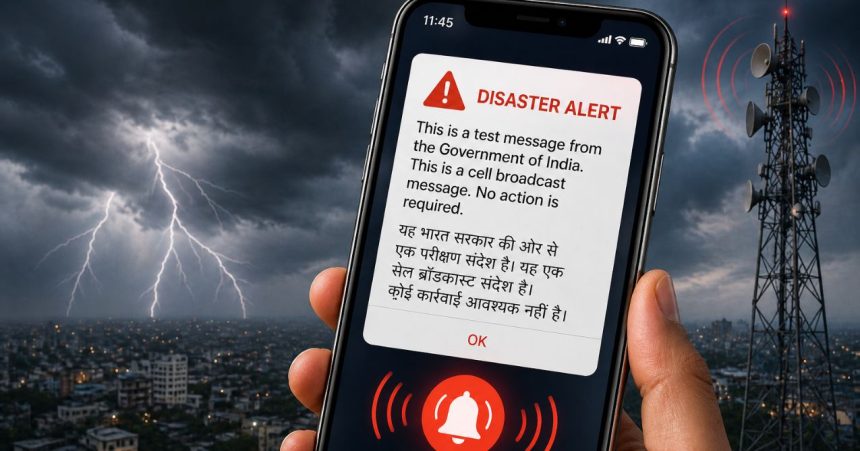
New Delhi, May 2, 2026 — India formally launched the Cell Broadcast upgrade to SACHET on Saturday, with Home Minister Amit Shah and Communications Minister Jyotiraditya Scindia inaugurating the system in New Delhi. The indigenously built platform, developed by C-DOT (Centre for Development of Telematics), has already delivered over 134 billion SMS alerts across all 36 states and union territories in more than 19 languages, per the Ministry of Communications. The Cell Broadcast layer, added on top of the existing SMS infrastructure, is designed to reach every mobile phone in a disaster zone simultaneously, including devices set to silent or Do Not Disturb.
What Just Changed and Why It Matters
The SMS system wasn’t broken. It worked through cyclones, severe weather events, and flood warnings for years. What it couldn’t do well was speed. Cell Broadcast technology has now been introduced alongside SMS to strengthen alert dissemination in time-critical situations such as tsunamis, earthquakes, lightning strikes, and man-made emergencies like gas leaks or chemical hazards.
The difference is structural. Unlike traditional SMS alerts, which are sent individually to each phone number, Cell Broadcast transmits alerts to all mobile devices within a defined geographic area simultaneously, enabling near real-time delivery even when mobile networks are congested during emergencies. During a disaster, network congestion is exactly when SMS fails. That is the gap this fixes.
The Test: What Happened on Saturday Morning
As part of the launch exercise, test alerts were sent to mobile phones across Delhi-NCR and the capital cities of all states and union territories between 11:15 a.m. and 12:15 p.m. in English, Hindi, and regional languages. The message explicitly identified itself as a drill, per the Ministry of Communications.
What stood out was the delivery behaviour. The emergency alert notification overrides standard device settings, arriving with a loud sound or vibration even on phones set to silent or Do Not Disturb. Alerts appear as full-screen pop-up messages that remain on screen until the user acknowledges them. This is not a standard notification that sits in a tray.
Users can enable or disable test alerts through Settings → Safety and Emergency → Wireless Emergency Alerts → Test Alerts. Actual emergency alerts operate on a separate mandatory channel that cannot be switched off at the device level, per the Ministry of Communications.
Compatibility note: C-DOT has confirmed the Cell Broadcast system is compatible with 4G and 5G handsets. For 2G and 3G devices, still widely used in rural India, where disaster alerts are most critical alerts will continue to be delivered via the existing SACHET SMS channel. The two systems run in parallel, not in sequence.
 The Indigenous Angle: No Foreign Vendor
This is the detail most coverage is skimming past. C-DOT, the DoT’s premier R&D centre, built and implemented the Cell Broadcast alert system entirely in-house. The US runs its Wireless Emergency Alert system through FEMA in coordination with private carrier infrastructure, according to FCC documentation. Japan’s J-Alert relies on a mix of government systems and NTT hardware, per the ITU’s 2023 country implementation review. India built its own, without a foreign vendor at any layer of the stack.
The system is based on the Common Alerting Protocol (CAP), as recommended by the International Telecommunication Union, globally interoperable in format, domestically owned in infrastructure. For developing countries that need disaster communication systems without the budget for proprietary Western platforms, India’s C-DOT build is the first fully indigenous model at this scale from a country of comparable size and linguistic complexity.
How Geo-Targeting Works
The system does not broadcast a national alert for a localised flood warning. It targets only the mobile devices physically present within the affected geographic zone, coastal users during a tsunami, residents within a chemical plant’s evacuation radius during an industrial leak. Cell Broadcast works at the tower level, meaning the alert goes to every device connected to towers in the target area, regardless of where that device’s SIM is registered.
This has a direct implication for travellers and migrant workers. A construction worker from Bihar working in flood-prone Assam receives the same alert as a local resident. A tourist from Tamil Nadu in a coastal Kerala zone during a cyclone warning gets the alert in real time. The system has no mechanism to identify or exclude out-of-state SIMs, every device on the tower gets the message.
What the 134 Billion Number Actually Tells You
The Ministry of Communications has disseminated over 134 billion SMS alerts in more than 19 Indian languages during disasters, weather warnings, and cyclonic events. That figure covers the SMS-only phase of SACHET, before Saturday’s Cell Broadcast upgrade. It is not a single campaign number. It is the cumulative output of a system that has been running across every state for years, firing warnings at scale every time a cyclone or flood event triggered an alert.
The Cell Broadcast layer does not replace that volume. It adds a faster, tower-direct channel on top for the seconds where SMS latency is the difference between an evacuation that happens and one that doesn’t.
Also Read: Retail AI Trading Bots Beat S&P 500 — With 22% Drawdowns
SACHET is developed and operated by C-DOT under the Department of Telecommunications, Ministry of Communications, Government of India.
FAQs
Q: Will this alert arrive on my phone even if it’s on silent or Do Not Disturb?
Yes. The emergency alert overrides standard device settings and arrives with a loud sound or vibration. Users can turn off test alerts through Settings → Safety and Emergency → Wireless Emergency Alerts → Test Alerts, but production emergency alerts operate on a mandatory channel that cannot be disabled at the device level, per the Ministry of Communications.
Q: Does the government need my phone number to send me an alert?
No. Cell Broadcast transmits to all mobile devices within a geographic area simultaneously; it does not use individual phone numbers. The alert goes to every device connected to towers in the target zone, including roaming users and tourists. Your number is never used or stored in the process, per the Ministry of Communications.
Q: My phone didn’t receive the May 2 test alert. What should I check?
First, confirm your device is 4G or 5G capable and that Wireless Emergency Alerts are enabled under Settings → Safety and Emergency. If your phone is a 2G or 3G handset, test alerts are not delivered over Cell Broadcast — only actual emergency alerts via the SMS channel will reach you. If your 4G device still missed the alert, C-DOT has advised users to contact their telecom operator to confirm Cell Broadcast support is active on their network band.