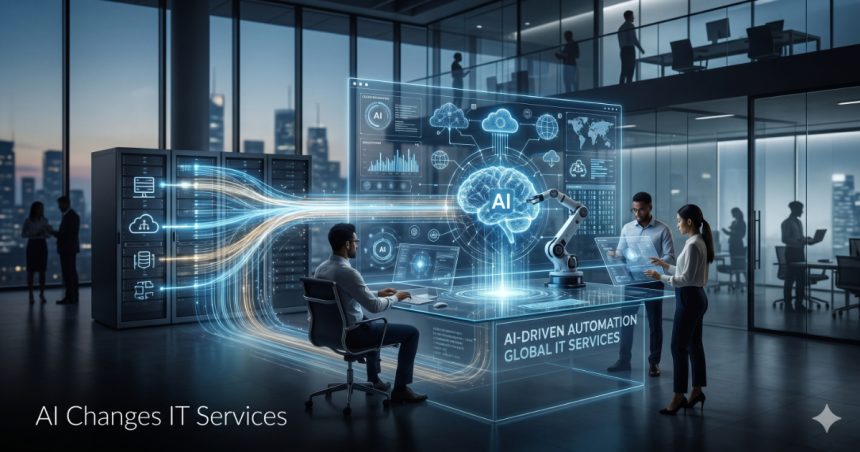
AI firms are moving beyond software and deeper into enterprise operations
India’s IT outsourcing industry is facing fresh pressure as OpenAI, Anthropic, and Google expand their enterprise AI strategies.
For years, outsourcing firms grew by supplying engineers, support teams, and software services to global companies. But AI companies are now moving closer to implementation and execution work.
Anthropic recently launched a $1.5 billion enterprise AI venture backed by Blackstone, Goldman Sachs, Hellman & Friedman, and Sequoia Capital. Reports also said OpenAI is raising over $4 billion for its enterprise-focused initiative called “The Development Company.”
Google Cloud has also strengthened partnerships with Vista Equity Partners and CVC while exploring deals with Blackstone, KKR, and EQT.

Read More : Sensex Falls 516 Points, Nifty Slips Below 24,200 as Global Tensions Shake Market Sentiment
Highest Profit Growth IT & AI Companies (2025 – May 2026)
| Company | Sector | Approx Share Price (May 2026) | Profit Growth / Performance | Why It Benefited Most |
|---|---|---|---|---|
| NVIDIA | AI Chips | $1,320 | Massive AI-driven earnings growth | Dominated AI GPU market powering OpenAI, Microsoft, Google, Meta AI infrastructure |
| Broadcom | AI Infrastructure | $2,050 | AI revenue doubled | Benefited from AI networking and hyperscaler custom AI chips |
| Microsoft | AI + Cloud | $560 | Strong AI cloud growth | Azure AI and Copilot monetisation surged |
| Alphabet | Cloud + AI | $245 | Google Cloud AI growth accelerated | Gemini AI and enterprise AI adoption boosted earnings |
| Palantir Technologies | Enterprise AI | $148 | Net income reportedly quadrupled | Huge demand for enterprise AI platforms |
| Micron Technology | AI Memory Chips | $172 | AI memory demand exploded | HBM memory demand from AI data centers |
| Anthropic | Enterprise AI | Private Company | Rapid enterprise AI expansion | Claude AI adoption and enterprise partnerships surged |
| OpenAI | Enterprise AI | Private Company | Revenue and valuation surged | ChatGPT Enterprise and AI deployment demand exploded |
Indian IT Companies With Highest Profit Growth
| Company | Sector | Approx Share Price (May 2026) | Profit Growth Trend | Key Reason |
|---|---|---|---|---|
| Coforge | Mid-tier IT + AI | ₹1,294 | Profit jumped ~134% YoY | Strong AI-led deal wins and digital engineering growth |
| Persistent Systems | AI Engineering | ₹5,900 | Strong multi-year profit growth | AI, cloud, and software engineering demand surged |
| Tata Consultancy Services | IT Services + AI | ₹3,950 | Stable AI-driven earnings | Strong enterprise AI adoption and transformation deals |
| Infosys | IT + AI Consulting | ₹1,179 | Moderate growth | AI consulting and enterprise modernization demand |
| LTIMindtree | Digital Transformation | ₹5,200 | Healthy AI-led growth | Benefited from cloud and AI modernization projects |
| Mphasis | BFSI Tech Services | ₹2,650 | Improving growth | AI and BFSI digital transformation exposure |
| HCLTech | Enterprise IT | ₹1,198 | Slower but stable growth | AI infrastructure and engineering support growth |
Who Benefits?
AI & Digital Transformation Leaders
- Tata Consultancy Services
- Strong AI deal pipeline
- AI revenue already crossing multi-billion-dollar scale
- Better positioned in enterprise AI integration and consulting
- Infosys
- Expanding AI-led services rapidly
- Strong consulting and enterprise transformation presence
- Higher exposure to AI modernization deals
- Persistent Systems
- Higher AI-native and cloud exposure
- Faster growth profile than traditional outsourcing firms
- LTIMindtree
- Benefiting from digital engineering and AI adoption trends
- Mid-tier firms with strong AI positioning may outperform
- Coforge
- Stronger niche transformation capabilities
- Beneficiary of AI orchestration and enterprise modernization
Cloud & AI Infrastructure Companies
- Google Cloud
- OpenAI
- Anthropic
- NVIDIA
- Amazon Web Services
Benefits:
- Higher enterprise AI spending
- Increased cloud usage
- AI infrastructure demand explosion
- Enterprise AI implementation revenues
Global Capability Centres (GCCs)
Companies building in-house AI teams may benefit:
- JPMorgan
- Goldman Sachs
- Walmart Global Tech
- Target
- UBS
Trend:
- More work moving in-house
- Reduced dependency on outsourcing vendors
- Strategic AI control staying with enterprises
Who Loses?
Labour-Heavy IT Outsourcing Firms
- Wipro
- Weak demand visibility
- Pricing pressure in legacy services
- Tech Mahindra
- Exposure to traditional enterprise support and telecom services
- HCLTech
- AI-driven pricing pressure emerging in legacy contracts
- Infosys
- Still exposed to commoditised ADM work despite AI pivot
Vulnerable Business Segments
Most exposed areas:
- Application maintenance
- Repetitive coding
- Manual testing
- BPO/KPO work
- Low-end support operations
- Fresher-heavy delivery models
Why?
AI agents can increasingly:
- write code
- automate testing
- manage documentation
- reduce repetitive human effort
Entry-Level Hiring Model
Indian IT’s traditional “pyramid model” faces disruption.
Signals already visible:
- Slower fresher hiring
- Workforce reductions
- Higher focus on AI specialists
Here’s what happened today and why traders reacted
Markets reacted because AI firms are no longer limiting themselves to selling AI models and APIs.
Anthropic said its engineers would work directly with enterprise teams to integrate AI into operational systems. The model resembles Palantir’s “forward-deployed engineer” strategy, where technology firms embed themselves deeply inside client operations.
Google Cloud is also helping private equity portfolio companies deploy AI systems more aggressively.
This has raised concerns that traditional IT services companies could lose parts of the implementation and transformation business.
“GenAI and agentic AI fundamentally attack the labour-centric economics that Indian IT services firms have relied on for three decades,” said Phil Fersht, CEO of HFS Research.
That warning added to investor concerns around the long-term outlook for outsourcing firms.
The traditional outsourcing model is starting to face structural pressure
The larger concern is automation.
Unlike earlier tech cycles, AI can directly automate parts of coding, testing, support, and maintenance work. Many of these services formed the core of traditional outsourcing revenues.
Shubham Rathore, Principal Analyst at Gartner, said the “traditional fresher-heavy pyramid model is under severe structural stress.”
Former Cognizant CEO Francisco D’Souza also described AI as “the biggest operating model shift since offshoring.”
He believes outsourcing companies may gradually move toward a “diamond-shaped” workforce with fewer junior engineers.
The trend is already visible.
India’s top IT firms collectively reduced headcount by nearly 7,000 employees in FY26 despite rising enterprise AI spending.
What impact could this have on investors and IT stocks?
For investors, the immediate concern is slower growth and pricing pressure.
Clients are increasingly demanding that AI-led productivity gains be reflected in contracts. HCLTech recently warned that AI efficiencies could create a 2-3 percent annual pricing impact in parts of its business.
That creates pressure on traditional manpower-driven revenue models.
However, analysts believe the disruption could also create new opportunities for firms that adapt quickly.
- AI governance and compliance
- Enterprise AI security
- AI orchestration and monitoring
- Agentic AI deployment
- Data modernisation
Cognizant Chief AI Officer Babak Hodjat recently said, “AI is an engineered discipline,” stressing that enterprises still require deep integration and governance expertise.
The future battle may be about who controls enterprise transformation
The outsourcing industry is now facing pressure from multiple directions.
AI-native firms want greater control over enterprise execution, while global corporations are also expanding in-house engineering capabilities and GCC operations.
Vanguard’s recent move to bring some outsourced functions back in-house from Infosys reflects this broader trend.
Anthropic CFO Krishna Rao recently said partnerships with systems integrators remain important. Still, the competitive landscape is clearly changing.
The next phase of the IT industry may no longer depend on workforce scale alone.