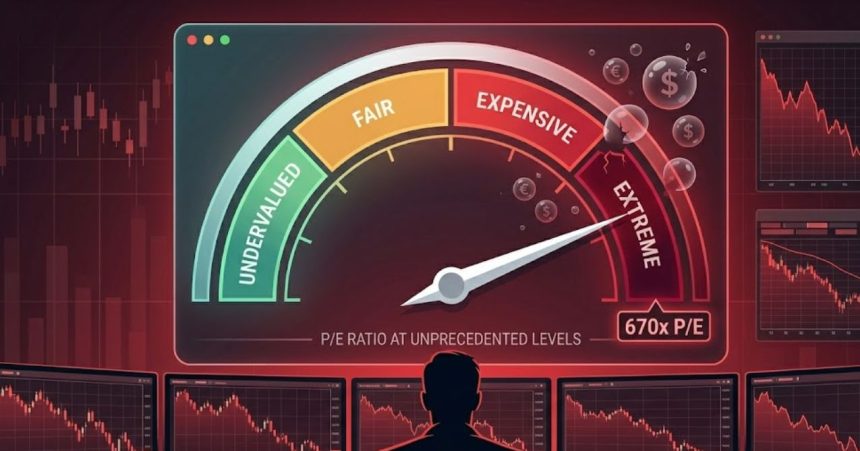
Retail investors added to their Eternal holdings through the March 2026 quarter, the second consecutive quarter they have done so, even as the stock slid roughly 13% over that period and trades nearly 30% below its 52-week high, shareholding data shows. The buying has continued despite a trailing-twelve-month P/E of around 670x, a valuation that has kept many institutional investors cautious.
Two Quarters of Dip-Buying, Back to Back
Retail holding in Eternal rose to 5.64% at the end of March 2026, representing over 54.44 crore equity shares, up 29 basis points from 5.35% in the December quarter. Before that, the December quarter had itself seen a 27-bps rise from 5.08% in September. Two consecutive quarters of retail accumulation on a declining stock are not noise. It is a pattern.
The stock, trading around ₹247–257 in late April 2026, has a 52-week high of ₹368.45 and a low of ₹212.60. Retail investors appear to be treating the correction as an entry window rather than a warning sign.

Also Read : Vodafone Idea Seeks ₹35,000 Cr Debt; SBI Set to Lead
Mutual Funds Pile In as FIIs Head for the Exit
What stood out even more sharply in the March quarter data: domestic mutual funds dramatically increased exposure while foreign institutional investors reduced theirs. Mutual fund ownership in Eternal jumped to 28.9% in March 2026 from 16.4% in December 2025. The buying was not concentrated; it was broad-based across fund houses.
SBI Nifty 50 ETF held 3.54% and HDFC Flexi Cap Fund 3.53%, while new entrants, including Mirae Asset at 1.42%, Motilal Oswal at 1.77%, and Aditya Birla Sun Life at 1.27%, added fresh exposure. On the other side, Kuwait Investment Authority and Antfin fully exited, alongside broad-based selling across smaller foreign shareholders.
The divergence is stark. Domestic money, both institutional and retail, is moving in one direction. Foreign money is moving in the other.
The Numbers Behind the Confidence
The buying is not without fundamental support. Eternal reported Q4 FY26 net profit of ₹174 crore, up from ₹39 crore in the same period last year, nearly 4.5 times growth year-on-year. Revenue for the quarter rose 196% to ₹17,292 crore. Sequentially, profit was up 70% from ₹102 crore in Q3.
Adjusted EBITDA increased 160% year-on-year to ₹429 crore and grew 18% quarter-on-quarter. The EBITDA margin at 2.8% was up 50 basis points sequentially — a small number in absolute terms, but the direction is consistent.
Blinkit is the engine driving most of this. Blinkit reported adjusted EBITDA of ₹37 crore in Q4 FY26, compared with a loss of ₹178 crore in the same quarter last year. It now operates 2,243 dark stores after adding 216 net new stores in the quarter.
The Non-Obvious Angle: Blinkit’s AOV Is Falling
Oddly, one number quietly undermines the volume story. Blinkit’s average order value has stalled at ₹525 in Q4 FY26, flat year-on-year, even as monthly transacting customers nearly doubled to 27.2 million. The company is not earning more per order despite the scale. What that tells you: new users are ordering smaller, more frequent baskets rather than high-value ones. Growth is coming from habits, not from spend. Whether AOV eventually recovers as the user base matures or stays flat as Blinkit chases volume in smaller cities is the margin question nobody in the bull camp has cleanly answered yet.
Blinkit holds over 40% market share in quick commerce as of Q4 FY26, substantially ahead of Zepto at approximately 20%. Market dominance is intact. Monetisation per order is another matter.
Analyst View and the Valuation Debate
According to Bloomberg, 29 of 32 analysts polled after Q4 results are bullish on the stock, with only three bearish. That consensus is almost uncomfortably one-sided for a stock at 670x trailing earnings.
The bull case rests on Blinkit’s 60% NOV CAGR guidance for the next three years and the idea that earnings will catch up to the valuation. The bear case is simply that at a market cap of roughly ₹2.36 lakh crore, a lot of that catch-up is already priced in, and then some.
Retail investors, apparently, are firmly in the bull camp. The next concrete test of that conviction: whether Blinkit can sustain EBITDA growth in Q1 FY27 while adding stores aggressively and holding off Zepto without sacrificing AOV further.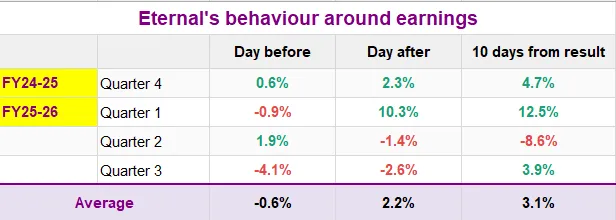
Also Read: Eternal Q4 Net Profit Rs.174 Crore, Beats Estimates; Blinkit Profitable
FAQ
Why are retail investors buying Eternal despite a 670x P/E?
Retail investors appear to be betting on forward earnings growth rather than trailing multiples. Eternal’s net profit grew 4.5x year-on-year in Q4 FY26 to ₹174 crore, and Blinkit sustained adjusted EBITDA profitability for a second consecutive quarter, improving sharply from ₹4 crore in Q3 FY26 to ₹37 crore in Q4 FY26. Both data points point toward a shrinking P/E over the next 2–3 years if the trajectory holds.
What happened to Eternal’s mutual fund and FII holdings in Q4 FY26?
Mutual fund holding jumped sharply to 28.9% from 16.4% in a single quarter. FII holding fell, with Kuwait Investment Authority and Antfin among those who fully exited. Domestic institutional money is replacing foreign money at the current price levels.
What is Eternal’s next major financial trigger?
Blinkit’s Q1 FY27 results, expected in July 2026, will be the first test of whether the company can sustain EBITDA growth while continuing dark store expansion toward its 3,000-store target by FY29.