Launched on March 29, 2026, the Bengaluru startup’s new vertical is built for on-premise, classified deployments as India runs 75+ active AI projects across its armed services and eyes a $250–300 million funding round. As of April 22, 2026, no signed defence contract has been disclosed; Chanakya’s defence positioning is based on its technical architecture and stated dual-use design intent.
Technology & Defence Desk · April 22, 2026 · New Delhi
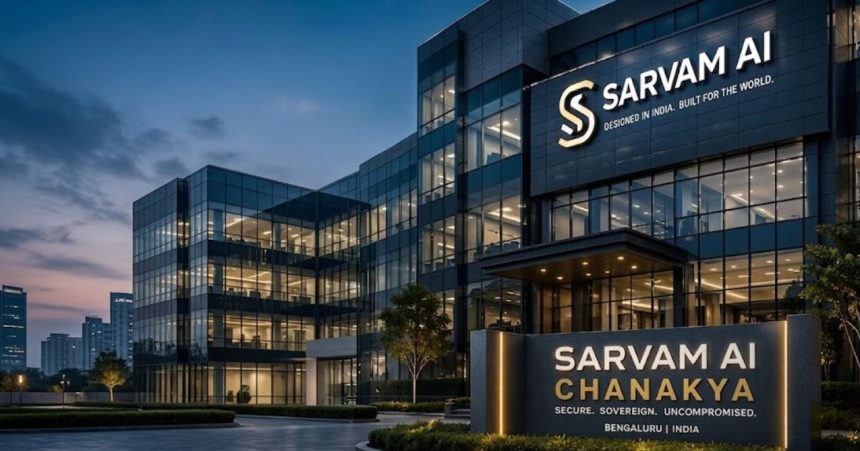
Sarvam AI, on March 29, 2026, formally launched “Chanakya,” a dedicated applied-AI vertical designed for air-gapped, on-premise deployments in defence, government, and critical infrastructure after more than 12 months of quiet development. The Bengaluru-based company announced the vertical via a post on X, stating it had been “applying our full-stack AI to problems of national consequence and complex enterprises.” The vertical is explicitly positioned for dual-use deployment across enterprise and defence environments where public cloud infrastructure is not an option, though no contract value or signed defence deal has been disclosed as of April 22, 2026.
Chanakya sits atop Sarvam’s existing model stack, Sarvam-30B and Sarvam-105B, two foundational large language models open-sourced under the Apache License 2.0 in early March 2026 and available on Hugging Face. Both models were trained from scratch on datasets covering 22 Indian languages, hosted on government-allocated GPU clusters under the IndiaAI Mission’s ₹10,372 crore compute programme, and unveiled at the India AI Impact Summit 2026 at Bharat Mandapam, New Delhi, in February 2026.
KEY NUMBERS
- Date Chanakya vertical was launched—March 29, 2026
- Indian languages supported by Sarvam’s model stack — 22
- Foundational models powering Chanakya — Sarvam-30B / Sarvam-105B
- Reported funding round in early talks (investors: Nvidia, HCLTech, Accel) — $250–300 million
- Government computing and financial support received under India AI Mission — ₹246.72 crore
- Total India AI Mission outlay: 38,000+ GPUs onboarded at subsidized rates—₹10,372 crore
- Active AI projects across India’s armed services as of March 2026 — 75+
- Sarvam’s seed + Series A raised in December 2023 (Lightspeed, Peak XV, Khosla)—$41 million
WHAT CHANAKYA IS AND WHAT IT DOES
Chanakya is not a standalone AI model; it is a full-stack applied AI service layer combining Sarvam’s models, tooling, and deployment infrastructure into a single offering for environments where, as the company says, “failure isn’t an option.” Three technical capabilities define it: on-premise deployments in air-gapped data centres completely isolated from the public internet; multimodal data ingestion, processing both text and images; and production-grade agentic workflows, autonomous AI pipelines designed to run reliably under strict security constraints. According to Sarvam AI’s March 29 announcement, the system supports deployments in facilities with zero external network access, processing multimodal inputs across Sarvam’s two foundational models, Sarvam-30B and Sarvam-105B, both supporting a combined parameter base of up to 105 billion.
The air-gapped design addresses the Indian military’s primary objection to adopting commercial AI: data sovereignty. Sensitive operational data, troop movements, intelligence assessments, and logistics planning never leave the installation. Standard commercial AI systems, by contrast, route inference requests through external cloud servers, creating an interception risk that defence agencies cannot accept. Sarvam AI’s March 29 technical disclosure states the stack is designed for “strict reliability and security constraints” in environments with zero cloud dependency.
THE BROADER INDIA DEFENCE-AI PICTURE
Sarvam’s move into defence AI is not happening in isolation. According to a March 2026 defence procurement analysis published by Mondaq, over 75 AI projects are currently active across India’s armed services. The Indian Army in February 2026 separately established a sovereign AI-ML lab with CoRover, built around its BharatGPT platform. The Indian Navy, at the same AI Impact Summit where Sarvam debuted its foundational models, unveiled TRIDENT-SAMUDRA, an AI-powered ocean surveillance system developed with Blurgs Innovations designed to identify, track, and monitor maritime activities in real time across the Indian Ocean Region using data from satellites, sensors, and underwater arrays.
The IndiaAI Mission, with a total outlay of ₹10,372 crore, has onboarded over 38,000 GPUs at subsidised rates and provides a 100% compute subsidy for foundational model builders. Sarvam AI is one of 12 organisations selected under the Mission’s Innovation Centre pillar to develop indigenous foundational models, receiving ₹246.72 crore in financial and compute support.
FUNDING AND COMPETITIVE POSITION
Sarvam AI raised approximately $41 million in a combined seed and Series A round in December 2023, led by Lightspeed Venture Partners, with Peak XV Partners and Khosla Ventures participating. The company is now reportedly in early talks to raise $250–300 million from Nvidia, HCLTech, and Accel Capital intended to scale the Chanakya stack across government and enterprise accounts. The company has also joined Nvidia’s Nemotron Coalition, a global initiative to build next-generation open foundation models.
WHY DEFENCE IS THE LOGICAL NEXT STEP
Sarvam was founded in August 2023 by Vivek Raghavan and Pratyush Kumar, both previously associated with AI4Bharat at IIT Madras. The company’s Sarvam-30B and Sarvam-105B models, trained on datasets spanning 22 Indian languages, were open-sourced on Hugging Face under Apache License 2.0 in March 2026, per the company’s official release.
India’s Defence Forces Vision 2047, released by Defence Minister Rajnath Singh on March 10, 2026, explicitly states that warfare is evolving from network-centric to data-centric and intelligence-centric models driven by AI, autonomous systems, and edge computing. That roadmap, prepared by the Headquarters Integrated Defence Staff, names AI and edge computing as non-negotiable capability requirements for India’s armed forces by 2047, the institutional mandate Chanakya is architecturally built to address.
KEY FACTS AT A GLANCE
- Chanakya launched: March 29, 2026, via Sarvam AI post on X
- Signed defence contracts under Chanakya: None disclosed as of April 22, 2026
- Deployment type: Air-gapped, on-premise — no cloud dependency
- Underlying models: Sarvam-30B and Sarvam-105B (open-sourced Apache 2.0, March 2026)
- Language support: 22 Indian languages
- Founders: Vivek Raghavan and Pratyush Kumar (ex-AI4Bharat, IIT Madras)
- IndiaAI Mission support: ₹246.72 crore (one of 12 selected organisations)
- Reported next funding: $250–300 million (Nvidia, HCLTech, Accel early talks)
- Existing raise: ~$41 million (December 2023)
- Active defence AI projects in India: 75+ across services (Mondaq, March 2026)
- Army AI lab: CoRover + BharatGPT, established February 2026
- Navy AI system: TRIDENT-SAMUDRA, unveiled AI Impact Summit 2026
Also Read: BEML Wins ₹590 Crore MoD Contract for T-72/T-90 Tank Trawls
FREQUENTLY ASKED QUESTIONS
What is Sarvam AI’s Chanakya, and is it actually deployed in defence?
Chanakya is an applied AI vertical launched on March 29, 2026, built for air-gapped, on-premise deployments in defence, government, and critical sectors. As of April 22, 2026, Sarvam AI has not disclosed any signed defence contracts under Chanakya. The vertical’s defence positioning is based on its technical architecture, specifically its air-gapped design and its stated dual-use intent.
What does “air-gapped” mean in the context of AI deployment?
An air-gapped system is physically isolated from the internet and all external networks. For AI, this means the model runs entirely on servers inside a secure facility, so sensitive data processed by the AI never leaves that environment. This is the standard operational requirement for classified military and intelligence deployments.
What models power Chanakya, and what are their specs?
Chanakya runs on Sarvam-30B (30 billion parameters, Mixture-of-Experts architecture, 32,000-token context window, approximately 1 billion parameters active per token) and Sarvam-105B (105 billion parameters, 9 billion active per token, and a 128,000-token context window). Both were released as open source under Apache License 2.0 on Hugging Face in early March 2026.
How much funding has Sarvam AI raised and from whom?
Sarvam raised approximately $41 million in a seed and Series A round in December 2023 from Lightspeed Venture Partners, Peak XV Partners, and Khosla Ventures. The company is reportedly in early-stage talks to raise a further $250–300 million from Nvidia, HCLTech, and Accel. The company is not publicly listed and has not disclosed profitability figures.
How does Chanakya fit India’s broader defence-AI strategy?
India currently has over 75 active AI projects across its armed services (Mondaq, March 2026). The IndiaAI Mission has deployed ₹10,372 crore and onboarded 38,000+ GPUs. The Indian Army established a BharatGPT-based AI lab with CoRover in February 2026. The Navy unveiled TRIDENT-SAMUDRA at the AI Impact Summit 2026. Defence Forces Vision 2047, released March 10, 2026, mandates AI and edge computing as core military capability goals.