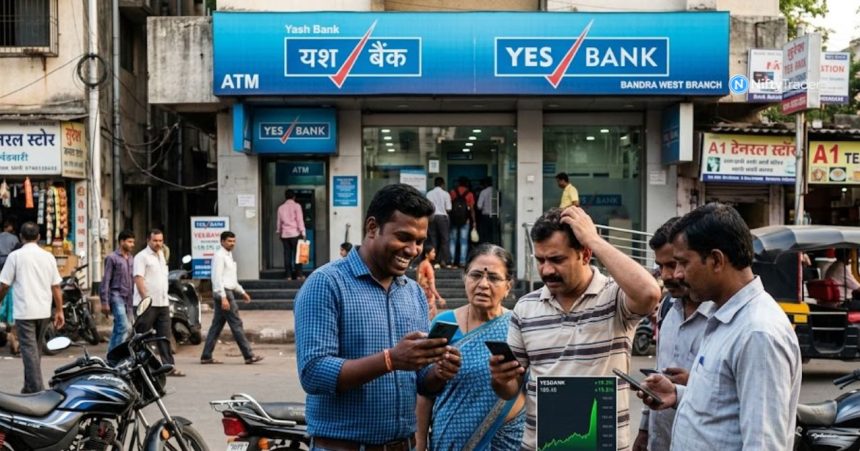
YES Bank’s latest earnings didn’t just print a beat; they reopened a debate the market thought was settled. The stock reaction has been noticeably uneven despite a ~45% YoY jump in net profit to ₹1,068 crore and ~16% NII growth, a divergence that signals something deeper than headline strength: positioning is still cautious, and conviction is not keeping pace with the numbers.
What stands out today is not the earnings itself, but the split between improving fundamentals and hesitant price action. While earnings momentum is clearly accelerating, multiple broker estimates and recent quarters suggest the market was already leaning into a recovery narrative, creating a setup where even strong results risk being partially “priced in” before confirmation.
What Triggered the Move
The immediate trigger came from a clean operating beat across key banking levers:
- Net profit surged ~45% YoY, crossing ₹1,000 crore mark again
- Net interest income rose ~16% YoY, showing core lending stability
- Broker expectations were broadly met or slightly exceeded in many models, with estimates clustering around ₹900–1,050 crore net profit range
- Loan growth and improving asset quality trends also supported sentiment, according to multiple brokerage previews
From a trading lens, this wasn’t a surprise breakout quarter; it was a confirmation quarter. And that matters, because confirmation phases often produce the most volatile reactions: buyers hesitate to chase, while profit-takers use strength to exit.
What the Market Is Really Signalling
Despite the strong print, the market reaction is revealing a classic expectation gap problem.
On one side, fundamentals are clearly improving:
- Lower provisioning pressure seen in broader sector trends
- Stable asset quality improving lender confidence
- Credit growth momentum gradually returning in the system
But on the other side, market memory is still heavy:
- Past volatility in YES Bank’s earnings cycle keeps institutional allocation selective
- Broker ratings remain mixed, with some still cautious on valuation sustainability
- Recovery narratives often face “prove-it-again” discounting behavior
This creates a tension loop: earnings are improving faster than trust is rebuilding. And in markets, trust usually lags fundamentals by several quarters.
There’s also a subtle forward-looking risk: if loan growth or margin stability slows even slightly in coming quarters, the current optimism could compress quickly. That asymmetry is why aggressive re-rating is not yet fully visible in price action.
What Traders Should Watch Next
The next move is less about this quarter and more about how positioning evolves around it:
- Follow-through buying vs fade: sustained accumulation would signal institutional acceptance of the turnaround
- Supply zones on rallies: repeated rejection near prior resistance would confirm distribution behavior
- Credit growth commentary: any slowdown in loan expansion could cap upside momentum
- Margin trajectory: NIM stability remains the most sensitive variable for re-rating
- Flow behavior: FII/DII participation will decide whether this becomes a trend or a trade
The setup is balanced but fragile. If sentiment improves even slightly, short covering can amplify upside quickly. If not, strong earnings could still end up being absorbed without meaningful trend continuation.
Final read: YES Bank is no longer in distress narrative mode, but it is not yet in conviction-led accumulation mode either. The gap between the two is where the next volatility cycle is likely to form.
Also Read: Bitcoin Hits 2-Month High at $78K, Yet Traders See a Hidden Reversal Risk Building
FAQs
Q1. Why did YES Bank stock not rally strongly after a 45% profit jump?
Despite strong earnings, the market had already priced in recovery expectations. The gap between improving results and cautious institutional positioning led to muted momentum.
Q2. What is driving the uncertainty around YES Bank’s recovery?
The main uncertainty is sustainability; traders are not fully convinced whether this earnings strength reflects a long-term trend or a short-term improvement cycle, creating hesitation in fresh buying.
Q3. Is the earnings beat enough to confirm a long-term turnaround?
Not yet. While profitability and NII growth are improving, the market is still looking for consistency over multiple quarters before assigning a full re-rating.
Q4. What is the key expectation gap in YES Bank’s results?
The expectation gap lies between strong headline profits and cautious price action. Investors expected improvement but not enough clarity on whether growth will sustain at this pace.
Q5. How are institutional investors reacting to the results?
Institutional participation appears selective. Some accumulation is visible, but overall positioning suggests partial confidence rather than aggressive long-term conviction.
Q6. What should traders watch next in YES Bank?
Key focus areas include loan growth momentum, margin stability, and whether the stock can hold gains above resistance levels without profit-booking pressure.
Q7. What is the forward-looking risk for YES Bank’s recovery story?
The main risk is a slowdown in credit expansion or margin compression. If either weakens, the current recovery narrative could lose momentum quickly, triggering volatility.