
A rare public spat has erupted between India’s two top financial institutions — the Reserve Bank of India (RBI) and the State Bank of India (SBI) — after a senior RBI official accused SBI’s economists of plagiarism on LinkedIn.
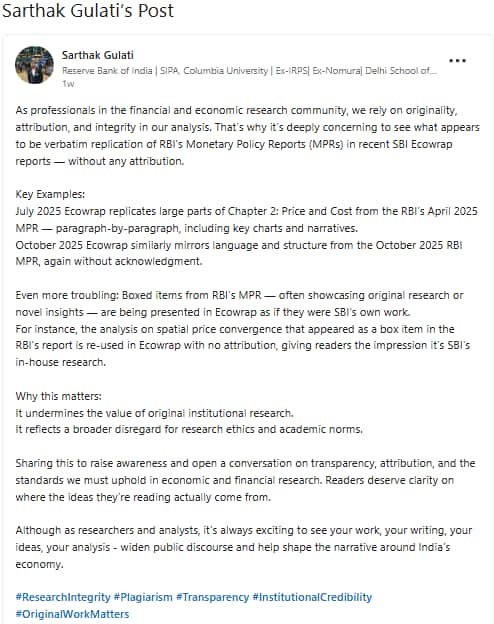
The controversy surfaced during the Diwali festivities, when Sarthak Gulati, Assistant General Manager at the RBI, published a detailed post alleging that the SBI economics team had copied key data, graphs, and charts from the central bank’s official Monetary Policy Reports (MPRs).
The Allegation by RBI’s Sarthak Gulati
In his LinkedIn post, Sarthak Gulati accused the SBI research team of replicating RBI’s monetary policy analysis in their Ecowrap reports without proper acknowledgment. Gulati described the situation as “deeply concerning,” emphasizing the importance of integrity and originality in professional economic research.
“As professionals in the financial and economic research community, we rely on originality, attribution, and integrity in our analysis,” Gulati wrote.
“That’s why it’s deeply concerning to see what appears to be verbatim replication of RBI’s Monetary Policy Reports (MPRs) in recent SBI Ecowrap reports — without any attribution,” he added.
The post included comparative data visuals, showing what Gulati claimed were identical charts and statistical representations between the two institutions’ publications. The accusation quickly gained traction among economists, analysts, and financial professionals on social media.
Also Read: Trump’s $300 Million White House Ballroom Backed by Corporate Titans
The Context: RBI and SBI Reports
Both the RBI’s Monetary Policy Report and SBI’s Ecowrap are widely followed publications in India’s financial community. The MPR, released periodically by the central bank, provides insights into economic conditions, inflation outlook, and monetary trends, while Ecowrap is SBI’s in-house economic and research publication, authored by its team of economists to interpret market and macroeconomic trends.
Gulati’s claim that SBI economists had copied “key data complete with graphs and charts” from RBI’s reports sparked an immediate debate over intellectual property and ethics in institutional research.
Social Media Reaction
The LinkedIn post quickly went viral, drawing reactions from banking professionals, economists, and policymakers. Many users expressed surprise at the rare public confrontation between two major financial entities.
While social media disagreements among individual economists are not uncommon, a dispute involving the RBI and SBI — the country’s central bank and largest lender, respectively — is an unusual and high-profile occurrence.
The post also triggered discussions about research ethics within public institutions and the responsibility of attribution in shared economic data and policy insights.
No Official Response Yet
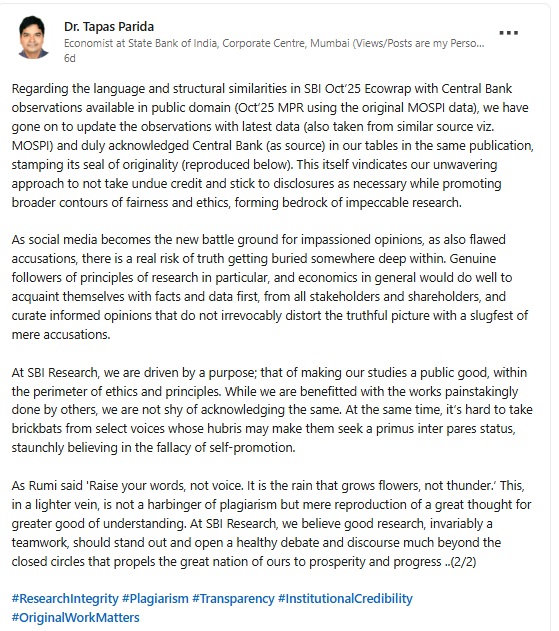
As of now, neither the RBI nor the SBI has issued an official statement regarding the allegations. The situation remains limited to the professional and social media space, though the incident has raised questions about how financial institutions handle data transparency, authorship, and accountability in their published analyses.
The post by Gulati continues to circulate widely on LinkedIn, where it has sparked debates over professional standards in financial research and the need for greater acknowledgment practices between institutions working on overlapping datasets.
Conclusion
The RBI vs SBI plagiarism row on LinkedIn has spotlighted an unexpected conflict between two of India’s most prominent financial bodies. With RBI’s Sarthak Gulati openly accusing SBI’s economists of copying sections of the Monetary Policy Report for their Ecowrap without credit, the matter has ignited broader conversations about intellectual honesty and academic rigor in economic research.
Until either institution issues a formal clarification, the dispute remains a reminder of how digital transparency and public accountability have reshaped professional boundaries in India’s financial ecosystem.
Click here to explore:
FII DII Data
IPO
BSE Sensex


