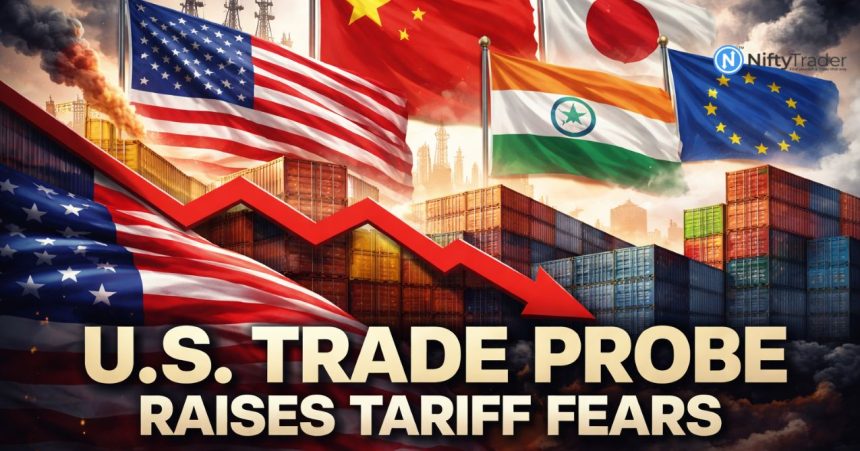
Global markets are once again facing the risk of escalating trade tensions after the United States launched a sweeping investigation into trade practices of 16 major economies, including India, China, Japan, and the European Union.
The probe, initiated under Section 301 of the Trade Act of 1974, gives the US government a pathway to impose fresh tariffs on imports if it determines that foreign trade practices harm American industries. Officials indicated the investigation could lead to new duties as early as this summer, a development that investors fear could disrupt global supply chains and weigh on export-driven sectors.
For markets, the move revives a familiar macro risk: the return of tariff escalation between major economies, which historically has triggered volatility across equities, currencies, and commodities.
What Just Happened
The administration of Donald Trump has launched a new set of trade investigations targeting 16 economies under Section 301, including the following:
-
India
-
China
-
European Union
-
Japan
-
South Korea
-
Mexico
-
Taiwan
-
Vietnam
-
Malaysia
-
Thailand
-
Singapore
-
Bangladesh
The investigation is being conducted by the Office of the United States Trade Representative and focuses on “structural excess industrial capacity” and trade practices that Washington believes disadvantage American manufacturers.
If the probe concludes that trading partners are unfairly supporting industries or flooding global markets with excess supply, the US government could impose retaliatory tariffs or other trade restrictions.
Why It Matters Right Now
For global investors, the probe comes at a sensitive moment when markets are already navigating slowing trade momentum and fragile supply chains.
Even the possibility of tariffs can influence market positioning because companies and investors start adjusting supply strategies long before duties are actually imposed.
In the near term, traders will be watching for:
• reactions from major trading partners, including China, the European Union and India
• signals from the US administration about the scope of potential tariffs
• early volatility in export-heavy sectors such as metals, electronics and autos
If tensions escalate, the development could once again turn trade policy into a key driver of global market sentiment, similar to the volatility seen during previous tariff disputes.
Why This Is Happening Now
The new probe follows a recent ruling by the Supreme Court of the United States that struck down key tariffs previously imposed under emergency powers.
That decision forced the administration to explore alternative legal tools to maintain pressure on trading partners. Launching a Section 301 investigation gives Washington a formal mechanism to review trade practices and potentially reintroduce tariffs through a legally structured process.
Officials say the investigation is aimed at addressing global overproduction in manufacturing sectors, which the US argues distorts prices and undermines domestic industry competitiveness.
Why Markets Care
For investors, the announcement reintroduces a major macro variable that has historically triggered market volatility.
1️⃣ Trade War Risks Could Resurface
Tariffs between major economies can escalate quickly into broader trade disputes. During previous trade conflicts, such measures triggered sharp moves in global equities and commodities as investors reassessed growth and export outlooks.
2️⃣ Global Supply Chains Could Shift
Modern manufacturing depends on cross-border supply networks. Tariffs can raise production costs, disrupt sourcing strategies, and force companies to relocate manufacturing bases.
3️⃣ Export-Heavy Economies May See Volatility
Countries that rely heavily on exports to the US could face pressure on currencies and equities if tariffs reduce competitiveness in American markets.
Sectors That Could See Market Impact
If the investigation leads to tariffs, several sectors could react quickly:
Manufacturing & Industrial Metals
Tariffs targeting excess capacity often focus on steel, aluminum and heavy industrial supply chains.
Electronics & Technology Hardware
Asian manufacturing hubs dominate the global electronics component ecosystem.
Auto & Auto Components
Automobile supply chains are deeply integrated across multiple countries and are frequently affected by tariff disputes.
Textiles & Apparel
Export-oriented economies such as Bangladesh and Vietnam rely heavily on US consumer demand.
What Happens Next
The Section 301 process typically unfolds in several stages:
-
Consultations with targeted countries
-
Public comments and hearings from businesses
-
Investigation findings and policy recommendations
-
Potential announcement of tariffs or trade restrictions
Officials indicated the review process could move relatively quickly, with possible decisions arriving before temporary tariff arrangements expire later this year.
The Bigger Global Trade Signal
Beyond the immediate tariff threat, the investigation highlights how trade policy is once again becoming a central market driver.
If tariffs are eventually imposed, the ripple effects could include:
-
retaliatory trade measures from affected economies
-
supply chain realignments across Asia and Europe
-
increased volatility in export-driven sectors
For traders and investors, the development is a reminder that policy decisions not just earnings or economic data, can rapidly reshape global market sentiment.
FAQs
What is the Section 301 investigation launched by the United States?
The investigation launched under the Section 301 of the Trade Act of 1974 allows the U.S. government to examine foreign trade practices that may harm American industries. If authorities conclude that certain countries are using unfair trade policies or creating excess industrial capacity, the United States can impose retaliatory tariffs or other trade restrictions.
Which countries are being investigated in the new U.S. trade probe?
The investigation targets 16 major trading economies, including India, China, Japan, the European Union, South Korea, Mexico, Taiwan, Vietnam, Malaysia, Thailand, Singapore, and Bangladesh. These economies play a critical role in global manufacturing and supply chains, which is why the probe is attracting strong attention from global investors.
Why are global markets concerned about the new U.S. trade investigation?
Markets are worried because the probe could lead to fresh tariffs on imports, potentially disrupting global supply chains. Historically, tariff disputes between major economies have triggered equity volatility, currency fluctuations, and commodity price swings, particularly in export-heavy sectors.
How could tariffs affect global supply chains?
If tariffs are imposed, companies may face higher import costs and supply disruptions. Manufacturers often respond by shifting production bases, redesigning supply chains, or passing costs to consumers, which can impact corporate earnings and global trade flows.
Which sectors could be most affected if new tariffs are imposed?
Several sectors are particularly sensitive to trade restrictions:
-
Industrial metals and manufacturing
-
Electronics and technology hardware
-
Automobiles and auto components
-
Textiles and apparel
These industries depend heavily on cross-border supply chains and U.S. consumer demand, making them vulnerable to tariff escalation.
When could the United States announce new tariffs?
Officials indicated that decisions could come as early as summer, although the investigation process includes consultations, hearings, and policy reviews before final action is taken. The timeline creates uncertainty for companies planning global production and trade strategies.
How could the trade investigation impact India’s economy and markets?
India could face export volatility if tariffs target sectors where it competes globally, such as manufacturing, engineering goods, and textiles. Indian markets may also react to broader shifts in global trade flows and investor sentiment if tensions escalate between major economies.
Could this investigation trigger a new global trade war?
It is still uncertain whether the probe will escalate into a broader trade conflict. However, if tariffs are imposed and other countries respond with retaliatory measures, global trade tensions could intensify, potentially affecting growth forecasts and market stability.
Why is the U.S. launching the investigation now?
The probe follows a ruling by the Supreme Court of the United States that struck down certain tariffs imposed under emergency powers. As a result, policymakers are turning to the legal framework of Section 301 of the Trade Act of 1974 to review trade practices and potentially reintroduce tariffs through a formal process.