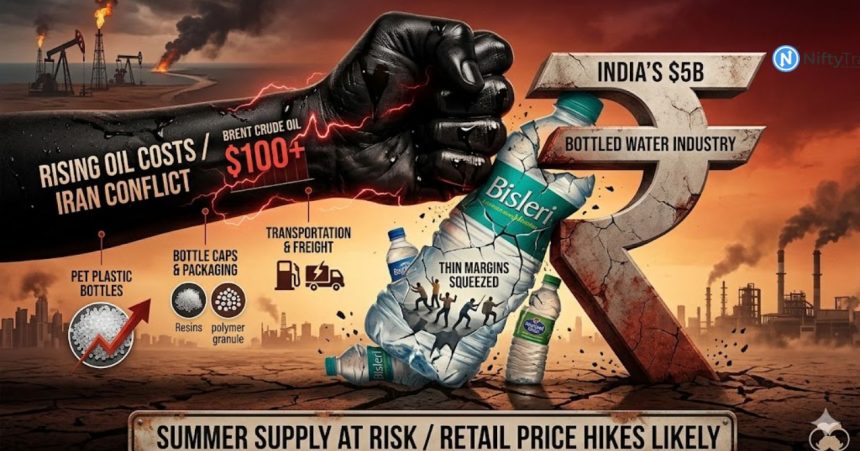
India’s $5-billion packaged drinking water industry is facing rising cost pressures as global crude oil prices spike following escalating tensions involving Iran, pushing up plastic packaging and transportation expenses across the supply chain.
The surge in oil prices is beginning to ripple through India’s consumer goods ecosystem, with bottled water manufacturers among the first to feel the impact. Higher crude prices raise the cost of petrochemicals used to produce plastic bottles, caps, and packaging materials, a key input for packaged water companies ahead of the peak summer demand season.
Industry participants say the cost pressures are already visible across the market, affecting both major brands such as Bisleri International and hundreds of regional bottlers that operate with thin margins.
What Just Changed
The immediate trigger is the sharp rise in global crude oil prices after the escalation of the Iran–Israel conflict escalation in the 2020s, which has heightened concerns about energy supply disruptions.
Brent crude has surged above the $100-per-barrel mark amid fears of disruptions near the Strait of Hormuz, one of the world’s most critical oil transit chokepoints that carries roughly one-fifth of global oil supply.
For India, which imports roughly 85% of its crude oil, higher energy prices quickly feed into domestic costs through fuel, freight, and petrochemical inputs.
Why the Bottled Water Industry Is Especially Exposed
Packaged drinking water companies rely heavily on petroleum-linked inputs throughout their supply chains.
Key cost components tied to crude prices include the following:
-
PET plastic bottles produced from petrochemical derivatives
-
Bottle caps and packaging films made from polymer resins
-
Fuel costs for transportation and distribution
When crude prices rise, polymer prices typically follow. That makes plastic packaging often the single largest cost component in bottled water significantly more expensive.
Industry estimates suggest packaging costs in several consumer goods segments have already risen 15–20% due to higher polymer prices, putting pressure on manufacturers’ margins.
A Fast-Growing but Margin-Sensitive Market
India’s packaged drinking water market has expanded rapidly over the past decade, driven by:
-
Rising urbanization
-
Increasing travel and tourism activity
-
Growing consumer demand for safe and hygienic drinking water
The sector, estimated at roughly $5 billion, includes large national brands as well as thousands of regional bottlers that supply hotels, restaurants, offices, and retail stores.
Despite strong demand growth, the industry typically operates on relatively thin margins, making it highly sensitive to sudden spikes in input costs.
Early Signs of Price Pressure
Industry associations say wholesale prices for packaged drinking water have already started rising as raw material and logistics costs increase.
Some distributors have reported higher supply prices, although most companies have not yet raised consumer retail prices.
Manufacturers may respond through a mix of strategies, such as:
-
Gradual price hikes during peak summer demand
-
Reducing distributor margins
-
Adjusting bottle sizes or packaging formats
If crude prices remain elevated, retail price increases could follow later in the season.
Why It Matters for Markets Today
The bottled water industry’s cost pressures are an early signal of a broader challenge building across India’s consumer goods sector.
Higher crude prices affect multiple cost components simultaneously, including:
-
Plastic packaging
-
Freight and logistics
-
Energy and manufacturing costs
For investors and traders, the development highlights several market signals:
FMCG Margin Risk:
Consumer companies heavily dependent on plastic packaging may face margin pressure if crude prices stay elevated.
Packaging and Petrochemical Demand:
Producers of PET resin, polymer granules, and packaging materials could see strong demand but volatile input costs.
Logistics Cost Inflation:
Fuel-driven freight increases may raise distribution costs across India’s retail supply chains.
Energy Sector Upside:
Higher crude prices often support earnings for upstream oil and gas companies while creating headwinds for downstream consumer sectors.
The Bigger Macro Risk
Rising oil prices also carry broader macroeconomic implications for India’s economy.
Sustained crude price increases could:
-
Push up inflation
-
Increase import bills
-
Pressure the Indian rupee
-
Raise operating costs across multiple industries
Sectors such as aviation, logistics, chemicals, and consumer goods are typically the most sensitive to oil price shocks.
What Traders Should Watch Next
Markets will be watching several key indicators in the coming weeks:
-
Global crude oil prices and Middle East geopolitical developments
-
Polymer and packaging material price trends
-
Pricing actions by FMCG and beverage companies
-
Inflation data and fuel policy decisions in India
For now, many bottled water producers are absorbing part of the cost shock. But if crude prices remain elevated through the peak summer season, price increases across bottled water and other packaged consumer goods may become difficult to avoid.
FAQs
Q1: Why are bottled water prices rising in India?
Rising crude oil prices from the Iran conflict are increasing costs for PET bottles, packaging, and transportation, pressuring India’s $5B bottled water market.
Q2: Which Indian bottled water brands are affected?
Major brands like Bisleri International and regional suppliers are impacted due to higher plastic, polymer, and logistics costs.
Q3: How much of India’s crude oil is imported?
India imports over 80–90% of its crude oil, making domestic industries like bottled water highly sensitive to global oil price spikes.
Q4: Will bottled water prices increase immediately?
Some distributors have already raised supply costs, and manufacturers may implement gradual price hikes or smaller bottle sizes if oil prices stay high.
Q5: How does the Iran conflict affect India’s FMCG sector?
Higher crude raises packaging and transport costs, squeezing margins for FMCG companies and pressuring consumer goods pricing.
Q6: What should traders and investors watch?
Monitor global crude prices, Middle East geopolitical developments, polymer costs, FMCG pricing strategies, and India’s inflation/fuel policy updates.