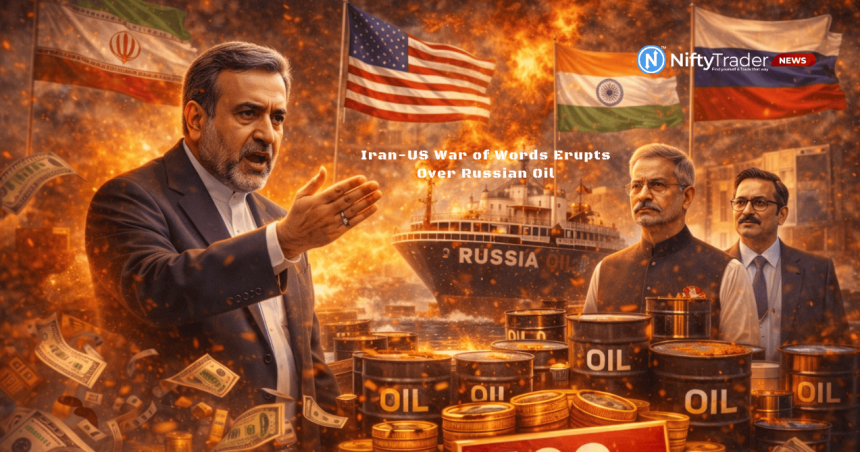
Iran Questions US Oil Policy Shift — Could the Oil Shock Trigger Fresh Volatility in Global and Indian Markets?
A fresh geopolitical confrontation between Iran and the United States has sent ripples across global energy markets, intensifying concerns about oil supply disruptions and potential economic spillovers. The dispute has emerged at a time when crude oil prices have already surged above $100 per barrel, a psychologically significant level that often signals stress in global energy supply chains.
Iran’s sharp criticism of Washington’s stance on Russian crude has added another layer of uncertainty to the already fragile geopolitical landscape in West Asia. Markets are increasingly sensitive to developments in the region because it sits at the heart of the global oil trade.
For India — which imports nearly 85% of its crude oil requirements — any sustained rise in oil prices has direct consequences for inflation, currency stability and corporate profitability. As a result, the unfolding diplomatic tension is not merely a political story; it has become a market-moving development that traders, fund managers and policymakers are closely watching.
Also Check :
Iran Accuses the US of Hypocrisy Over Russian Oil Purchases
Iran’s Foreign Minister Seyed Abbas Araghchi strongly criticised Washington’s evolving policy toward Russian oil exports, arguing that the US has reversed its stance within weeks due to the pressures created by rising global oil prices.
“The US spent months on bullying India into ending oil imports from Russia. After two weeks of war with Iran, the White House is now begging the world — including India — to buy Russian crude,” Araghchi wrote in a post on social media platform X.
He also criticised European governments that supported Washington’s geopolitical approach.
“Europe thought backing illegal war on Iran would win US support against Russia. Pathetic,” he added.
Araghchi’s remarks were accompanied by a Financial Times report suggesting that rising crude prices are significantly boosting Russia’s oil revenues despite Western sanctions. The situation highlights a broader contradiction in global energy policy: attempts to isolate a major oil producer can tighten global supply and push prices higher, ultimately benefiting the very exporters targeted by sanctions.
For energy markets, such policy reversals create uncertainty and increase price volatility, especially during periods of geopolitical tension.
Why Washington Allowed Limited Russian Oil Purchases Again
The controversy intensified after the US administration introduced a temporary 30-day waiver allowing certain Russian oil cargoes to be purchased, despite earlier restrictions.
The decision reflects the growing pressure policymakers face when global energy markets tighten. With crude prices climbing above $100 per barrel due to supply disruptions linked to the West Asia conflict, the risk of a broader energy shock has increased.
US Treasury Secretary Scott Bessent acknowledged that India had earlier complied with Washington’s request to limit purchases of Russian oil.
“The Indians had been very good actors. We had asked them to stop buying sanctioned Russian oil this fall. They did,” Bessent said.
He explained that the waiver was introduced primarily to allow refiners — including those in India — to buy Russian cargoes that had been stranded at sea due to sanctions-related complications. According to Bessent, Washington could consider allowing additional barrels into the market if global supply pressures intensify further.
This shift illustrates how geopolitical realities and market stability often force governments to adjust earlier sanctions or trade restrictions.
Strait of Hormuz Tensions Intensify Global Energy Supply Risks
Another key factor behind the surge in crude prices is the rising tension surrounding the Strait of Hormuz, one of the world’s most critical maritime energy corridors.
Nearly one-fifth of global oil shipments pass through the narrow waterway, connecting the Persian Gulf to international markets. Any disruption in this route immediately raises alarms across global energy markets.
Iran’s actions and the broader conflict in West Asia have heightened fears that shipping routes could face prolonged disruptions. Energy traders, shipping companies and governments are therefore closely monitoring developments in the region.
However, Iran’s Ambassador to India Mohammad Fathali attempted to calm concerns about potential disruptions to Indian oil shipments.
“Yes. Because India and I are friends. We believe that Iran and India are friends. We have common interests and a common fate,” Fathali said when asked whether Indian-bound ships would receive safe passage.
While the assurance provides some diplomatic comfort, markets remain cautious because even limited disruptions around the Strait of Hormuz can significantly influence global oil prices.
Here’s What Happened Today and Why Traders Reacted
Financial markets reacted to a series of interconnected geopolitical and economic developments that unfolded within a short period. Traders tend to respond quickly when oil supply risks emerge because energy prices influence inflation, interest rates and corporate earnings expectations.
Several developments shaped market sentiment today:
• Iran publicly accused the US of reversing its position on Russian oil imports
• Crude oil prices climbed above $100 per barrel amid supply fears
• The US introduced a temporary waiver allowing Russian oil cargo purchases
• Shipping risks increased due to tensions around the Strait of Hormuz
• Rising geopolitical uncertainty triggered volatility across commodity markets
These developments triggered cautious sentiment among traders as energy costs play a crucial role in shaping global economic expectations.
Impact on Indian Stock Market and Key Sectoral Movements
For the Indian stock market, rising crude prices often create a mixed impact across sectors. While energy producers may benefit from higher prices, industries that depend heavily on fuel tend to face margin pressure.
Sectors likely to face near-term pressure include:
• Aviation companies due to rising aviation turbine fuel costs
• Paint and chemical manufacturers dependent on petrochemical inputs
• Transportation and logistics firms experiencing higher operating costs
At the same time, some sectors could benefit from rising oil prices.
Potential beneficiaries include:
• Oil exploration and production companies
• Upstream energy companies
• Select refining companies with strong margins
Market participants often respond to such developments by shifting capital toward sectors expected to benefit from rising energy prices.
What the Oil Price Surge Means for Traders and Investor Portfolios
For investors, the current geopolitical developments serve as a reminder of how quickly external shocks can influence financial markets. Crude oil prices affect a wide range of economic variables including inflation, currency movements and central bank policy decisions.
If oil prices remain elevated for an extended period, several macroeconomic risks could emerge.
Key risks investors should monitor include:
• Higher inflation due to increased fuel costs
• Pressure on the Indian rupee because of rising oil import bills
• Potential changes in interest rate expectations
• Increased volatility in equity markets
For portfolio management, diversification and sectoral allocation become especially important during such phases of geopolitical uncertainty.
Investors with exposure to oil-sensitive sectors may experience short-term fluctuations, while companies linked to energy production could benefit from improved earnings outlooks.
The Key Market Question: Is the Oil Rally Temporary or the Start of a New Cycle?
The central question for global markets now is whether the current surge in crude prices represents a short-term geopolitical disruption or the beginning of a longer oil price cycle.
Historically, conflicts involving key oil-producing regions or strategic shipping routes have led to prolonged volatility in energy markets. If tensions in West Asia persist or shipping disruptions around the Strait of Hormuz intensify, global supply could remain constrained.
For India, such a scenario could influence inflation trends, fiscal planning and corporate profitability across multiple sectors.
In the coming weeks, traders and investors will closely monitor diplomatic developments, oil supply conditions and global crude price movements. These factors will ultimately determine whether the current geopolitical crisis becomes a temporary market shock or a defining turning point for global energy markets and investor sentiment.