What Just Changed
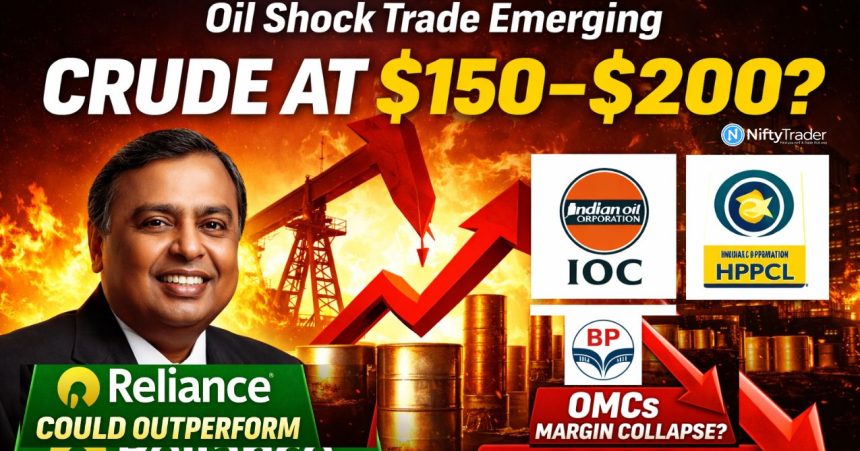
Markets are no longer treating a high crude oil scenario as a distant macro risk. With geopolitical tensions rising and supply routes increasingly vulnerable, traders are beginning to price in the possibility of oil moving toward $125, $150, or even higher in a serious disruption scenario.
This matters now because crude has already climbed sharply in recent weeks, and the conversation has shifted from “can oil rise?” to “which sectors break first if it does?” That makes this less of a commodity story and more of a market structure story.
Why Markets Care Right Now
For India, oil is not just another input cost. The country imports roughly 85–90% of its crude needs, which means any sustained rise in oil quickly feeds into the following:
-
inflation pressure
-
weaker corporate margins
-
higher fiscal stress
-
sharper sector divergence across the market
That is why the crude risk is no longer theoretical. Once oil starts moving into the $100–$125 zone, markets begin repricing earnings, policy risk, and relative sector winners and losers.
The key shift is this: the market is not reacting to oil headlines alone anymore; it is beginning to price the possibility of a high-oil regime.
Who Holds Up, Who Gets Hit
1) Reliance Industries — Better Positioned Than Most
Reliance stands out because it is not a one-dimensional oil play. Its business mix gives it both upstream and refining exposure, which makes it structurally more balanced in a rising crude environment.
-
Refining margins can improve as crude rises
-
Upstream earnings also benefit from higher prices
-
Integrated operations help cushion the shock better than pure downstream names
That said, Reliance is not a direct high-beta crude beneficiary. Some of the upside gets diluted through hedging, business mix, and broader margin offsets.
Market takeaway:
Reliance looks more like a relative safety play within the energy space than a pure oil trade. In a high-crude market, that alone can make it attractive.
2) ONGC and Upstream Players — Beneficiaries, But Not Clean Winners
At first glance, rising oil should be a clear positive for upstream names like ONGC. But the market structure is more complicated.
-
Realisations do not fully move in line with global crude
-
Effective price caps and policy constraints can limit upside
-
PSU dynamics often reduce the direct benefit investors expect
There is also a second layer of risk: weaker downstream subsidiaries can drag consolidated earnings and blunt the headline benefit of higher oil.
Market takeaway:
ONGC may gain from higher crude, but probably less than the market initially assumes. This is a beneficiary story, just not an unlimited one.
3) OMCs (IOC, BPCL, HPCL) — The Maximum Stress Zone
This is where the real pain starts to show.
Oil marketing companies are the most exposed because rising crude directly lifts their raw material costs, while retail fuel prices often do not adjust fast enough to protect margins.
That creates a difficult setup:
-
input costs rise sharply
-
marketing margins get squeezed
-
cash flow visibility weakens
-
government intervention risk goes up
If crude remains elevated, OMCs also face rising subsidy risk, especially around LPG and politically sensitive fuel pricing.
In recent sessions, this vulnerability has already started showing up in price action, with OMCs underperforming as investors reassess margin risk.
Market takeaway:
If crude sustains above $100–$125, OMCs remain the most vulnerable pocket in the energy chain.
4) Gas and LNG Players — The Underestimated Risk
One of the least-discussed but most important risks sits in the gas value chain.
A large share of India’s LNG flows remains exposed to the Strait of Hormuz, which means any supply disruption there can hit both availability and pricing.
Key exposure points include:
-
Petronet LNG — high import route sensitivity
-
Gujarat State Petronet — meaningful exposure
-
GAIL — relatively better diversified, but not insulated
The risk is not just supply. A sharp crude rise also hits industrial demand, especially if gas becomes uneconomical for key users.
In a prolonged shock scenario, this creates a double problem:
-
supply-side stress
-
demand-side pressure
Market takeaway:
Gas-linked names could face a far more complex earnings squeeze than the market is currently discounting.
The Risk Escalation Zone: Why $100, $125, and $150 Matter
The market’s reaction to oil is unlikely to be linear.
Below $100
Pressure builds, but the system can still absorb it.
Around $125
The pain becomes broader:
-
margins compress more visibly
-
inflation pressure rises
-
fiscal flexibility narrows
-
sector rotation becomes sharper
At $150 and above
This becomes a full market and policy problem:
-
government response becomes more likely
-
taxes/subsidies become active variables
-
earnings downgrades spread wider
-
market leadership changes fast
The real issue is not just the price of oil itself; it is the point at which oil begins forcing policy action, demand destruction, and earnings repricing at the same time.
What Traders Should Watch Now
This is where the setup becomes actionable.
1) Crude holding above key levels
A brief spike is one thing. A sustained move above $100 is where earnings risk starts entering equity pricing more seriously. If crude starts pushing toward $125, broader market stress becomes harder to ignore.
2) Government response
Watch for:
-
fuel price adjustments
-
subsidy announcements
-
excise duty or tax changes
-
any signalling aimed at cushioning retail pain
These decisions will directly affect how much damage reaches corporate margins.
3) Sector rotation
This is likely to be the clearest market expression of the oil shock trade.
Watch for:
-
relative strength in integrated players like Reliance
-
continued weakness in OMCs
-
pressure in gas and industrial demand-linked names
The trade may not be “buy energy” broadly; it may be owning the right energy exposure and avoiding the wrong one.
4) Supply-route risk
Any escalation around the Strait of Hormuz or broader Middle East shipping routes can rapidly turn a gradual crude rally into a pricing shock.
This is the trigger traders cannot afford to ignore.
Bottom Line
This is not just an oil story anymore. It is a sector-divergence story.
The same trigger, rising crude, does not hit every energy-linked stock the same way:
-
Reliance looks like the relative stability play
-
ONGC benefits, but with limits
-
OMCs sit in the highest-risk zone
-
Gas players face both supply and demand pressure
Final Take
The real market shift is this: investors are no longer reacting only to oil spikes; they are beginning to position for the possibility of a higher-oil regime. Once that happens, the trade is no longer about crude alone. It becomes about which business models can absorb the shock and which cannot.
FAQs
1. Why is the $200 oil scenario becoming a serious market discussion?
Rising geopolitical tensions, especially around critical supply routes, have increased uncertainty in global oil supply. Markets are now actively modelling extreme scenarios as crude prices trend higher, creating an expectation gap between current pricing and potential risk.
2. Which Indian sectors benefit the most from rising crude oil prices?
Integrated energy players like Reliance tend to benefit due to refining and upstream exposure. However, gains are moderated, making them relative outperformers rather than direct high-beta plays.
3. Why are Oil Marketing Companies (OMCs) most vulnerable in a high oil environment?
OMCs face rising input costs without immediate pass-through to retail prices. This creates margin pressure and cash flow stress and increases the risk of government intervention, especially above the $125 oil level.
4. Do upstream companies like ONGC fully benefit from higher crude prices?
Not entirely. Realisations are often capped due to policy and pricing structures, which limits upside despite rising global crude prices. This creates a mismatch between market expectations and actual earnings growth.
5. How does high crude oil impact India’s overall economy?
India imports the majority of its oil, so rising crude leads to higher inflation, increased fiscal burden, and pressure on corporate profitability. This can slow economic growth and impact market sentiment.
6. What is the biggest hidden risk in the current oil rally?
Gas and LNG supply disruptions, especially via critical routes like the Strait of Hormuz, pose a major risk. A supply shock combined with falling industrial demand could hit volumes and pricing simultaneously.
7. At what crude levels do markets start reacting sharply?
-
Around $100: Early signs of stress
-
Around $125: System-wide pressure builds
-
Above $150: Policy intervention risk rises
-
Near $200: Severe macro and market disruption possible
8. How should traders position themselves in a rising oil price environment?
Traders typically rotate toward relatively stable integrated players while avoiding sectors with margin sensitivity. Monitoring crude price trends, government actions, and supply risks is critical.
9. What role does government policy play in oil-driven market moves?
Government actions like fuel price controls, tax cuts, or subsidies can significantly alter sector profitability, especially for OMCs, making policy a key forward-looking risk factor.
10. Is the market fully pricing in a high oil regime yet?
Not completely. While early positioning is visible, there remains uncertainty around how sustained the rally will be. This creates volatility and opportunity as markets adjust to evolving supply and geopolitical risks.