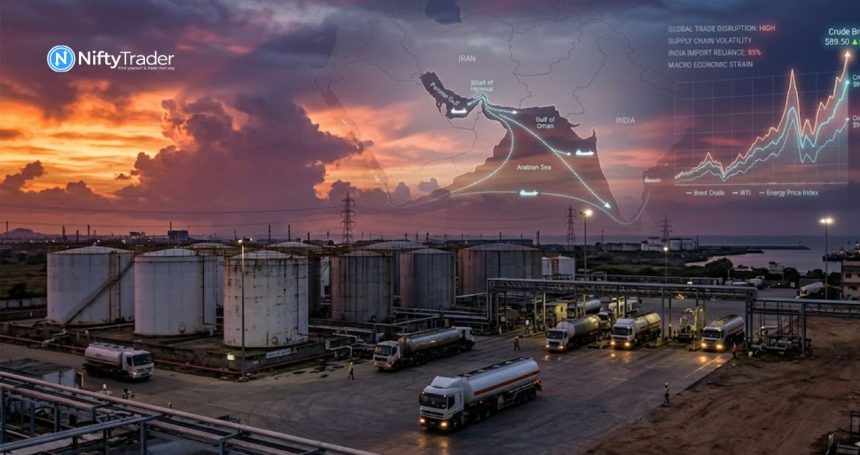
India’s energy cost shock is no longer theoretical.
In a sharp and immediate move, oil companies have raised industrial diesel prices by nearly ₹22 per litre (around 25%) for bulk buyers as global crude prices surge amid escalating tensions in the Iran war.
This is one of the fastest and steepest increases in recent years, and it’s already beginning to ripple through sectors that depend heavily on fuel.
What Just Changed And Why It Matters Now
- Industrial diesel (used by factories, logistics players, generators) has seen a sudden ₹22/litre spike
- The increase comes directly from a global crude oil surge triggered by supply disruptions
- Unlike retail petrol/diesel, bulk fuel pricing adjusts faster, making it an early signal
👉 Translation for markets:
This is the first real domestic transmission of the global oil shock into India’s economy.
Why Prices Are Rising So Fast
The trigger is global, but the impact is now local.
- The ongoing conflict has disrupted oil flows from the Middle East, a region that supplies a large portion of global crude
- Shipping routes like the Strait of Hormuz critical for energy trade, are under pressure
- Global oil prices have already crossed $100 per barrel and remain volatile
For India, which imports the majority of its crude oil, this creates a direct cost pass-through risk.
Immediate Sector Impact
1. Logistics & Transport
- Diesel is the backbone of trucking, rail freight, and supply chains
- Higher fuel costs = higher freight rates
- Expect pressure on:
- Logistics companies
- E-commerce delivery margins
- FMCG distribution costs
2. Manufacturing & MSMEs
- Many factories rely on diesel for the following:
- Backup power (generators)
- Machinery operations
Rising fuel costs:
- Increase input costs sharply
- Compress margins for small and mid-sized businesses
- Already, industrial clusters are reporting cost pressure from rising energy inputs
3. Chemicals, Plastics & Textiles
- These sectors are indirectly tied to crude derivatives
- Diesel cost surge → logistics + raw material inflation
➡️ Result: Dual pressure from input cost + transportation cost
4. Inflation-Sensitive Sectors
This is where the macro signal becomes critical.
Higher diesel prices can feed into the following:
- Food prices (transport)
- Construction costs
- Consumer goods pricing
➡️ That means inflation risk rises again, complicating the rate outlook.
Why Retail Fuel Prices Haven’t Moved (Yet)
Interestingly, petrol and diesel at the pump haven’t seen the same spike.
That’s because:
- Oil companies often absorb volatility temporarily
- Government may delay pass-through for retail consumers
But bulk fuel hikes usually come before retail adjustments, so markets treat this as an early warning signal.
What Smart Money Is Watching Now
Traders and investors are focusing on:
1. Will crude sustain above $100–110?
- Sustained levels could force wider fuel price increases
2. Inflation trajectory
- Higher fuel → higher CPI → possible policy implications
3. Sector rotation
- Pressure on:
- Consumption plays
- Transport-heavy businesses
- Relative resilience in:
- Energy producers
- Oil marketing companies (depending on pricing dynamics)
Bigger Macro Signal: This Isn’t Just About Fuel
Globally, the energy shock is already
- Raising inflation expectations
- Slowing growth outlook
- Triggering emergency energy measures in some economies
For India:
- Higher oil prices can widen the current account deficit
- Put pressure on the rupee
- Increase fiscal balancing challenges
The Real Takeaway
This isn’t just a diesel price hike.
It’s the first visible crack showing how a global geopolitical shock is entering India’s real economy.
- The move is sharp
- The transmission has begun
- And the second-order effects inflation, margins, and demand, are still ahead
Bottom Line
The ₹22/litre diesel spike is not just a cost change; it’s a market signal.
When fuel costs move this sharply, the impact rarely stays limited to energy.
It spreads:
- across sectors
- into earnings
- and eventually into market sentiment
The real question now is not whether prices have risen but how far this ripple will go across the economy and markets.
Also Read:
Hormuz Shock Threatens India’s Oil Supply — 1.7 Million Tonnes of Cargo Trapped in Shipping Freeze
Frequently Asked Questions
Q1. Why did industrial fuel prices rise suddenly in India?
Bulk diesel prices adjust quickly to global crude movements, especially when supply routes tighten and import costs rise.
Q2. Does this immediately affect retail petrol and diesel prices?
Not always. Retail prices often lag because companies absorb short-term volatility before passing it to consumers.
Q3. Which sectors feel the first impact of higher diesel costs?
Logistics, manufacturing units, MSMEs, and freight-heavy industries typically see the earliest margin pressure.
Q4. Can this fuel spike increase inflation in India?
Yes, higher transport and energy costs can gradually feed into food, goods, and services inflation.
Q5. What could decide the next market reaction?
Crude stability, currency movement, and how long supply pressure persists in global shipping routes.