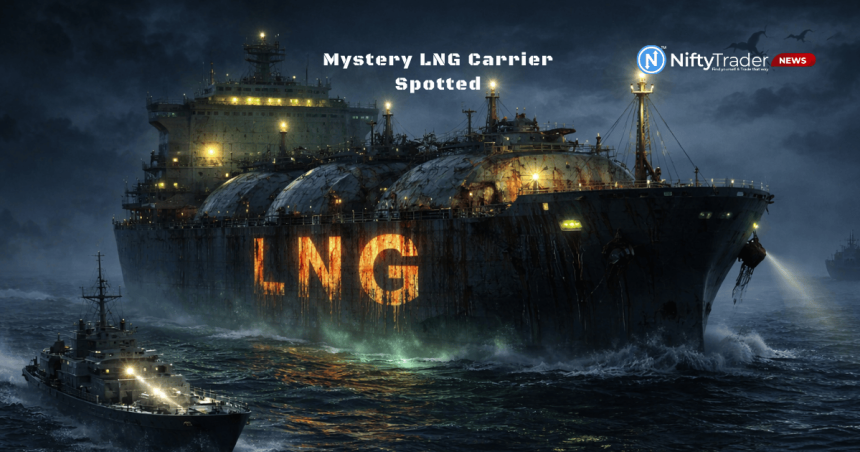
A vessel posing as a scrapped LNG carrier raises fresh concerns over maritime security in the Gulf
In a striking development that underscores the growing complexity of maritime risks in the Middle East, a vessel suspected to be a “zombie ship”—a ship operating under a false identity—has reportedly transited the Strait of Hormuz, one of the world’s most critical energy chokepoints.
The vessel, identifying itself as liquefied natural gas (LNG) carrier Jamal, exited the strait on Friday morning, according to ship-tracking data. However, market intelligence and port records suggest a startling contradiction—the real Jamal had already been beached at an Indian ship-breaking yard in October last year, where it is currently being dismantled.
This raises a serious question: Who—or what—actually crossed the Strait of Hormuz under Jamal’s identity?
Also Check :
A ‘zombie vessel’ emerges as shipping risks escalate in the Gulf
The vessel in question is believed to be a “zombie ship”, a term used for ships that assume the identity of decommissioned or scrapped vessels to evade scrutiny or bypass restrictions.
This incident is particularly significant because:
- It marks the first known use of a zombie vessel to transit Hormuz during the ongoing conflict
- It signals a shift toward more covert and deceptive shipping tactics
- It highlights how operators are adapting to extreme geopolitical risks
The Strait of Hormuz has become increasingly dangerous amid Iranian threats and attacks, leading to a near standstill in normal shipping activity. In such an environment, unconventional methods are beginning to emerge.
Read More : Free Seats, Costly Flights? Airlines Push Back as Govt’s 60% Seat Rule Sparks Pricing Debate
Here’s what happened and why this incident is raising alarms
The sequence of events surrounding the vessel adds to the mystery:
- A ship identifying as LNG carrier Jamal appeared in tracking systems
- It initially signaled a destination of Sohar, Oman on March 13
- The vessel then went “dark,” ceasing transmissions temporarily
- It reappeared near Sharjah on March 20 with no clear destination
- It was last tracked off the southeastern coast of Iran
Crucially, the real Jamal had already been scrapped months earlier, making this identity highly suspicious.
This pattern—appearance, disappearance, and re-emergence—is typical of vessels attempting to mask their true identity and movement.
Why the use of a fake LNG carrier identity is unusual
While “dark shipping” and identity manipulation are not new in sanctioned oil trades, the use of an LNG carrier identity is particularly noteworthy.
LNG vessels are:
- Highly specialised and technologically advanced
- Limited in number compared to crude tankers
- Closely tracked due to their strategic importance
The use of such an identity suggests a deliberate attempt to exploit the credibility and rarity of LNG carriers to avoid scrutiny.
Market participants note that such tactics have rarely been seen in LNG trade, making this case highly unusual.
Hormuz turns into a high-risk zone as war disrupts normal shipping
The backdrop to this incident is the escalating conflict in the Middle East, which has significantly disrupted shipping through the Strait of Hormuz.
Key developments include:
- Iranian threats targeting vessels leaving the Gulf
- Sharp decline in tanker movement through the strait
- Increased insurance and security risks for ship operators
- Growing congestion as vessels wait for safe passage
As a result, shipping activity has slowed dramatically, with only a handful of vessels managing to transit—often after securing approval from regional authorities.
Growing use of covert tactics signals deeper disruption in global trade
The emergence of a zombie vessel highlights a broader shift in maritime behavior:
- Ships are increasingly turning off tracking systems (“going dark”)
- Electronic interference is disrupting location signals
- False identities are being used to navigate high-risk zones
These tactics point to a fragmentation of transparency in global shipping, where tracking systems can no longer be fully relied upon.
Experts warn that this could complicate:
- Monitoring of global oil and gas flows
- Enforcement of sanctions
- Risk assessment for insurers and regulators
Limited number of vessels crossing Hormuz under strict conditions
Apart from vessels linked to Iran, only a few ships have successfully crossed the strait in recent days.
- Some vessels reportedly secured approval from Tehran
- Countries like India and Turkey have negotiated safe passage for select ships
- Japan has also received assurances for its vessels
This indicates that access to the strait is becoming increasingly controlled and conditional, further tightening global energy supply routes.
Ownership and identity trail adds to the mystery
According to maritime databases:
- Jamal’s manager is listed as Resurgence Ship Management Pvt. Ltd., Mumbai
- The registered owner is Liner Shipping Inc., sharing the same address
However, there has been no official response from the company regarding the vessel’s identity or the reported transit.
This lack of clarity adds another layer of uncertainty, making it difficult to verify whether the vessel is:
- A legitimate ship misidentified
- A sanctioned vessel masking its identity
- Or a deliberately disguised “ghost” ship
What does this mean for global markets and investors?
The incident has significant implications for global markets, particularly energy and shipping sectors.
For energy markets:
- Increased risk premium in oil and LNG prices
- Greater uncertainty around supply flows
- Potential for sudden price spikes
For investors:
- Volatility in energy and shipping stocks
- Heightened geopolitical risk exposure
- Increased focus on supply chain resilience
The situation reinforces the idea that geopolitical risks are directly influencing market dynamics.
The bigger picture: A new era of opaque and high-risk shipping
The appearance of a zombie vessel in one of the world’s most critical shipping lanes signals a deeper transformation in global trade dynamics.
As conflict intensifies:
- Transparency in shipping is diminishing
- Risk mitigation strategies are becoming more complex
- Traditional tracking and monitoring systems are being challenged
This marks a shift toward a more opaque and fragmented global logistics environment.
Final takeaway: A warning sign for markets and policymakers
The “zombie ship” incident is more than a maritime anomaly—it is a warning signal about the evolving nature of global trade risks.
As geopolitical tensions rise and supply routes become increasingly uncertain, unconventional tactics like identity masking could become more common.
For markets, this means one thing:
uncertainty is no longer just about supply and demand—it’s about visibility and trust in the system itself.
In such an environment, investors and policymakers alike must prepare for a world where even tracking a ship may not reveal the full story.