Swiggy’s ₹17.58 Fee Move Mirrors Zomato — A Small Price Change That Signals a Big Shift in Profit Strategy
Swiggy Raises Platform Fee to ₹17.58, Quietly Aligning with Zomato’s Pricing Strategy
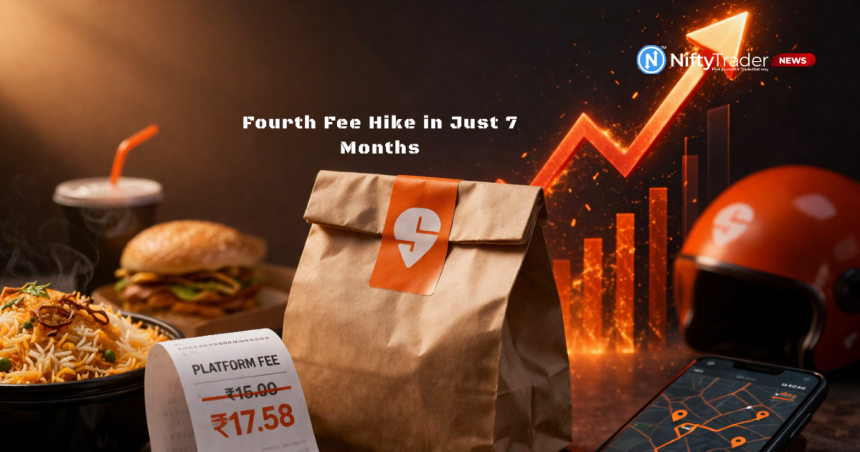
India’s food delivery duopoly is once again moving in sync. Swiggy has raised its platform fee by nearly 17% to ₹17.58 per order, up from ₹14.99—marking its fourth increase in just seven months.
The move comes shortly after Zomato revised its effective platform fee to the same level of ₹17.58 (including GST).
While the pricing structures differ—Zomato splits base fee and GST, while Swiggy shows a combined figure—the outcome for users is identical. This convergence is not coincidental; it reflects a deliberate shift from price competition to disciplined monetisation.
“This is no longer about undercutting each other—it’s about building sustainable margins,” said a digital economy analyst.
Also Check :
A Series of Fee Hikes Reveals a Clear Pattern of Margin Expansion
What stands out is not just the hike, but the frequency. Swiggy has now increased its platform fee four times in seven months, signaling a consistent recalibration of its revenue model.
The journey has been sharp:
- 2023: Platform fee began at ~₹2
- September 2025: Zomato at ₹12, Swiggy at ₹14
- 2026: Both converge at ₹17.58
This steady escalation highlights how a once negligible charge has evolved into a meaningful and scalable revenue stream.
Why Food Delivery Giants Are Leaning Heavily on Platform Fees
The logic behind these increases is rooted in structural challenges within the food delivery business. Growth remains strong, but profitability has been elusive.
Key drivers behind the shift include:
- Restaurant resistance to higher commissions, limiting B2B monetisation
- High delivery and logistics costs, especially in peak demand periods
- Intensifying competition, including low-cost and quick-commerce models
- Need for predictable, recurring revenue streams
As a result, companies are increasingly turning to user-facing charges as a stable lever.
“Platform fees are low-friction monetisation tools—they don’t disrupt demand immediately but scale efficiently,” noted a sector expert.
Here’s What Happened Today and Why Traders Reacted
Today’s development is less about the absolute fee and more about what it signals. The synchronized pricing by Swiggy and Zomato indicates:
- A reduced focus on aggressive discounting
- A clear pivot toward profitability and unit economics
- Growing confidence that users will absorb incremental costs
Traders interpreted this as a positive signal for margin expansion, particularly in a sector that has long been scrutinized for cash burn.
However, the reaction is nuanced. While profitability prospects improve, concerns linger around demand elasticity if fees continue to rise.
Impact on Users: Small Increase, Gradual Behavioral Shift
At ₹17.58 per order, the platform fee remains a small portion of the total bill. But repeated hikes can subtly reshape consumer behaviour over time.
India’s food delivery ecosystem processes 4.3–4.5 million orders daily, meaning even a ₹2–₹3 increase can generate substantial incremental revenue annually.
So far, demand resilience suggests:
- Convenience outweighs minor cost increases
- Users are relatively price-insensitive at low increments
But there is a threshold. If cumulative charges—delivery fee, surge pricing, and platform fee—rise further, ordering frequency could moderate.
Impact on Investors: Profitability Narrative Gains Strength
For investors, this move carries more weight than it appears.
What’s Positive:
- Higher per-order revenue without major cost additions
- Improved unit economics and operating leverage
- Strengthens the long-term profitability narrative
What Needs Watching:
- Customer retention amid rising cumulative costs
- Competitive disruption from lower-cost alternatives
- Regulatory or public pushback on pricing transparency
Overall, the development reinforces a key theme: food delivery companies are transitioning from growth stories to profit-driven businesses.
A Broader Industry Shift: Platform Fees Become Core Revenue Drivers
This trend is not isolated. Across digital commerce—whether ecommerce, ticketing, or fashion—platform fees are becoming standard practice.
Industry estimates suggest these charges contribute ₹3,500–₹4,000 crore annually, underlining their growing significance.
The shift marks a structural evolution:
- From subsidised growth models
- To sustainable, user-funded monetisation
What Lies Ahead: Incremental Hikes Likely, But Carefully Calibrated
The latest hike suggests that both Swiggy and Zomato are testing the upper limits of consumer tolerance.
Going forward, expect:
- Gradual, incremental fee increases rather than sharp jumps
- Greater focus on profitability metrics over order volume growth
- Continued alignment in pricing strategies between major players
“The real test will be how far companies can push pricing without impacting order frequency,” said a market observer.
The Bottom Line: A Subtle Shift with Big Market Implications
What appears to be a minor ₹2–₹3 increase is, in reality, a reflection of a larger strategic pivot in India’s startup ecosystem.
Swiggy and Zomato are signaling that the era of aggressive discounting is fading. In its place, a more disciplined, profitability-focused model is emerging—one where every order contributes more meaningfully to the bottom line.
For investors and traders, this is a crucial inflection point. The question is no longer how fast these companies can grow—but how efficiently they can convert that growth into sustainable profits.