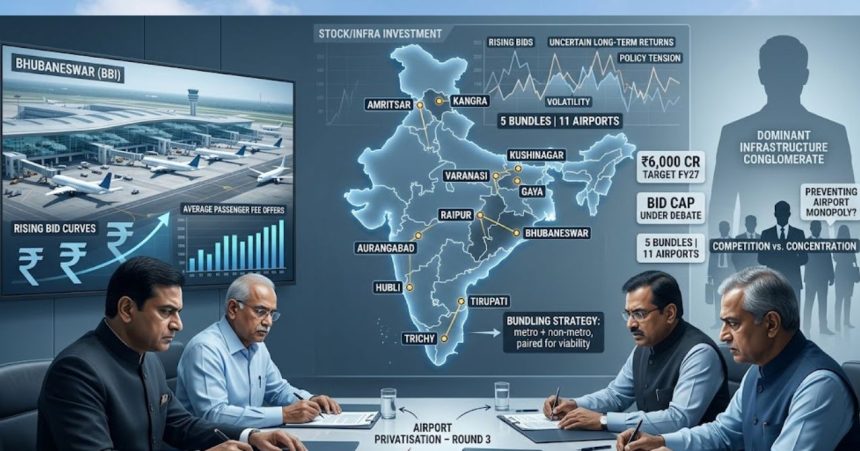
The Finance Ministry and Cabinet Secretariat are pushing to cap the number of airports a single entity can win in India’s third round of airport privatisation, which covers 11 Airports Authority of India (AAI) facilities grouped into five bundled packages. The move, still under inter-ministerial debate, would directly constrain Adani Group, which already operates six of India’s eight long-term PPP airports, including Ahmedabad, Jaipur, Lucknow, Mangaluru, Guwahati, and Thiruvananthapuram, from repeating that sweep. The government aims to raise ₹6,000 crore in FY2026–27 from the leases to fund AAI’s expansion programme.
The Inter-Ministry Standoff
The civil aviation ministry and AAI have framed rules that allow any entity to bid for all five bundled packages. The Finance Ministry and the Cabinet Secretariat want that changed. This is not a new fight. In 2018, the Department of Economic Affairs (DEA) explicitly recommended that “no more than two airports be awarded to the same bidder,” citing the high capital intensity of airport projects and the risk of concentrating performance obligations. The Committee of Secretaries overruled that recommendation, and Adani Group went on to win all six airports in the 2019–20 round, offering bids that were in some cases double the second-highest offer (₹177 per passenger for Ahmedabad versus the next-best bid).
The 2018 DEA note, reviewed by Business Standard, stated that awarding airports to different operators would “facilitate yardstick competition,” the ability to benchmark one operator’s performance against another’s. That argument is now back on the table, with the Cabinet Secretariat giving clear directions to rework the rules before requests for proposals are issued.
What Is Being Privatised
The 11 airports are bundled into five packages. Confirmed pairings include Amritsar with Kangra, and Varanasi with Kushinagar and Gaya. Other airports in the list include Bhubaneswar, Hubli, Raipur, Aurangabad (Chhatrapati Sambhajinagar), Tiruchirapalli, and Tirupati. Each package pairs a larger airport handling up to one million passengers annually with one or more smaller facilities. The bundling structure is designed to make lower-traffic airports commercially viable by tying them to higher-volume assets.
Five airport operators have expressed preliminary interest, according to officials in the Ministry of Civil Aviation. Named potential bidders include Adani Group, GMR Airports, Vinci Airports (France), and infrastructure investment firm NIIF. Several global private equity funds have also shown interest. Airports will be awarded to the bidder offering the highest revenue share per passenger to AAI, a bid parameter chosen specifically for transparency, and a return to the model used in 2018 after criticism that the per-passenger fee structure in the 2019–20 round gave aggressive bidders room to overcommit and then recover costs through passenger levies.
The Adani Precedent and Why It Matters
In the 2019–20 round, Adani bid ₹115 per passenger for Mangaluru, while the nearest competitor bid ₹45 per passenger, a gap of 155%. Rating agency ICRA estimated at the time that AAI would earn more than ₹600 crore per year from the Adani Group alone. The aggressive bids, however, came with a downstream consequence: airport tariffs at privatised facilities rose sharply in subsequent years, as operators sought to recover the per-passenger commitments through user development charges regulated by the Airport Economic Regulatory Authority (AERA).
The finance ministry’s concern is structural: if Adani, or any single group, wins all five packages in this round, India’s private airport sector becomes a near-monopoly outside Delhi and Mumbai, both separately structured with limited ability for the government to benchmark service quality or negotiate from a position of regulatory strength.
Timeline and What Comes Next
The Public Private Partnership Appraisal Committee (PPPAC) is expected to clear the proposal within two months, after which requests for proposals will be issued. The final decision on whether a bid cap will be written into the RFP rests with the Cabinet Secretariat. Until that call is made, the privatisation process remains on hold.
Under the National Monetisation Pipeline, privatisation of 25 airports was projected to generate over ₹20,000 crore. Aviation has lagged behind roads and railways in meeting those targets. The ₹6,000 crore FY27 target from this round represents a meaningful step toward closing that gap but only if the bidding structure is finalised and competition concerns are resolved before the window for this financial year closes.
Also Read: Maruti Revenue Hits Record ₹52,462 Cr; Bajaj Finance, Airtel Q4 Results Today
Frequently Asked Questions
1. Why is the government considering a cap on airport bids?
The Finance Ministry and Cabinet Secretariat are concerned that allowing one group to win all 11 airports, as Adani did in the 2019–20 round, creates a near-monopoly in private airport operations outside Delhi and Mumbai, reduces the government’s ability to benchmark performance, and creates bad optics. The DEA made the same recommendation in 2018, was overruled, and is now reviving the argument.
2. Which 11 airports are being privatised in this round?
The airports include Amritsar, Kangra, Varanasi, Kushinagar, Gaya, Bhubaneswar, Hubli, Raipur, Aurangabad (Chhatrapati Sambhajinagar), Tiruchirapalli, and Tirupati, grouped into five bundled packages. The official final list has not been released by the government.
3. How much money does the government expect to raise?
The government targets ₹6,000 crore in FY2026–27 from the airport leases to fund AAI’s expansion and new asset creation. Under the broader National Monetisation Pipeline, privatisation of 25 airports was projected to generate over ₹20,000 crore in total.
4. Can Adani Group bid for all 11 airports?
Under the current rules framed by the civil aviation ministry and AAI, yes. But the Finance Ministry and Cabinet Secretariat are pressing for a cap potentially limiting any single entity to two of the five packages, mirroring the 2018 DEA recommendation that was overruled. No final decision has been taken.
5. When will the bids actually be invited?
The PPPAC must first clear the proposal, expected within two months of the current date. Only after PPPAC approval and Cabinet sign-off will requests for proposals be issued. A bid cap decision must come before that, or it cannot be written into the tender conditions.