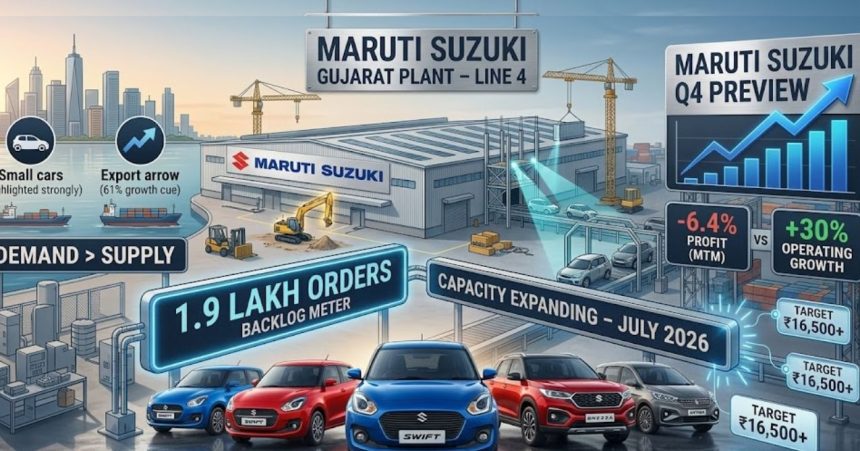
QUICK SUMMARY: Maruti Q4 consolidated profit fell 6.4% to ₹3,659 crore on a ₹1,028 crore non-cash MTM hit. Revenue hit an all-time high of ₹52,462 crore (+28.2% YoY). The 1.9-lakh order backlog 1.3 lakh in small cars will start clearing when the Gujarat fourth line goes live in July 2026. Stock trades at ₹13,565 , 22% below its ₹17,370 peak. JM Financial targets ₹16,570 (+23% upside).
Maruti Suzuki Q4 FY26 Results at a Glance
| Metric | Q4 FY26 | Q4 FY25 | Change |
|---|---|---|---|
| Consolidated Revenue | ₹52,462 crore | ₹40,920 crore | +28.2% YoY |
| Standalone Revenue | ₹50,078.7 crore | ₹38,839.1 crore | +28.9% YoY |
| Consolidated Net Profit | ₹3,659 crore | ₹3,911 crore | -6.4% YoY |
| Standalone Net Profit | ₹3,590.5 crore | ₹3,857.3 crore | -6.9% YoY |
| Operating EBITDA | ₹6,156.9 crore | ₹4,844 crore | +27.1% YoY |
| Operating Profit (EBIT) | ₹4,409.2 crore | ₹3,381 crore | +30.4% YoY |
| Total Sales Volume | 6,76,209 units | 6,04,635 units | +11.8% YoY |
| Export Volumes | 1,37,215 units | 85,089 units | +61.3% YoY |
| Order Backlog (year-end) | ~1,90,000 units | — | — |
| Dealer Inventory | ~12 days | ~30 days (industry norm) | Critically lean |
| FY26 Annual PAT (standalone) | ₹14,445.4 crore | ₹14,297.6 crore | +1% YoY |
| Final Dividend | ₹140/share | ₹135/share | Highest ever |
Source: Maruti Suzuki India exchange filings, April 28, 2026; Bajaj Broking; Business Standard
Why Did Maruti’s Q4 Profit Fall Despite Record Revenue?

Also Read: TCS, Titan, Tata Power: Tata Trusts May 8 Analysis
This is the question every investor is searching for right now. The answer is precise and non-recurring.
Maruti’s operating performance was the strongest in its history this quarter, operating profit up 30.4% YoY to ₹4,409.2 crore, EBITDA up 27.1% to ₹6,156.9 crore. The profit fall had nothing to do with operations.
The culprit was a collapse in other income (non-operating): from ₹1,528 crore in Q4 FY25 to ₹500 crore in Q4 FY26, a ₹1,028 crore swing caused entirely by a mark-to-market (MTM) impact on Maruti’s bond portfolio as yields moved against the company’s treasury positions. Tax expenses simultaneously rose from ₹1,005 crore to ₹1,245 crore, per Outlook Business. The company clarified this was a notional, unrealised loss, recoverable as bond yields normalise.
JM Financial noted that operating margins benefited from: lower discounts (-50 bps), favourable forex (+30 bps), and fixed cost absorption from inventory accretion (+50 bps), partially offset by higher commodity costs (+80 bps), model launch costs (+60 bps), and other seasonal expenses, per Business Standard. The operating margin headwinds are real but temporary. The MTM hit is the entire story behind the headline profit miss.
The market initially sold the headline. By the next session, it had read the detail, the stock recovered 4.5% to ₹13,565 .
The 1.9-Lakh Order Backlog: The Number That Changes Everything
Maruti ended FY26 with approximately 1,90,000 pending customer orders against dealer inventory of just ~12 days’ stock, versus the industry norm of 30 days. That lean inventory with a 1.9-lakh backlog means one thing: demand is structurally exceeding supply.
What makes this backlog extraordinary is its composition. Nearly 1,30,000 of those 1,90,000 pending orders are in the small car segment, the 18% GST bracket, per the company’s own press release. This directly contradicts the dominant bear narrative of the past two years: that small cars are in structural decline as Indian consumers migrate permanently to SUVs.
The GST cut in September 2025 (from 28% to 18% on small petrol/CNG and diesel cars) triggered a demand response that analysts underestimated. After a marginal 0.4% decline in PV industry volumes in H1 FY26, the market rebounded 20.5% in Q3. Maruti outperformed industry growth of 15.1% with retail volumes up 16.3% YoY, recovering ~170 basis points of market share to reach 40.9%, per Trade Brains.
A 1,30,000-unit backlog in the segment everyone wrote off is not noise. It is a structural demand signal with a specific, datable catalyst: the GST reform.
Maruti Suzuki Share Price: Why the 25% Selloff May Have Been the Setup
Maruti’s stock hit its 52-week high of ₹17,370 on January 5, 2026, since then it fell to a multi-month low of ₹11,289, a 35% peak-to-trough drawdown. The three drivers of that selloff are well-documented:
1. Market share at 13-year low. Maruti’s overall PV share stands at ~41% in FY26, down from 48% at its peak, a 13-year low per Outlook Business, with the sharpest erosion in the ₹10–20 lakh SUV segment where Hyundai, Tata, and Mahindra have built dominant positions.
2. FII relentless selling. FII holdings declined 164 basis points QoQ to 14.12% from 15.76% in December 2025, per MarketsMojo. Foreign investors rotated out of Maruti as EV transition anxiety peaked.
3. Cautious Q3 guidance misread. The market interpreted Q3 FY26’s conservative commentary as evidence of structural margin trouble. Q4’s record operating profit has now challenged that read directly.
The stock currently trades at ₹13,565 , 22% above its multi-month low, 22% below its 52-week peak, and approximately 13x FY27 estimated earnings. The wealth erosion from peak to trough wiped out approximately ₹1.32 lakh crore in market capitalisation, per Kotak Neo.
The July 2026 Event: Why Gujarat’s Fourth Line Is the Real Catalyst
The market has been pricing Maruti as if demand is the constraint. It isn’t. The constraint is production capacity, and it is being removed on a specific, confirmed date.
Current total installed capacity is approximately 2.6 million units per annum following Kharkhoda’s commissioning. Two simultaneous additions are now underway:
Kharkhoda Phase 2 (April 2026): The second assembly line at Kharkhoda in Haryana was commissioned in April 2026, adding 2,50,000 units per year, confirmed by R.C. Bhargava in his Business Standard interaction.
Gujarat Line 4 (July 2026): The fourth production line at Hansalpur, Gujarat goes live in Q2 FY27, adding another 2,50,000 units annually at a cost of ₹3,200 crore, pushing the Gujarat facility from 7,50,000 to 10,00,000 units per year, per Autopunditz.
Together these additions push total capacity toward approximately 2.85 million units, a nearly 22% jump in under twelve months. Once the Gujarat line is live, the 1,90,000-unit backlog converts directly and immediately into deliverable revenue. That is why July 2026 is the single most important date for Maruti shareholders between now and the Q2 FY27 earnings call.
Management has guided 10% domestic volume growth for FY27 and earmarked a record ₹14,000 crore capex, its highest ever, to fund this ramp, per Upstox. Chairman R.C. Bhargava told Business Standard that production ramping across Kharkhoda and Gujarat combined would add 5 lakh units of annual capacity by end of FY27.
Maruti Suzuki Exports: The Overlooked Outperformer
While domestic attention fixated on the profit miss, the export story delivered its strongest quarter on record.
Exports rose 61.3% YoY in Q4 to 1,37,215 units, the highest ever quarterly export volume. Full-year FY26 exports reached 4,47,774 units, making Maruti India’s top passenger vehicle exporter for the fifth consecutive year, accounting for 49% of total Indian PV exports, per the company’s exchange filing.
Maruti’s first battery EV, the e-Vitara, was shipped to 44 countries in FY26. The Gujarat plant is now the global production hub for the e-Vitara, priced from ₹15.99 lakh to ₹19.79 lakh domestically, or ₹10.99 lakh under the Battery-as-a-Service scheme at ₹3.99/km, per Autocar India. Current waiting period for the e-Vitara is 6–8 weeks; the July Gujarat line expansion is specifically designed to scale EV output alongside conventional models.
Maruti’s longer-term export ambition: 7.5–8 lakh units by FY31, implying a ~25% volume CAGR from FY25 levels.
Maruti Suzuki FY26 Dividend: Record ₹140 Per Share — Key Dates
The board recommended a final dividend of ₹140 per share for FY26, the highest payout in the company’s history, up from ₹135 per share in FY25.
- Record Date: August 7, 2026
- Payment Date: September 9, 2026
- Face Value: ₹5 per share
- Total Dividend Outflow: ₹44,016 million (~₹4,400 crore), per exchange filings
Investors must hold shares before the August 7 record date to receive the dividend. At the current price of ₹13,565, the ₹140 dividend yields approximately 1.03%.
Analyst Targets on Maruti Suzuki After Q4 FY26
| Brokerage | Rating | Target Price | Implied Upside vs ₹13,565 |
|---|---|---|---|
| JM Financial | Buy | ₹16,570 | +22.8% |
| Elara Securities | Buy | ₹16,546 | +22.6% |
| Motilal Oswal | Buy | ₹15,529 | +15.1% |
| Axis Securities / Axis Direct | Buy | ₹14,620 | +8.3% |
| Choice Institutional Equities | Add | ₹14,600 | +8.2% |
| Jefferies | Cautious | Below consensus | — |
JM Financial expects a 16% earnings CAGR over FY26–28. Elara Securities values at 26x June 2028 EPS. Axis Direct values at 26x FY28E EPS. 38 brokerages carry an Outperform rating with an average 12-month target of ~₹16,897, per Whalesbook.
Jefferies is the outlier, flagging persistent concerns about Maruti’s ability to significantly increase domestic market share and profitability even as overall PV demand stays strong. That is a structural concern, not a near-term one.
What the Q4 Numbers Reveal About FY27
Three forward-looking signals buried in the Q4 data that most coverage missed:
1. April 2026 already confirms the FY27 thesis. Maruti sold 2,39,646 units in April 2026 — its highest-ever monthly sales — with domestic sales hitting 1,91,122 units, per Screener. The backlog conversion is already beginning.
2. Kharkhoda Phase 2 is live. The second Kharkhoda assembly line was commissioned in April 2026. This is the first of two capacity additions, the July Gujarat line is the second. By Q2 FY27, both will be running.
3. ₹14,000 crore capex signals management conviction. A company that allocates its highest-ever capital expenditure in the year it posts a profit dip is signalling that management’s conviction in FY27 demand is unshaken by one MTM quarter.
The story has shifted: from “Maruti is structurally declining” to “Maruti is production-constrained in a confirmed demand boom, and the July 2026 Gujarat line is the specific event that removes the constraint.”
Also Read: Maruti Suzuki NSE Stock Price Today
FAQ
Q: Why did Maruti Q4 profit fall despite record revenue?
The operating business posted record results, EBITDA up 27.1%, operating profit up 30.4%. The standalone profit fell 6.9% because other income (non-operating) collapsed from ₹1,528 crore to ₹500 crore, a ₹1,028 crore MTM hit on treasury bond positions as yields rose. This is non-cash and notional, recoverable when yields normalise. It had zero relationship to car sales, margins, or the core business.
Q: What is Maruti’s order backlog in FY26 and why does it matter?
Maruti ended FY26 with ~1,90,000 pending customer orders, of which ~1,30,000 are in the small car segment (18% GST bracket). Dealer inventory stands at just ~12 days vs the industry norm of ~30 days. The constraint is entirely on the supply side, all existing plants are at 100% utilisation. The 1.9-lakh backlog converts directly into deliverable revenue once the Kharkhoda Phase 2 (April 2026) and Gujarat Line 4 (July 2026) additions ramp up.
Q: What is the Maruti Suzuki share price target after Q4 results?
Post-Q4 broker targets: JM Financial ₹16,570 (Buy), Elara Securities ₹16,546 (Buy), Motilal Oswal ₹15,529 (Buy), Axis Direct ₹14,620 (Buy), Choice Equities ₹14,600 (Add). Average consensus across 38 brokerages is ~₹16,897. The stock trades at ₹13,565 , the average target implies ~25% upside.
Q: What is the Maruti Suzuki dividend record date and payment date for FY26?
The board declared a final dividend of ₹140 per share for FY26, the highest ever. Record date: August 7, 2026. Payment date: September 9, 2026. Investors must hold shares before August 7 to qualify.
Q: When does the Maruti Gujarat plant fourth line go live and how much capacity does it add?
The fourth production line at the Hansalpur, Gujarat plant is scheduled to go live in Q2 FY27 — July 2026. It adds 2,50,000 units per year at a cost of ₹3,200 crore, pushing Gujarat facility capacity from 7,50,000 to 10,00,000 units annually. Combined with the Kharkhoda Phase 2 already commissioned in April 2026, total new capacity by end-FY27 reaches 5 lakh units, per R.C. Bhargava’s statement to Business Standard.
Q: Is Maruti Suzuki a good buy after Q4 results?
Not investment advice, but the analyst data is: 38 brokerages rate it Outperform with a consensus target of ~₹16,897. The bull case rests on three specific events: (1) July 2026 Gujarat line clearing the 1.9-lakh backlog, (2) small car demand holding post-GST cut, and (3) FY27 export volumes sustaining above 4 lakh units. The bear case (Jefferies) questions whether domestic market share can recover from the 13-year low of 41% against structurally stronger SUV competition. Consult a SEBI-registered advisor before acting.
BOTTOM LINE FOR INVESTORS: Maruti’s Q4 profit miss was 100% non-cash and non-operational. The operating business posted record metrics. The 1.9-lakh order backlog in a supply-constrained market, 1.3 lakh of them in small cars, is the strongest forward demand signal the company has reported in three years. The July 2026 Gujarat line commissioning is the single event that converts this backlog thesis into delivered revenue. JM Financial’s ₹16,570 target implies 23% upside from current levels. The dividend record date is August 7, 2026.
Disclaimer: This article is for informational purposes only. It does not constitute investment advice. Investors should consult a SEBI-registered financial adviser before making investment decisions. Data sourced from Maruti Suzuki India exchange filings (April 28, 2026), Business Standard, Bajaj Broking, Autopunditz, Outlook Business, Autocar India, Kotak Neo, Trade Brains, and Upstox.