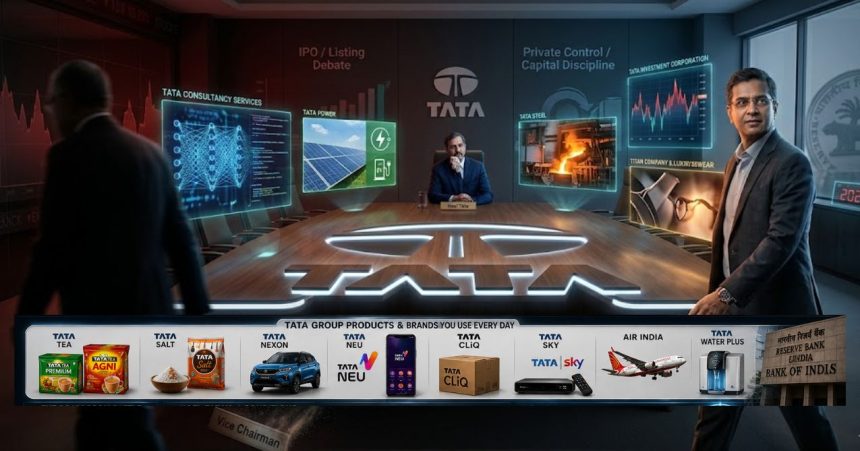
Tata Trusts will meet on May 8 to remove Venu Srinivasan as a nominee director on the Tata Sons board and replace him with Bhaskar Bhat, 71, the former managing director of Titan Company, people familiar with the matter told Moneycontrol. The two main Tata Trusts, Sir Dorabji Tata Trust and Sir Ratan Tata Trust, together hold a 52% majority stake in Tata Sons, making this the most consequential governance decision at India’s largest conglomerate since Ratan Tata handed the chairmanship to Cyrus Mistry in 2012.
Also Read: TATA STEEL NSE Stock Price Today
The Listing Fault Line That Broke the Consensus
The primary ground for Srinivasan’s removal is a public break from a position that trustees had unanimously agreed on: keeping Tata Sons private. Both Srinivasan and fellow vice-chairman Vijay Singh endorsed a Tata Sons IPO in media interviews, arguing the group needs capital to absorb mounting group losses. A majority of trustees continue to favour retaining the private structure and view the public shift as a significant departure from an earlier unanimous decision, per Moneycontrol sources.
At the February 24 Tata Sons board meeting, Tata Trusts chairman Noel Tata raised the issue of losses in certain group companies and asked N. Chandrasekaran to commit in writing that Tata Sons will never be listed. That demand was not met. Chandrasekaran instead sought a deferral of his reappointment decision to allow for wider consultation, leaving the group’s leadership structure unresolved for over two months.
The May 8 meeting is where Noel Tata intends to brief the full body of trustees on those February 24 discussions, including losses at Air India and Tata Digital, long-term planning requirements, and succession at Tata Sons.
Srinivasan Out, Vice-Chairman Role Gone Entirely
The personnel change is significant. The structural change is more so.
Along with Srinivasan’s exit, the Trusts are considering abolishing the vice-chairman designation altogether, a title currently shared by Srinivasan and Singh. This is not just about removing individuals. Eliminating the role dismantles the formal platform through which a minority view can be elevated inside the Tata Sons governance structure. Without the designation, there is no institutional mechanism for dissenting trustees to exert influence at the board level. Proxy advisory firm InGovern, which has separately urged the RBI to reject Tata Sons’ deregistration request, has noted that governance clarity at the Trust level is directly linked to accountability on the Tata Sons board.
The Trusts currently have two of their three permitted nominee slots filled, Noel Tata and Srinivasan. The third has been vacant since Vijay Singh left the Tata Sons board in September 2025. Bhat’s nomination would restore full nominee strength and shift the internal composition entirely toward Noel Tata’s position.
Who Is Bhaskar Bhat
Bhat was inducted as a trustee of the Sir Dorabji Tata Trust in November 2025, a move Moneycontrol reported as a deliberate alignment shift, with Bhat widely seen as close to Noel Tata. His track record is specific: he joined the Tata Watch Project in the early 1980s and spent nearly two decades as MD of Titan, during which the company expanded from a watch manufacturer into India’s largest organised jewellery, eyewear, and lifestyle accessories business. He also served on the board of Tata Digital.
Tata Sons holds a 71.75% stake in TCS and a 35.80% stake in Tata Motors, businesses whose strategic direction Bhat, if elevated to the Tata Sons board, would now formally oversee.
The Chandrasekaran Problem
Noel Tata has outlined four conditions before any reappointment extension for Chandrasekaran can be finalised: Tata Sons must remain unlisted; the holding company must stay debt-free; a long-term business plan must be presented; and succession planning must be addressed.
Air India’s losses of ₹20,500 crore in FY26 and the resignation of CEO Campbell Wilson have added pressure, with Noel Tata reportedly seeking a committed turnaround timeline. Other board members have argued that early-stage greenfield losses are normal for capital-intensive projects. That disagreement remains unresolved ahead of May 8.
The RBI Variable Nobody Can Override
Here is where internal trust politics hits a regulatory constraint that neither Noel Tata nor Srinivasan controls.
InGovern has urged the RBI to reject Tata Sons’ deregistration request and direct it to list by March 2027, arguing that the RBI’s April 2026 framework, which sets a ₹1 lakh crore asset threshold for Upper Layer NBFC classification—makes Tata Sons’ inclusion automatic and non-discretionary. Tata Sons had attempted to surrender its Core Investment Company registration after repaying over ₹20,000 crore in standalone debt. InGovern described the deregistration application as “substantively and procedurally deficient.”
The position is clear: regardless of what trustees decide on May 8, a March 2027 regulatory listing deadline now exists on paper. What the May 8 meeting actually determines is who controls how that outcome is managed, not whether it happens.
5 Stocks Directly Exposed — With Numbers
Titan Company ⬆ Clearest Winner
Bhat’s nomination makes Titan the most directly affected stock this week. He built the company from a watch manufacturer into a ₹3-lakh-crore jewellery and lifestyle conglomerate; his elevation to the Tata Sons board is a governance signal of strategic continuity for the brand. Mutual funds raised their Titan stake to 8.43% in recent months, buying a net ₹458 crore, following 46% year-on-year growth in Titan’s jewellery segment in Q4 FY26. Analyst consensus 12-month target stands at ₹4,200–4,600, with MOFSL at ₹4,400 and YES Securities at ₹4,600.
Tata Investment Corporation (TATAINVEST) ⬆ Highest Re-Rating Headroom
The fastest-moving proxy for any Tata Sons governance headline. When Chandrasekaran’s reappointment was deferred in February, TATAINVEST fell 2.94% to ₹668 in a single session. As of May 4, 2026, the stock trades at ₹715, against a 52-week high of ₹1,184.70 and a 52-week low of ₹538.85, placing it 40% below its yearly peak. A positive resolution on May 8 carries significant re-rating headroom.
TCS ➡ Insulated from Governance Noise
Tata Sons holds approximately 71.7% of TCS, making it the largest single contributor to the group’s listed portfolio value. YES Securities has a Buy rating with a target of ₹3,534, citing strong AI deal momentum into FY27. Equirus Securities upgraded to Long with a target of ₹2,945. Governance instability at Tata Sons does not change TCS’s earnings trajectory; it affects only the holding company discount applied to TCS’s implied value.
Tata Steel ➡ Secondary Listing Play
Tata Steel owns a 3.06% stake in Tata Sons. A forced listing would assign a public market value to that holding, potentially triggering a balance sheet re-rating. Anand Rathi has a Buy with a target of ₹240; ICICI Securities targets ₹226. The stock has returned 58% over the past year, per Master Capital Services.
Tata Power ➡ Secondary Listing Play
Tata Power holds a 1.65% stake in Tata Sons, giving it direct valuation exposure to any listing event. Mutual funds net-bought ₹442 crore worth of Tata Power in March 2026, raising institutional stake to 9.14%.
The verdict: Of the five, Titan benefits most directly, Bhat’s elevation is a governance endorsement of the brand he built over two decades. TATAINVEST carries the highest re-rating potential, given it trades 40% below its 52-week peak. TCS is insulated from governance noise. Tata Steel and Tata Power are positioning trades on a Tata Sons listing that the RBI may ultimately force regardless of what any trustee decides.
Also Read: TATA INVESTMENT CORPORATION NSE Stock Price Today
FAQ
Q: Will the May 8 Tata Trusts meeting force a Tata Sons IPO decision?
No, but it will clarify who controls the decision. The internal meeting addresses board nominees, not a formal IPO vote. The binding constraint is the RBI’s April 2026 framework, which sets a ₹1 lakh crore asset threshold for Upper Layer NBFC classification, placing Tata Sons on a compliance path toward a March 2027 listing deadline. Trustees can oppose it internally; they cannot override the RBI.
Q: Can Noel Tata remove Chandrasekaran at this meeting?
Not directly. May 8 is a trustees’ meeting, not a Tata Sons board meeting. Noel Tata’s leverage over Chandrasekaran’s reappointment lies in controlling the Trust nominees on the Tata Sons board. With Bhat replacing Srinivasan, the nominee bloc would be fully aligned with Noel Tata, strengthening his position ahead of any formal board-level reappointment vote.
Q: What does Bhaskar Bhat’s appointment mean specifically for Titan investors?
Bhat ran Titan for nearly two decades. His appointment to the Tata Sons board signals that the group’s leadership values what Titan has built: a 46% jewellery growth rate in Q4 FY26, mutual fund inflows of ₹458 crore, and analyst targets of ₹4,200–4,600. It also reduces any near-term governance uncertainty around Titan’s capital allocation and brand priorities.
Q: Does Chandrasekaran’s uncertain reappointment affect TCS dividends?
No. TCS dividend decisions are made at the TCS board level, independent of Tata Sons leadership. Dividends from TCS fund group investments, including Air India, Tata Neu, and Tata Electronics, but the payout depends on TCS’s standalone profitability, not on who chairs Tata Sons.
Q: Which listed Tata stock moves fastest on this news?
Tata Investment Corporation, trading at ₹715 with a 52-week high of ₹1,184.70, has the most direct governance sensitivity; it dropped 2.94% on a single Chandrasekaran headline in February. At 40% below its yearly peak, it carries both the highest headline risk and the most re-rating potential depending on May 8’s outcome.
What to watch on May 8: Whether Bhaskar Bhat’s name appears as a nominee director on Tata Sons’ filings, and whether the vice-chairman designation is formally abolished. If both happen and the RBI’s March 2027 listing deadline holds, Titan and TATAINVEST are the clearest beneficiaries, and Tata Sons enters its most consequential structural transition in over a decade.