
The July 31 ITR deadline is getting closer—and taxpayers are filing fast
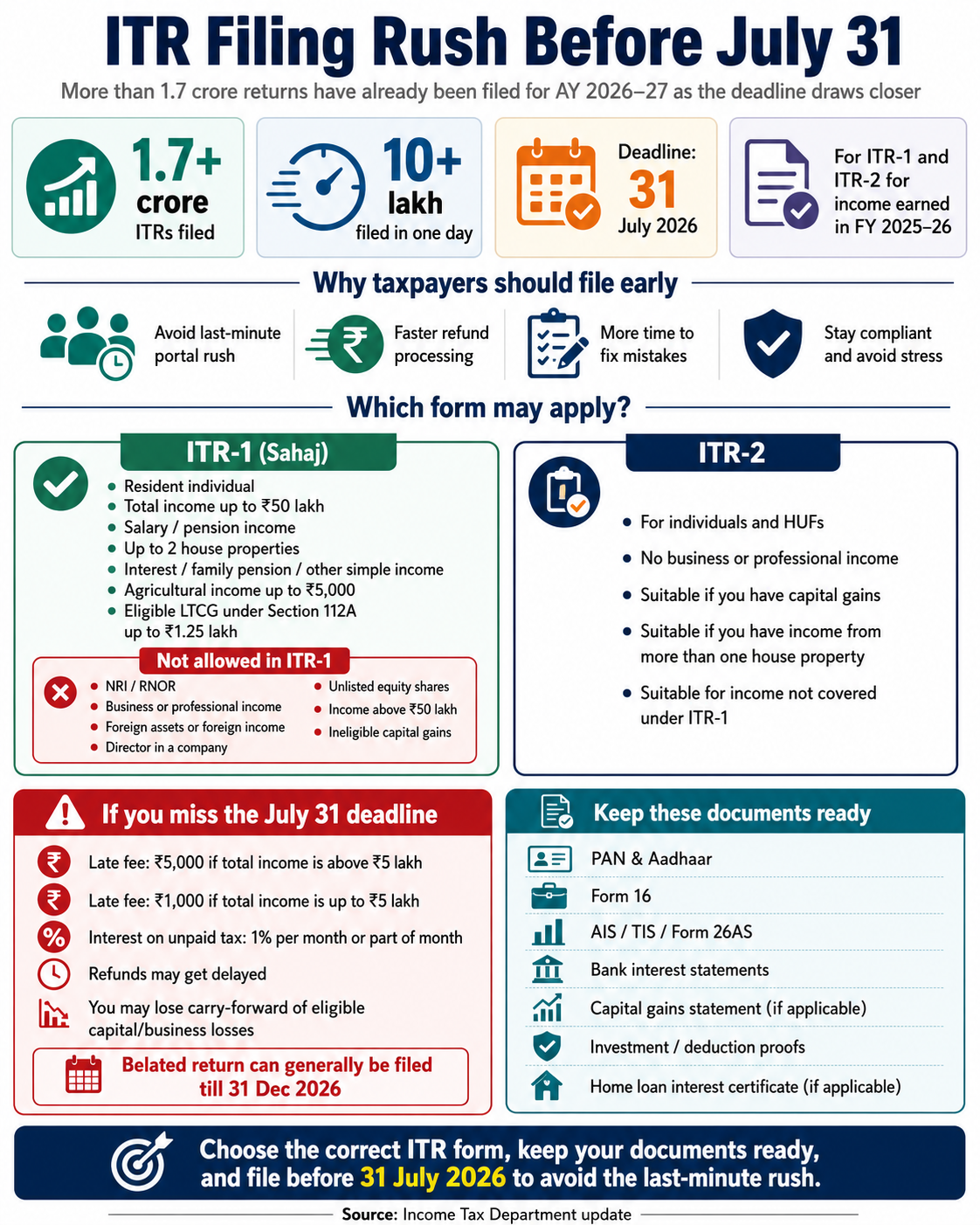
The race to file Income Tax Returns (ITR) is gathering momentum as the July 31, 2026 deadline approaches. The Income Tax Department has announced that more than 1.7 crore Income Tax Returns (ITRs) have already been filed for Assessment Year (AY) 2026-27, reflecting a sharp rise in taxpayer participation.
The latest update also highlights that over 10 lakh ITRs were filed in a single day on Friday, indicating that taxpayers are increasingly choosing to complete their filings before the last-minute rush.
If you have not filed your ITR yet, the latest figures serve as an important reminder to complete the process before the deadline to avoid heavy traffic on the e-filing portal.
Income Tax Department urges taxpayers to avoid the last-minute rush
Sharing the latest update on X, the Income Tax Department said:
“Over 1.7 Crore taxpayers have already taken the smart step and filed their ITRs for A.Y. 2026-27. With more than 10 lakh returns filed just yesterday, the momentum is building. Have you filed your ITR 1 & 2 yet? Don’t wait for the final rush. Beat the last-minute traffic and file smoothly before the deadline of 31 July 2026.”
The department’s message is aimed at encouraging taxpayers to file their returns early instead of waiting until the final days, when higher website traffic can slow down the filing process.
Read More : India Holds 20% of World’s Data But Just 3% Data Centre Capacity. Why Billions Are Rushing In
Who Can File ITR-1 (Sahaj)?
| Particulars | Eligibility |
|---|---|
| Residential Status | Resident Individual |
| Total Annual Income | Up to ₹50 lakh |
| Salary/Pension Income | Allowed |
| House Property | Up to 2 House Properties |
| Other Sources | Interest income, family pension, etc. |
| Agricultural Income | Up to ₹5,000 |
| Long-Term Capital Gain (Section 112A) | Up to ₹1.25 lakh (subject to prescribed conditions) |
| Capital Gains (Other than eligible LTCG u/s 112A) | Not Allowed |
| Business/Professional Income | Not Allowed |
| Foreign Assets/Foreign Income | Not Allowed |
| Company Director | Not Allowed |
| Investment in Unlisted Equity Shares | Not Allowed |
| Non-Resident (NRI) / RNOR | Not Allowed |
Who can file ITR-1 (Sahaj)?
ITR-1 (Sahaj) is designed for resident individuals with relatively simple income sources.
A taxpayer can use ITR-1 if:
- Annual income is up to ₹50 lakh.
- Income is earned from salary or pension.
- There is income from one house property.
- Agricultural income does not exceed ₹5,000 in a financial year.
Because of its simplified format, ITR-1 remains the most commonly used return form among salaried taxpayers.
Track Live : Live Stock Screener for Indian Markets
Who should file ITR-2?
ITR-2 is meant for individuals and Hindu Undivided Families (HUFs) that do not earn income from business or profession.
It is generally applicable to taxpayers who have:
- Capital gains from investments.
- Income from more than one house property.
- Other income sources that are not covered under ITR-1.
Taxpayers should carefully choose the correct return form to avoid delays in processing or notices from the tax department.
Who Cannot File ITR-1?
You cannot use ITR-1 if you:
- Are a Non-Resident (NRI) or Resident Not Ordinarily Resident (RNOR)
- Have total income exceeding ₹50 lakh
- Have business or professional income
- Have capital gains that are not eligible for reporting in ITR-1
- Own foreign assets or earn foreign income
- Are a director in a company
- Hold unlisted equity shares
- Do not satisfy the eligibility conditions prescribed for ITR-1.
Important update for AY 2026-27: The Income Tax Department has expanded ITR-1 eligibility to allow reporting of income from up to two house properties and certain eligible long-term capital gains under Section 112A, making the form applicable to a larger number of taxpayers than in previous years.
What Happens If You Miss the July 31 ITR Deadline?
Missing the July 31, 2026 deadline for filing your Income Tax Return (ITR) doesn’t mean you lose the opportunity to file, but it can lead to several financial and compliance consequences.
Late Filing Fee
If you file your return after the due date, you may have to pay a late filing fee under the applicable provisions of the Income-tax Act:
| Total Income | Late Filing Fee |
|---|---|
| Above ₹5 lakh | ₹5,000 |
| Up to ₹5 lakh | ₹1,000 |
Interest on Outstanding Tax
If you have unpaid tax, interest at 1% per month (or part of a month) may be charged from August 1 until the tax is paid.
You May Lose the Benefit of Carrying Forward Certain Losses
Missing the due date can prevent you from carrying forward eligible losses such as:
- Capital losses
- Business or professional losses
These losses generally cannot be used to offset future taxable income if the return is filed after the prescribed due date.
Delay in Tax Refunds
Late filing can delay the processing of your return, which may postpone the receipt of any tax refund due to you.
You Can Still File a Belated Return
Even if you miss July 31, you can generally file a belated return. For AY 2026-27, the deadline for filing a belated return is December 31, 2026, subject to the applicable provisions and payment of any late fee, interest, and other dues.
Why Filing Before July 31 Matters
Filing your ITR on or before the due date helps you:
- Avoid late filing fees
- Save interest on unpaid taxes
- Receive tax refunds faster
- Preserve the right to carry forward eligible losses
- Stay compliant with tax laws and avoid last-minute technical issues.
Documents to Keep Ready Before Filing Your ITR
Keeping the right documents handy helps you file an accurate Income Tax Return, reduces the chances of mismatches with the Income Tax Department’s records, and speeds up refund processing. The Income Tax Department also advises taxpayers to reconcile their return with AIS, TIS, and Form 26AS before filing.
| Document | Why You Need It |
|---|---|
| PAN Card | Mandatory for filing ITR and linking all tax records. |
| Aadhaar Card | Required for PAN-Aadhaar linkage and e-verification of your return. |
| Form 16 | Issued by your employer; contains salary details and TDS deducted. |
| AIS (Annual Information Statement) | Shows detailed financial transactions such as salary, interest, dividends, securities transactions and other reported income. |
| TIS (Taxpayer Information Summary) | Provides a summarized version of AIS to help reconcile your income before filing. |
| Form 26AS | Consolidated tax statement showing TDS, TCS, advance tax, self-assessment tax and other tax credits. |
| Salary Slips | Useful for verifying salary components, exemptions and allowances. |
| Bank Interest Certificates/Statements | Required to report interest earned on savings accounts and fixed deposits. |
| Capital Gains Statement (if applicable) | Broker statement showing gains or losses from shares, mutual funds or other investments. |
| Dividend Statement | Helps report dividend income accurately. |
| Home Loan Interest Certificate | Required to claim deductions on home loan interest and eligible principal repayment. |
| Investment & Deduction Proofs | Documents for deductions under applicable provisions such as life insurance, EPF, PPF, ELSS, health insurance and donations, wherever applicable. |
How to File Your ITR Online: Step-by-Step Guide (AY 2026-27)
Filing your Income Tax Return (ITR) online is simple if you have all the required documents ready. Follow these five steps to complete your return on the official Income Tax e-Filing portal.
Step 1: Log In to the Income Tax e-Filing Portal
- Visit the official Income Tax e-Filing portal: Income Tax e-Filing Portal
- Log in using your PAN (or Aadhaar) and password.
- Click e-File → Income Tax Returns → File Income Tax Return.
- Select Assessment Year (AY) 2026-27 (for income earned between April 1, 2025 and March 31, 2026).
- Choose Online mode and click Continue.
Step 2: Select the Correct ITR Form
- Choose your filing status as Individual.
- Select the appropriate return form:
- ITR-1 (Sahaj): For eligible salaried individuals with income up to ₹50 lakh.
- ITR-2: For individuals with capital gains, multiple house properties, foreign assets or other eligible income.
- Select the applicable reason for filing, such as taxable income exceeding the basic exemption limit, if applicable.
Step 3: Verify the Pre-Filled Information
Before proceeding, carefully review the details auto-populated by the portal:
- Personal information and contact details
- Bank account details for refund
- Salary details from Form 16
- Interest income
- Capital gains (where applicable)
- Deductions under Sections 80C, 80D and other eligible provisions
- Tax deducted at source (TDS) with Form 26AS, AIS, and TIS
Correct any discrepancies before submitting your return.
Step 4: Review Tax Liability and Submit
- Check whether you have:
- Tax Payable, or
- Tax Refund
- If any tax is due, pay it through the integrated e-Pay Tax facility.
- Click Preview Return and review all information carefully before submission.
Step 5: Submit and E-Verify Your Return
- Click Submit after reviewing your return.
- Complete the filing by e-verifying it using any of the available methods:
- Aadhaar OTP
- Net Banking
- Demat Account
- Bank Account EVC
- Digital Signature Certificate (where applicable)
Important: Your ITR is not considered filed until it is successfully e-verified. If you do not complete e-verification within the prescribed time, your return will be treated as invalid.
Quick Checklist Before You Click “Submit”
- ✔ Choose the correct ITR form.
- ✔ Verify PAN, Aadhaar and bank details.
- ✔ Match income with Form 16, AIS, TIS and Form 26AS.
- ✔ Claim only eligible deductions.
- ✔ Pay any outstanding self-assessment tax.
- ✔ Complete e-verification after submission.
What does this mean for taxpayers?
For taxpayers who have not yet filed their Income Tax Return, filing early offers several advantages.
Early filing can help avoid technical issues caused by heavy traffic near the deadline, provide more time to correct any mistakes, and enable faster processing of returns and refunds, wherever applicable.
Waiting until the last few days may increase the chances of portal congestion and unnecessary delays.