DMart Profit Rose 11% delivers another steady quarter, but one trend is catching investors’ attention
DMart Q1 Results were largely in line with expectations as Avenue Supermarts reported double-digit growth in profit and revenue for the June quarter. However, investors are likely to closely watch one key trend—the slowdown in older metro stores, even as non-metro markets continued to deliver healthy growth.
The supermarket retailer also expanded its footprint by opening three new stores during the quarter, taking its total store count to 503. At the same time, the company streamlined its e-commerce business by exiting seven low-performing cities.
The results underline that while DMart continues to grow, the next phase of expansion could increasingly depend on new markets and operational efficiency.
DMart Q1 Results: Profit climbs 11%, revenue jumps nearly 15%
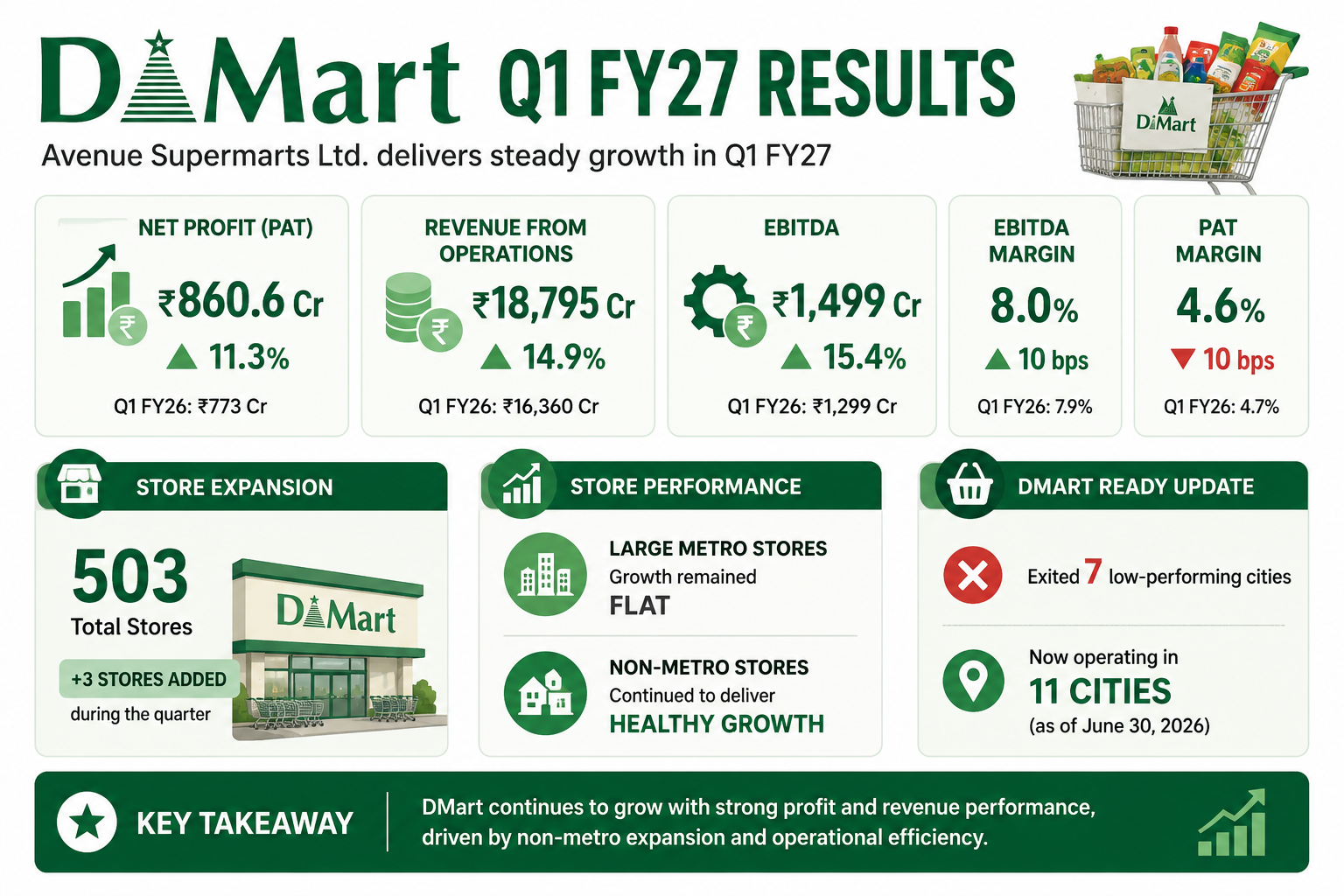
Avenue Supermarts, which operates the DMart retail chain, reported a consolidated net profit of ₹860.6 crore for the quarter ended June 30, 2026, up 11.3% from ₹773 crore reported in the same quarter last year.
Revenue from operations rose 14.9% year-on-year to ₹18,795 crore, compared with ₹16,360 crore in the corresponding period of the previous financial year.
The strong revenue growth reflects continued customer demand and store expansion despite a challenging consumption environment.
Track Live : Live Stock Screener for Indian Markets
DMart Q1 FY27 Results: Key Highlights
Avenue Supermarts Ltd., the operator of DMart, reported a healthy set of results for the quarter ended June 30, 2026, driven by double-digit growth in revenue and profit despite muted demand in large metro markets. The company also expanded its retail footprint by opening three new stores during the quarter.
Q1 FY27 Financial Performance
| Particulars | Q1 FY27 | Q1 FY26 | YoY Change |
|---|---|---|---|
| Consolidated Revenue | ₹18,795 crore | ₹16,360 crore | +14.9% |
| Consolidated Net Profit (PAT) | ₹860.6 crore | ₹773 crore | +11.3% |
| EBITDA | ₹1,499 crore | ₹1,299 crore | +15.4% |
| EBITDA Margin | 8.0% | 7.9% | +10 bps |
| PAT Margin | 4.6% | 4.7% | -10 bps |
| Basic EPS | ₹13.20 | ₹11.88 | +11.1% |
| Total Stores | 503 | 500* | +3 stores in Q1 |
*Store count increased by three during the June quarter.
EBITDA improves while margins remain stable
Operating performance also remained healthy during the quarter.
EBITDA increased 15.4% year-on-year to ₹1,499 crore, compared with ₹1,299 crore a year ago.
The company’s EBITDA margin improved marginally to 8%, up from 7.9% in the same quarter last year, indicating stable operating efficiency despite rising costs.
However, PAT margin slipped slightly to 4.6%, compared with 4.7% in Q1 FY26.
Basic earnings per share (EPS) rose to ₹13.20, compared with ₹11.88 in the year-ago quarter.
Read More : 1.7 Crore ITRs Filed Already: Why Waiting Until July 31 Could Be Risky
Evaluating Core Business Operations and Management Commentary
- Slowing Metro Stores: Older brick-and-mortar stores in major metros saw flat growth. These properties typically yield DMart’s highest revenue per square foot.
- Thriving Non-Metros: Retail stores located in tier-2 and tier-3 non-metro markets drove the majority of the healthy growth.
- Physical Footprint Expansion: DMart launched 3 new brick-and-mortar stores during the quarter, bringing its total national store count to 503 locations.
- E-Commerce Restructuring: Its online arm, DMart Ready, streamlined operations to boost profit paths. The platform shut down operations in 7 low-performing cities to refocus entirely on large metro hubs. It now operates in 11 cities.
DMart adds new stores but metro growth remains flat
The company continued expanding its retail network by opening three new stores during the quarter, taking its total count to 503 stores across India.
Management said stores located in large metro cities, which generate significantly higher revenue per square foot, recorded flat growth during the quarter.
In contrast, stores in non-metro markets continued to post healthy growth, highlighting the growing contribution of Tier-II and Tier-III cities to DMart’s expansion strategy.
DMart Ready sharpens focus on profitable markets
DMart’s online grocery platform DMart Ready continued to optimise its operations during the quarter.
According to Vikram Dasu, Whole-Time Director and CEO of Avenue E-Commerce Ltd., the company remained focused on strengthening its presence in large metro cities while refining its business model.
As part of this strategy, DMart Ready discontinued operations in seven cities that made only a marginal contribution to the business.
As of June 30, 2026, the online platform was operating in 11 cities.
Here’s what happened today and why traders reacted
DMart reported another quarter of steady earnings growth, supported by higher sales, improving operating profit and continued store expansion.
However, investors are likely to pay close attention to management’s comments about flat growth in older metro stores, as these outlets contribute significantly higher revenue per square foot.
The decision to exit underperforming cities in the DMart Ready business also signals that management is prioritising profitability over aggressive expansion.
What do the Q1 results mean for investors?
The latest DMart Q1 Results indicate that Avenue Supermarts continues to deliver consistent financial performance despite evolving consumer spending patterns.
The company’s ability to maintain margins, expand its store network and generate double-digit revenue growth remains a positive for long-term investors.
At the same time, slower growth in mature metro stores suggests that future earnings growth may increasingly depend on expansion into smaller cities, operational efficiencies and the successful scaling of its e-commerce business.
The bottom line
DMart Q1 Results reaffirm the company’s position as one of India’s strongest retail businesses.
With net profit rising 11.3%, revenue nearing ₹19,000 crore, and the store network crossing 500 outlets, Avenue Supermarts continues to strengthen its market presence.
Going forward, investors will closely monitor same-store sales growth, the performance of metro markets and the evolution of DMart Ready, as these factors are expected to play a crucial role in shaping the company’s growth trajectory and the DMart share price in the coming quarters.