India challenges US tariff proposal, saying trade issues should be resolved through dialogue
India has formally urged the United States to reconsider its proposed 12.5% tariff on Indian imports, arguing that the findings of the US Trade Representative (USTR) are legally and factually flawed. The move comes as both countries continue negotiations on a broader bilateral trade agreement.
At a public hearing held by the USTR, India maintained that trade disputes should be addressed through bilateral negotiations, not unilateral tariff measures. The government also stressed that India remains committed to eliminating forced labour as both a constitutional obligation and an international commitment.
For exporters and investors, the proposed tariff has become an important development to watch as it could influence trade flows between the world’s two largest democracies.
Track Live : GIFT Nifty Live – Today Price, Chart, Timings and Nifty Opening Signal
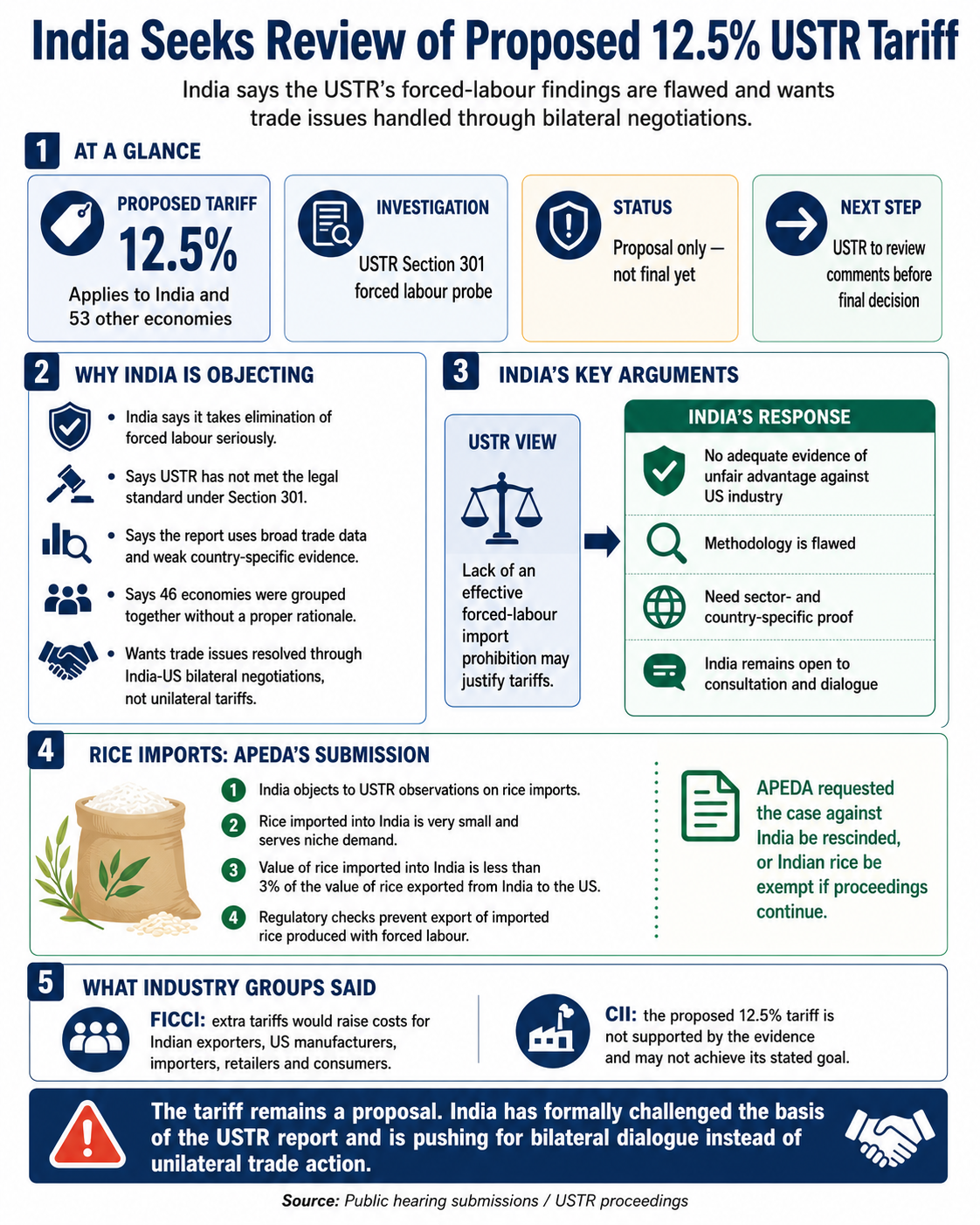
Why is the US proposing a 12.5% tariff?
The proposed tariff stems from the USTR’s Section 301 investigation, which examined whether several economies have adequate measures to prohibit imports of goods produced using forced labour.
The investigation covered 60 economies, with the USTR proposing:
- 10% tariff on imports from Canada, the European Union, Indonesia, Mexico, Ecuador and Pakistan.
- 12.5% tariff on imports from 54 economies, including India and China.
However, the proposal has not been finalised, and the USTR is currently reviewing comments submitted during the consultation process before making a final decision.
India says the USTR report contains legal and factual flaws
Representing India at the hearing, Brij Mohan Mishra, Joint Secretary in the Department of Commerce, argued that the USTR had failed to meet the legal standards required under Section 301(d) of the US Trade Act.
According to India, the report groups 46 economies together without providing sufficient country-specific evidence linking India’s imports or exports to forced labour.
The government also questioned the methodology used in the investigation, saying the findings rely on a few case studies and broad trade patterns rather than concrete evidence.
“India takes the elimination of forced labour seriously as a constitutional obligation, and as a matter of international law and principle,” Mishra said during the hearing.
India added that there is insufficient evidence to show that its policies create an unfair competitive advantage that harms American industries.
Read More : DMart Profit Rose 11%, But Big Metro Stores Stayed Flat — Here’s Why
Why India Opposes the Proposal
According to the Department of Commerce, India raised several objections during the USTR public hearing:
- India considers the elimination of forced labour a constitutional obligation and an international commitment.
- The USTR report allegedly fails to meet the legal standards required under Section 301.
- India argues there is no country-specific evidence linking its policies to harm suffered by US industries.
- The report groups 46 economies together, including India, without individual assessments.
- The methodology relies on broad trade patterns rather than direct evidence of forced labour-linked exports to the US.
India’s Defence on Rice Exports
Officials from the Agricultural and Processed Food Products Export Development Authority (APEDA) argued that:
- Rice imports into India are very small and limited to niche varieties.
- Imported rice allegedly produced with forced labour cannot be re-exported from India because of regulatory safeguards.
- Rice exports to the US are permitted only from registered mills and processing units approved by the Agriculture Ministry.
- India has requested that the investigation against Indian rice be rescinded, or that rice be exempted if tariffs proceed.
Industry Bodies Back India
Leading industry associations have also opposed the proposal:
- FICCI warned that the tariff would raise costs for Indian exporters, US manufacturers, retailers and American consumers.
- CII said the USTR has not established that India’s policy framework unfairly burdens US commerce and argued the additional duty lacks sufficient evidence.
Potential Impact if the Tariff Is Approved
| Sector | Likely Impact |
|---|---|
| Textiles & Apparel | Higher export costs to the US |
| Engineering Goods | Reduced price competitiveness |
| Auto Components | Margin pressure on exporters |
| Chemicals | Potential decline in US demand |
| Agricultural Exports | Additional scrutiny despite India’s objections |
India wants trade concerns addressed through bilateral negotiations
India has requested the USTR to reconsider the proposed tariff and resolve any outstanding concerns through the ongoing India-US bilateral trade negotiations.
The government reiterated that it remains willing to engage constructively with the United States through consultation and dialogue instead of unilateral trade actions.
Officials argued that stronger cooperation between the two countries would be more effective than imposing additional import duties.
APEDA rejects allegations over rice exports
India also defended its agricultural exports during the hearing.
Representing the Agricultural and Processed Food Products Export Development Authority (APEDA), First Secretary Shreyans Gupta rejected the USTR’s observations regarding rice imports allegedly linked to forced labour.
According to APEDA, India’s rice imports are extremely small and mainly cater to niche demand. The authority also noted that imported rice produced with forced labour cannot be re-exported to the US because only rice processed through registered mills approved by the Agriculture Ministry is eligible for export.
Gupta urged the USTR to either withdraw the investigation against India or exempt Indian rice if the proposed tariff moves forward.
Indian industry warns of higher costs for both countries
Leading industry bodies have also opposed the proposed tariff.
FICCI said an additional 12.5% tariff would increase costs not only for Indian exporters but also for American manufacturers, retailers and consumers.
The industry chamber argued that higher import duties could disrupt supply chains that have become increasingly important for both economies.
Similarly, CII stated that the USTR’s report does not establish that India’s regulatory framework burdens US commerce or justifies additional tariffs.
What Is Section 301? Here’s a Simple Explanation
Section 301 is a provision of the US Trade Act of 1974 that gives the United States Trade Representative (USTR) the authority to investigate foreign governments for trade practices that the US believes are unfair, unreasonable, discriminatory, or harmful to US commerce. If the USTR concludes that such practices exist, the US government can impose trade measures—most commonly additional import tariffs.
How Does Section 301 Work?
| Step | What Happens? |
|---|---|
| 1. Investigation Begins | The USTR launches an investigation on its own or after receiving a complaint from US industries. |
| 2. Review of Trade Practices | The USTR examines whether another country’s laws, policies, or practices are unfair or place US businesses at a disadvantage. |
| 3. Consultation | The US may hold discussions with the concerned country to resolve the issue. |
| 4. Trade Action | If no satisfactory resolution is reached, the US can impose unilateral measures such as higher import tariffs, restrictions, or other trade remedies. |
Why Is Section 301 Controversial?
Section 301 has been controversial because:
- Unilateral action: The US can impose trade measures without waiting for a decision from the World Trade Organization (WTO).
- Broad scope: It has been used not only for traditional trade barriers but also for issues such as intellectual property, digital taxes, and now forced labour standards.
- Risk of trade disputes: Countries targeted under Section 301 sometimes respond with their own tariffs, leading to wider trade tensions.
Why Is India Facing a Section 301 Investigation?
In the current case, the USTR has proposed a 12.5% additional tariff on imports from India and several other economies. The proposal is based on the allegation that these countries do not adequately prohibit or enforce restrictions on the import of goods produced using forced labour. The proposal is still under consultation and has not yet been finalized.
India’s Response
India has strongly contested the proposal, arguing that:
- It treats the elimination of forced labour as a constitutional and international obligation.
- The USTR has not provided sufficient country-specific evidence linking India’s policies to harm suffered by US industries.
- Simply lacking a specific import prohibition does not automatically qualify as an “unreasonable” trade practice under Section 301.
- Trade disagreements should be resolved through India-US bilateral negotiations, rather than unilateral tariff actions.
What could this mean for exporters and investors?
If the proposed 12.5% tariff is approved, Indian exporters shipping goods to the US could face higher costs, potentially affecting competitiveness in certain sectors.
However, since the proposal is still under review, businesses are hopeful that continued negotiations and India’s legal objections could lead to modifications or exemptions before any final decision is announced.
Investors will also monitor the progress of the broader India-US trade negotiations, as a positive resolution could support export-oriented industries and strengthen long-term trade relations.