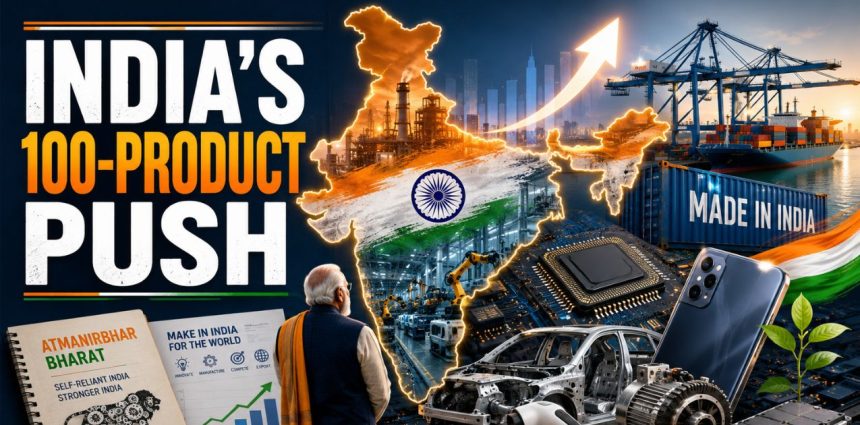
India is quietly building one of its most ambitious economic overhauls in years, a sweeping plan to cut reliance on foreign goods and insulate the economy from a world where trade has become a weapon. Behind closed doors, Prime Minister Narendra Modi’s government is drawing up a list of more than 100 products it wants manufactured at home instead of shipped in from abroad, according to people familiar with the discussions.
Why Delhi Is Suddenly Worried About Imports
The urgency isn’t accidental. India spent nearly $775 billion on imports in the last financial year, and almost a fifth of that flowed in from China alone. Add to that a brutal stretch of energy shocks tied to the Iran conflict and closures around the Strait of Hormuz, rising global export controls on rare earths and chips, and Washington’s threat of tariffs as high as 100% on countries still buying Russian oil, India included, and the picture becomes clear: New Delhi wants fewer chokepoints it doesn’t control. Businesses worldwide are having the same reckoning, increasingly prioritising economic security alongside cost efficiency and pushing supply chains toward local manufacturing and diversified sourcing.
The 100-Product Hit List
Six sector-specific working groups, chaired by the DPIIT secretary and stacked with officials from Commerce, NITI Aayog, and the science ministry, have been racing to identify goods that India either doesn’t make at all or can’t produce in enough volume.
The sectors under the microscope: pharmaceuticals and medical devices, chemicals and textiles, automobiles and EV components, energy, construction equipment, and defence-adjacent electronics.
The final list is headed to the Cabinet Secretariat, with former RBI governor Shaktikanta Das, now a top aide in the PM’s office, helping steer the broader import-substitution blueprint alongside the Prime Minister’s Economic Advisory Council.
Some categories, like crude oil and critical minerals, are effectively impossible to replace soon. Others, pulses, edible oils, select electronics — are seen as realistic near-term wins. The government is also weighing sweeteners for exporters, including relaxed rules under the Advance Authorisation programme for manufacturers that lean more heavily on Indian-made components.
A $20 Billion Down Payment on Chips and Phones
This week’s cabinet meeting turned the strategy into hard cash. Ministers approved roughly 1.9 trillion rupees, about $19.7 billion, split between semiconductor incentives and a new mobile phone manufacturing scheme.
Technology minister Ashwini Vaishnaw was blunt about the ambition: “We must create an Indian mobile brand,” he told reporters, signalling Delhi’s hope of eventually rivalling Chinese and Korean phone makers rather than just assembling their devices.
The numbers are striking. India has become the world’s second-largest mobile phone maker by volume, with over 99% of phones sold domestically now built in the country, and handsets overtook diesel and cut diamonds as India’s top export category in 2025. The new phone scheme alone is projected to unlock roughly ₹39 lakh crore in cumulative production and around 60,000 direct jobs over five years.
Fertiliser Independence Gets Its Own Blueprint
Alongside the tech push, the cabinet cleared a National Investment Policy aimed at closing India’s stubborn urea gap, the country produces around 30 million tonnes against 40 million tonnes of demand. Eight to nine new gas-based plants are planned to add 10 million tonnes of capacity, following supply scares linked to the Hormuz closures, with officials targeting a meaningful cut in fertiliser imports over the next three years.
What Economists Are Watching
Analysts see the logic but flag the risks. IndusInd Bank economist Gaurav Kapur has argued that weaponised trade policy leaves India little choice but to build self-reliance. ANZ’s Dhiraj Nim strikes a more cautious note, pointing out that import substitution born of necessity, rather than pure efficiency, will only pay off “if it happens at real scale” — otherwise it risks propping up costlier domestic production without truly denting the trade deficit. Ongoing free trade talks with the EU and UK could sweeten the deal further, giving domestic manufacturers better market access just as they scale up.
What It Means for Investors
For markets, the direction of travel points to fresh opportunity across domestic manufacturing, industrial equipment, electronics, specialty chemicals, capital goods and the semiconductor supply chain, the same sectors that have already drawn heavy inflows under existing Production-Linked Incentive schemes in electronics, pharma and autos.
On the flip side, companies still leaning on imported raw materials will want to watch closely, since any shift in incentives or duty structures could reshape sourcing costs and competitiveness fast.
Read Next: IPO Market Fires on All Cylinders as Devson Jumps 66% and SBI Funds Enters Final Hours
The Bigger Picture
For now, the strategy is still being assembled rather than finalised, no product list has been publicly released, and several ministries are still haggling over incentive design. But between the chip-and-phone money, the fertiliser build-out, and the 100-product review, India is signalling that self-reliance is no longer a slogan reserved for Independence Day speeches. It’s becoming the operating principle of its next economic decade.