Key Takeaways
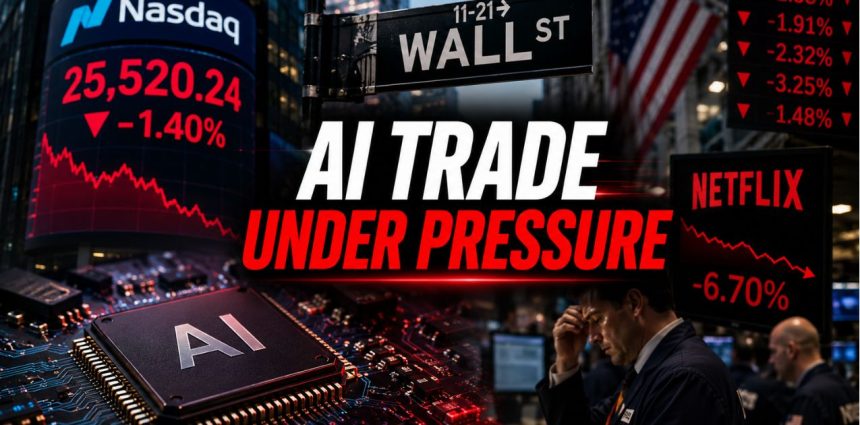
- S&P 500 closed at 7,457.69 (-1.01%) and Nasdaq at 25,520.24 (-1.4%) on Friday, July 17; weekly losses stood at 1.6% and 2.9% respectively
- Philadelphia Semiconductor Index (SOX) entered a bear market, down over 20% from its late-June peak
- Netflix sank more than 10% in early trading before closing down 6.7% after Q3 revenue and EPS guidance missed estimates; stock is down more than 20% year-to-date
- A federal judge will rule by July 22 on whether to pause Paramount Skydance’s $110-billion Warner Bros. Discovery takeover
- SpaceX, Bank of America and Latigo Biotherapeutics also made AI, crypto and IPO headlines Friday
Market Snapshot
| Index | Close | Daily Change | Weekly Change |
|---|---|---|---|
| Dow Jones | 52,146.42 | -0.77% | -0.9% |
| S&P 500 | 7,457.69 | -1.01% | -1.6% |
| Nasdaq | 25,520.24 | -1.40% | -2.9% |
| SOX (Semiconductors) | — | -1.8% | Bear market |
Source: CNBC, Yahoo Finance, LSEG (data as of July 17, 2026 close)
Wall Street closed the week under pressure Friday as an extended chip-stock selloff and a sharp Netflix slide offset a strong start to second-quarter earnings season. Even as 90% of the 49 S&P 500 companies that had reported results beat estimates, per LSEG data, the AI-capex worry driving the chip rout overwhelmed that strength.
Why This Matters Today
Investors are turning more selective after months of AI-driven gains, a strong earnings beat alone is no longer enough to hold up a stock; the market now wants stronger forward guidance. Netflix’s guidance miss and the semiconductor sector’s bear-market slide both reflect the same shift: capital is rotating away from momentum names that can’t back up valuations with a clean outlook.
Chip Selloff Pushes Semiconductor Index Into a Bear Market
The SOX index fell 1.8% Friday, its worst week since March, and has shed over 20% from its late-June record. Applied Materials, Lam Research, Intel, KLA and Arm each fell about 4%, while Micron and Nvidia dropped more than 2%. Traders are repricing this year’s AI rally on concern that hyperscalers may slow infrastructure spending, a worry sharpened by news of a rival AI model launch from China.
Netflix Slides on Weaker Q3 Guide, Thinner Disclosure
Netflix forecast Q3 revenue of $12.86 billion and EPS of 82 cents, both below estimates of $13 billion and 84 cents. The stock sank more than 10% in early trading, nearing a two-year low, before paring losses to close down 6.7% as the session wore on. Q2 itself was solid, revenue rose 13% year-on-year to $12.56 billion and net income climbed to $3.40 billion from $3.13 billion a year earlier.
What spooked the market was disclosure: Netflix will now report viewing hours annually instead of twice a year, starting 2027. At least 18 analysts cut price targets; the stock is off more than 20% for 2026, trading near 20x forward earnings versus 13.5x for Disney and 6.6x for Comcast.
NiftyTrader Desk View
| Index/Stock | Key Technical Trigger | Trader View |
|---|---|---|
| Nasdaq Composite | Down 2.9% for the week as SOX enters bear-market territory | Chip weakness remains the dominant swing factor into next week’s Intel and Tesla earnings |
| S&P 500 | Energy outperformed on rising crude, partly offsetting tech drag | Broad earnings beats (90% so far) cushion the index-level pullback |
| Netflix (NFLX) | Sank 10%+ intraday, closed down 6.7%; down over 20% YTD | Focus has shifted to reduced engagement disclosure and a compressing growth premium |
Source: CNBC, Reuters, Yahoo Finance (data as of July 17, 2026 close)
What This Means for Indian Markets
A sustained correction in U.S. semiconductor and AI-linked stocks typically feeds through to sentiment in Indian IT and technology counters, given the sector’s revenue exposure to U.S. clients and its correlation with global risk appetite.
Traders should watch whether GIFT Nifty opens weak Monday tracking the overnight Wall Street move, and monitor institutional activity via NiftyTrader’s FII-DII Tracker, since prolonged U.S. tech weakness has historically coincided with more cautious FII positioning across emerging markets.
What Traders Should Watch Next
- Intel and Tesla earnings, due next week
- Hyperscaler commentary on AI infrastructure spending
- The July 22 ruling on the Paramount-Warner Bros. Discovery merger
- Movement in US Treasury yields
- Crude oil prices amid geopolitical tensions
- Any fresh Fed commentary on rate policy
Paramount-Warner Bros. Discovery Deal Faces July 22 Court Test
US District Judge Araceli Martínez-Olguín said Friday she will rule by July 22 on an emergency request from 12 states, led by California, to pause Paramount Skydance’s $110-billion acquisition of Warner Bros. Discovery.
States argue the deal would concentrate theatrical distribution and cable licensing; Paramount says streaming rivals keep the market competitive. Paramount’s counsel told the court the deal won’t close by the 22nd regardless, around when the EU is also due to rule.
Also in Focus
Bank of America restructured leadership within its Global Markets platforms division, naming Sonali Theisen to add oversight of digital assets to her existing FICC e-trading role and Kevin Milsom as head of platforms AI transformation.
Separately, SpaceX is in talks with the US Department of Defense to supply AI data-center capacity worth billions of dollars, per a WSJ report, a deal that would pit it against Amazon, Microsoft, Google and Oracle. And clinical-stage biotech Latigo Biotherapeutics filed its S-1 for a Nasdaq listing under ticker LTGO, backed by Blue Owl Capital, with roughly $304 million raised to date.
Also Read: Reliance Heads Into Q1 Results With Expectations Running High
Bottom Line
Friday’s session shows the AI trade being repriced, not abandoned. Chipmakers remain most exposed to capex doubts, while Netflix’s slide shows how fast a growth premium compresses once disclosure thins out.
Watch next week’s Intel and Tesla earnings and the July 22 Paramount-WBD ruling for the next directional cues, and for Indian traders, keep an eye on how FII flows respond if U.S. tech weakness persists.
Disclaimer: This article is for informational purposes only and should not be construed as investment advice. Please consult a registered financial advisor (SEBI-registered) before making investment decisions.