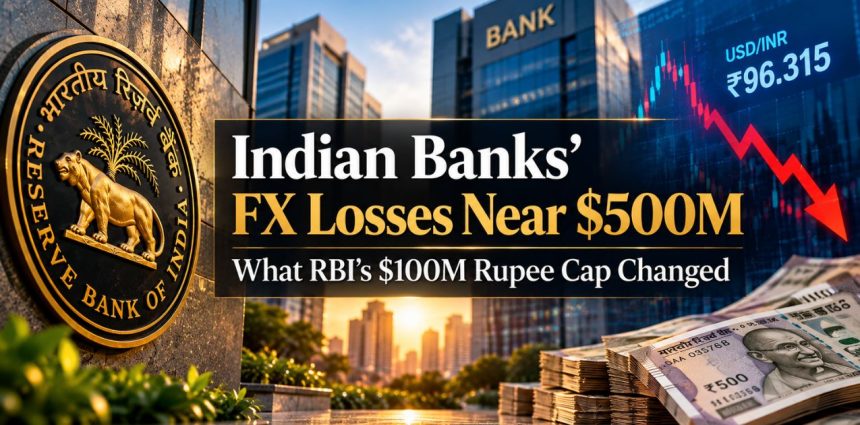
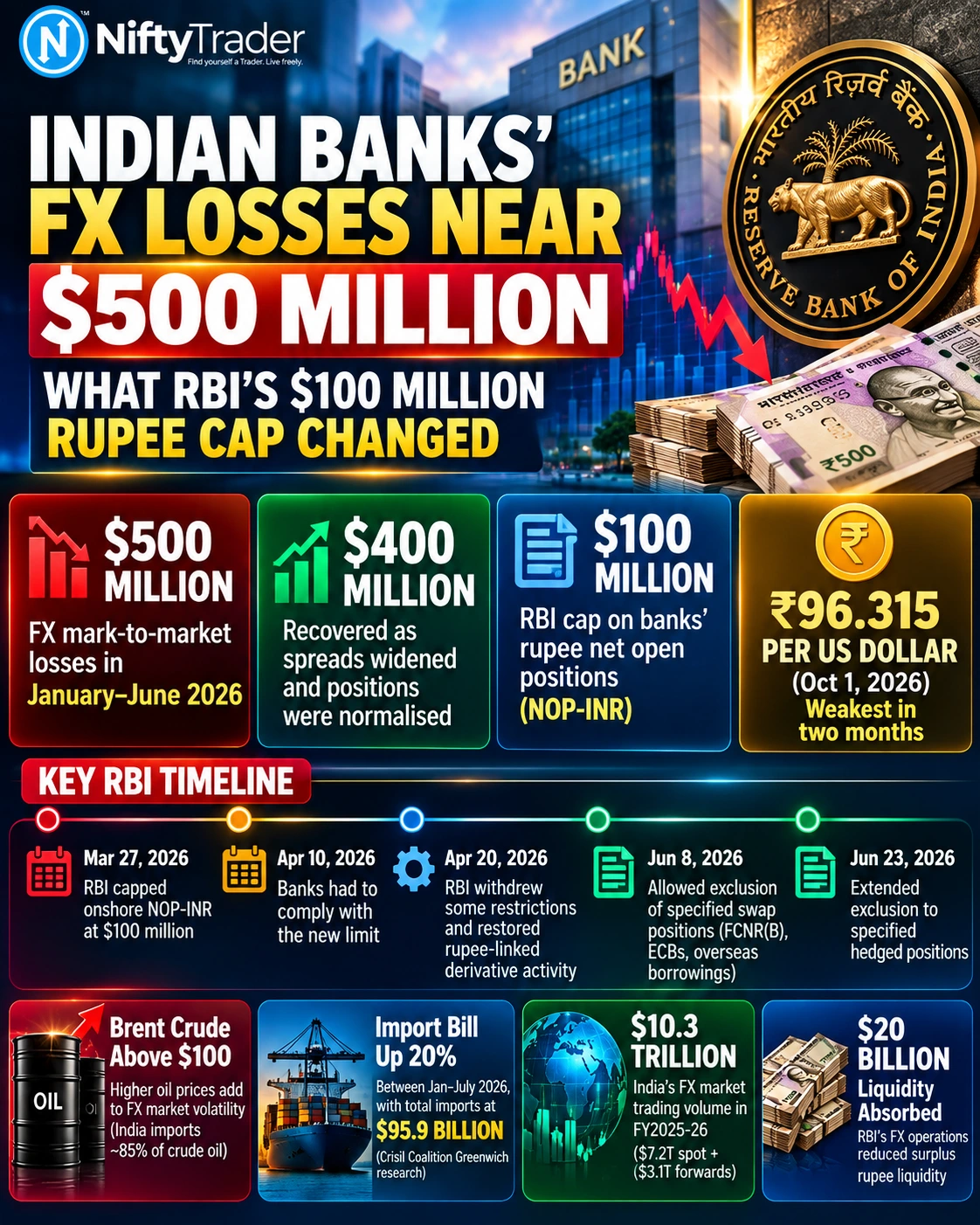
Indian banks faced nearly $500 million in mark-to-market foreign exchange losses in January-June 2026 after an RBI rule required authorised dealers to reduce rupee positions. Banks later recovered around $400 million as FX market spreads widened and positions were normalised. Now, with the rupee at ₹96.315 per US dollar and Brent crude back above $100, traders are watching whether renewed currency volatility can again affect bank treasury performance.
The numbers from Crisil Coalition Greenwich show how a regulatory change can quickly alter trading conditions for banks when it arrives during a volatile currency market. The episode began with the RBI’s March decision to impose a common limit on rupee net open positions and was followed by a rapid adjustment in bank trading books.
The latest rupee weakness gives the story a fresh market angle. The issue is no longer only what happened in March and April, but how banks operate in an FX market where balance-sheet capacity, hedging demand and regulatory limits have all changed.
Track Live: INDIAN BANK Option Chain (NSE) — Live OI, PCR & Greeks
What caused the nearly $500 million FX losses?
The immediate trigger was the RBI’s March 27, 2026 circular on NOP-INR positions.
The central bank directed authorised dealers to keep their Net Open Position in Rupee (NOP-INR) in the onshore deliverable market within US$100 million at the end of each business day. Banks had to comply at the earliest and no later than April 10, 2026.
For banks, the practical impact was immediate: positions above the new threshold had to be reduced, rebalanced or otherwise adjusted within a short period.
Business Standard, citing Crisil Coalition Greenwich research, reported that Indian banks faced nearly $500 million in mark-to-market losses on their FX trading books during January-June 2026.
These were mark-to-market losses, meaning the reported figure reflected changes in the market value of trading positions. It should not automatically be treated as $500 million of permanent cash losses across the banking sector.
Why did the RBI introduce the $100 million NOP-INR cap?
NOP-INR represents a bank’s net exposure to movements in the rupee after relevant FX positions are taken into account.
A bank with a larger open position has greater potential exposure to currency movements. That can create trading opportunities, but it can also increase losses when the market moves sharply against the position.
The RBI’s March 27 circular created a common ceiling of $100 million in the onshore deliverable market at the end of each business day.
The measure came at a time of elevated currency-market volatility, making the implementation window particularly important for bank trading desks.
When multiple dealers need to reduce positions within a narrow period, the adjustment can affect liquidity and trading conditions across the market.
Forced unwinding changed bank trading books
The new limit reduced how much rupee-related FX risk authorised dealers could carry overnight.
That matters because banks are central intermediaries in India’s currency market. They handle corporate hedging demand from importers and exporters, provide liquidity to clients and participate in interbank and derivative markets.
Crisil Coalition Greenwich said the short implementation period forced banks to unwind or rebalance positions when the rupee was volatile, foreign-investor flows were under pressure and corporate demand for currency hedging was elevated.
The result was a sharp adjustment in trading books and the mark-to-market losses reported for January-June 2026.
Also Check: FII/DII Activity and Foreign Flow Trends
The $400 million recovery changed the picture
The most notable part of the research is that the initial loss was followed by a substantial recovery.
Crisil Coalition Greenwich said banks recovered around $400 million of the losses as market spreads widened and positions were normalised.
That recovery is important because it shows that the regulatory change affected the pricing of FX liquidity, not just the size of bank positions.
When dealers have less room to warehouse currency risk, they may demand wider spreads to compensate for tighter balance-sheet capacity and higher execution risk. According to the research cited by Business Standard, that widening in spreads helped banks recover part of the earlier mark-to-market loss.
The sequence was therefore more nuanced than a simple policy-to-loss link:
RBI cap → rapid position reduction → initial trading-book pressure → wider spreads → partial recovery.
RBI later eased parts of the FX framework
The regulatory story did not end with the April 10 deadline.
On April 20, 2026, the RBI withdrew certain restrictions introduced on April 1 and restored specified rupee-linked derivative activity, while retaining restrictions on certain related-party transactions.
The central bank then made further adjustments in June 2026.
On June 8, authorised dealer Category-I banks were permitted to exclude specified swap positions connected with FCNR(B) deposits, external commercial borrowings and overseas foreign-currency borrowings from NOP-INR calculations, subject to the applicable conditions.
On June 23, the RBI further amended the framework to include specified hedged positions arising from those transactions within the permitted exclusions.
The $100 million NOP-INR framework continued to apply to other positions.
The RBI Annual Report 2025-26 confirms the March 27 NOP-INR measure and its April 10 implementation. The June 8 and June 23 exclusions were introduced separately through subsequent RBI circulars, allowing specified FCNR(B), ECB and overseas foreign-currency borrowing swap positions, and related hedged positions, to be excluded from NOP-INR calculations.
Also Check: India VIX and Market Volatility
India’s FX market is too large for this to be a niche issue
The scale of India’s currency market helps explain why changes in bank FX positioning can matter.
Coalition Greenwich estimates that India’s combined spot and forward FX trading volume reached $10.3 trillion in FY2025-26.
Spot transactions accounted for about $7.2 trillion, or 70 per cent, while forwards represented $3.1 trillion, or 30 per cent.
This makes dealer balance-sheet capacity an important part of how India’s FX market functions.
For bank investors, the point is not that every rupee movement will produce a comparable trading loss. Instead, major changes in the regulatory treatment of open positions can affect how banks price risk, provide liquidity and manage treasury books.
Why the rupee is back in focus in October
The March-April episode is becoming relevant again because the rupee market is under fresh pressure.
On October 1, 2026, the Indian rupee weakened 0.5 per cent to ₹96.3150 per US dollar, its weakest level in two months.
The move came as global bond yields jumped and crude oil prices surged.
The US 10-year Treasury yield reached 5.34 per cent, while Brent crude crossed $100 a barrel.
This is a different episode from the March regulatory adjustment, but it creates another environment in which FX volatility and hedging demand can become important for bank trading desks.
Check Live: GIFT Nifty for Global Market Cues
Why crude oil matters for the rupee
Crisil Coalition Greenwich also identified crude oil prices as a key source of FX volatility because of India’s dependence on imported energy.
The research cited by Business Standard said India imports around 85 per cent of its crude oil and 50 per cent of its natural gas.
When crude prices rise sharply, India’s dollar requirement for energy imports can increase. That can influence demand for foreign currency, although the final impact on the rupee also depends on capital flows, exports, remittances, RBI operations and broader global conditions.
That is why oil and USD/INR are being watched together as the October market develops.
India’s import bill is another variable to watch
Crisil Coalition Greenwich also highlighted India’s rising import requirement.
According to research cited by Business Standard, India’s import bill increased 20 per cent between January and July 2026, while the research cited total imports of $95.9 billion.
Because that figure is being presented through the Coalition Greenwich research, it is best treated as a research-cited statistic, rather than as an independently verified government trade-data figure.
A higher import requirement can add to dollar demand, but it does not by itself determine the direction of the rupee. Capital flows, export receipts, global dollar strength and RBI intervention also influence the currency.
RBI liquidity operations are adding another layer
The RBI’s FX operations have also been affecting domestic liquidity and hedging conditions.
Recent market reporting has pointed to sizeable absorption of surplus rupee liquidity through FX operations, alongside changes in dollar-rupee forward pricing and hedging costs.
That matters because bank treasury operations are influenced not just by spot USD/INR movements but also by forward pricing, funding conditions and the cost of managing FX exposure.
The combination of higher global yields, expensive oil, a weaker rupee and changing forward-market pricing therefore gives the banking-sector FX story a new dimension in October.
Does the $500 million figure mean banks are facing another loss now?
No.
The nearly $500 million figure relates to January-June 2026, following the regulatory-driven adjustment in FX positions. The same Crisil Coalition Greenwich research said banks subsequently recovered around $400 million as spreads widened and positions were normalised.
The number should therefore not be presented as a fresh October loss or as a forecast of what banks will lose in the current quarter.
The more relevant question is whether the current environment produces another period of unusually wide spreads, higher hedging costs or tighter dealer liquidity.
That is where the earlier RBI episode becomes useful for investors: it demonstrates how changes in FX positioning rules and market conditions can affect bank trading books.
What traders should watch next
The first variable is USD/INR volatility. A sharper or more disorderly move in the rupee can increase hedging activity and alter execution conditions for banks.
The second is market spreads and forward pricing. The earlier recovery in bank positions showed that spreads can change materially when dealers face tighter risk capacity.
The third is crude oil. Brent above $100 keeps India’s external dollar requirement and currency sensitivity on the radar.
The fourth is RBI intervention and liquidity operations. These can influence domestic liquidity conditions and the pricing of FX hedges.
Finally, traders will be watching foreign portfolio flows and global bond yields, both of which can alter demand for the dollar and pressure emerging-market currencies.
Track Here: Nifty Option Chain, OI and PCR
Bottom line
Indian banks faced nearly $500 million in mark-to-market FX losses during January-June 2026 after the RBI’s March 27 NOP-INR directive required authorised dealers to keep rupee net open positions in the onshore deliverable market within $100 million by April 10.
Banks subsequently recovered around $400 million as market spreads widened and positions were normalised, according to Crisil Coalition Greenwich research cited by Business Standard.
The regulatory framework then evolved. The RBI partially withdrew certain April restrictions and introduced further June exclusions for specified FCNR(B), ECB and overseas foreign-currency borrowing swap positions and related hedges.
Now, the market backdrop has changed again. The rupee closed at ₹96.315 per dollar on October 1, while Brent moved above $100 and the US 10-year Treasury yield reached 5.34 per cent.
For investors, the key signal is not simply the historical $500 million loss. It is whether the current combination of rupee weakness, elevated oil prices, higher global yields, FX hedging demand and tighter liquidity conditions changes spreads and treasury-market conditions for Indian banks.
Read Next: DIIs Absorb 106% of FII Selling, Yet Nifty Ends October 1 Down 0.88%
Disclaimer: The figures and market developments cited are based on RBI, Reuters and Crisil Coalition Greenwich research as reported in public sources. FX losses, treasury income and currency movements may vary across banks and are not indicative of future performance.
This article is for informational purposes only and should not be treated as investment advice.