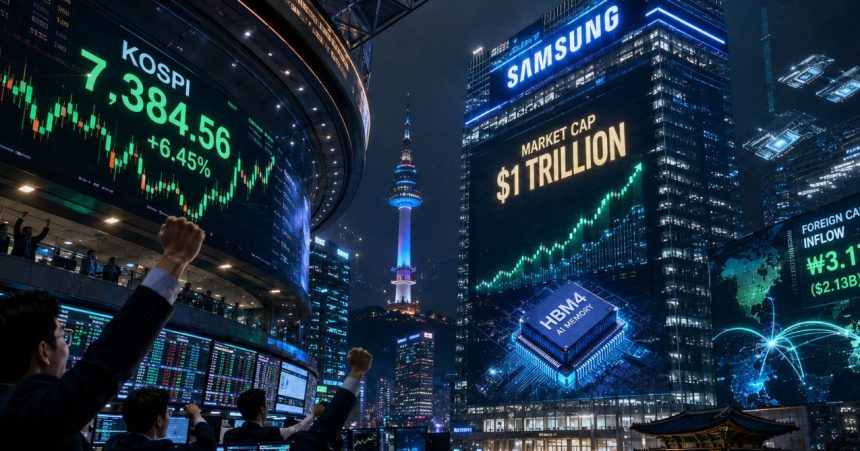
On Wednesday, May 6, foreigners made their biggest-ever single-day purchase of Korean shares. Samsung crossed $1 trillion. The KOSPI hit 7,000 for the first time. All three happened in the same session.
KOSPI Closes at Record 7,384 as Samsung Joins the $1 Trillion Club
South Korea’s KOSPI surged 6.45% to a record close of 7,384.56 on Wednesday, crossing 7,000 for the first time in history, as Samsung Electronics cleared the $1 trillion market capitalisation barrier and foreign investors posted their biggest-ever single-day purchase of Korean shares at 3.1 trillion won ($2.13 billion), per Reuters. The index briefly hit an intraday high of 7,426.60, triggering the seventh sidecar trading curb of the year, a rare suspension of programme buy orders, before pulling back to close at 7,384.56. The KOSPI has now gained 75% year-to-date in 2026, extending last year’s world-leading 76% advance, per Korea Exchange data.
Samsung’s Q1 Profit Surged 750% — One Quarter Earned More Than All of 2025
Samsung’s rally to $1 trillion didn’t come from nowhere. The company reported Q1 2026 operating profit of 57.2 trillion won ($39.3 billion), a 750% year-on-year increase, with chips responsible for 94% of the total, per Reuters. To put that in context: a single quarter’s profit surpassed the entire 43.6 trillion won Samsung earned across all of 2025, per TechTimes. Samsung’s stock has more than quadrupled over the past year and has doubled in 2026 alone, making it only the second Asian company after TSMC to reach the $1 trillion threshold. Samsung and SK Hynix together account for more than 43% of the KOSPI’s total weighting, which is precisely why the index moves the way it does when chips move.
The Uncomfortable Truth: 691 Stocks Fell on the Day the KOSPI Hit 7,000
Here is the number that didn’t make most front pages. On the same day the KOSPI posted one of its largest single-session gains ever, 691 of the KOSPI’s constituent stocks declined, per Korean market data. On Monday, May 4, a 5.12% surge day immediately preceding Wednesday’s record, advancing issues numbered only 392 against 476 decliners, per Seoul Economic Daily. The pattern is consistent: the index rallies hard, but the gains are running through an extremely narrow canal. Samsung and SK Hynix alone are driving the scoreboard. What looks like a broad bull market from the headline number is, in breadth terms, a two-stock rally with 800 passengers along for the ride.
SK Hynix Leads HBM With 55% Share—But Samsung is Catching Up Fast
Read Next: Kotak Secures 9.99% Federal Bank Stake in Surprise RBI Move
SK Hynix, which was worth less than $100 billion just 16 months ago, is now closing in on $800 billion, within reach of JP Morgan, the world’s most valuable bank, per Reuters. The company holds approximately 55% of the global HBM market versus Samsung’s roughly 25%, per CNBC. But Samsung announced in February it had begun mass production of HBM4, the sixth and newest generation, and customer feedback on its latest products has been positive, per CNBC.
Oddly, it is Samsung, the number two player in its most profitable segment, that just crossed $1 trillion. The market is pricing in the catch-up, not just the current share split. SK Hynix also struck a deal to share 10% of its annual operating profit with workers, which in 2027 could amount to an average payout of $680,000 per employee, based on Reuters calculations.
Korean ‘Ants’ Borrow Record 25 Trillion Won; Institutional Money Bets on Supply Squeeze
Retail investors in South Korea, known locally as “ants” for their collective behaviour, are borrowing at record levels to get in. Leveraged buying of KOSPI shares hit 25 trillion won in late April, a record, per Reuters data. But the bigger structural argument is being made by institutional money. Sam Konrad, investment manager at Jupiter Asset Management, put it plainly: the memory market is currently undersupplied, Samsung has indicated 2027 will see tighter supply-demand conditions than 2026, and NAND and DRAM prices are likely to keep rising, per Reuters. Multi-year supply agreements between Asian chipmakers and customers are signal that the AI cycle will run longer than most models had assumed.
“It’s a seller’s market for AI suppliers,” said Alex Huang, chairman of Fubon Financial Holding’s fund arm, which holds TSMC shares, per Reuters. Nvidia, he noted, isn’t negotiating on price, it’s worried about failing to secure capacity at all. TSMC’s advanced node utilisation rate has run above 100% for four consecutive quarters, per industry estimates, forcing customers to book capacity 12–18 months in advance. That dynamic, where your biggest customer’s primary concern is supply availability rather than cost, is the definition of pricing power.
Goldman Sachs Targets 8,000; But $43 Billion in Outflows Has Yet to Return
Goldman Sachs raised its 12-month KOSPI target from 7,000 to 8,000 in April, forecasting 220% earnings growth for Korean companies in 2026, per Seoul Economic Daily. Timothy Moe, Goldman’s Asia-Pacific equity strategist, noted the KOSPI’s forward P/E of approximately 7.5 times remains below the historical average of 10 times, meaning the market is expensive on momentum but not on earnings multiples. JPMorgan set a bull-case target of 8,500. Neither bank thinks the rally is over.
The positioning argument supports them. Global investors pulled nearly $50 billion from South Korean and Taiwanese stocks in March. Only about $7 billion has flowed back, per Reuters. That means roughly $43 billion in capital that was in these markets less than two months ago is still sitting on the sidelines, a significant dry powder figure for markets that have already run this hard.
Taiwan GDP Jumps 13.69%; Cloud Capex Growing 70% YoY — The Macro Engine Behind It All
The chip boom is rewriting economic data, not just stock prices. Taiwan’s Q1 2026 GDP rose 13.69%, the biggest quarterly jump in nearly four decades. South Korea grew 1.7%, its fastest pace in nearly six years, per Reuters. Chris Lo, vice president at Nomura Asset Management Taiwan, cited 70% year-on-year growth in cloud service provider capital spending as the upstream demand engine, with many Taiwan companies’ production capacities fully booked through 2027, per Reuters.
The overheating signals are real too. A Hong Kong-listed single-stock leveraged ETF tracking SK Hynix has drawn HK$40 billion ($5.11 billion) in just seven months since launch, making it the world’s second-largest single-stock leveraged ETF, per Reuters. “My sense is that it is getting dangerous,” said Nick Ferres, chief investment officer of Vantage Point Asset Management, per Reuters. Ian Samson, multi-asset portfolio manager at Fidelity International, offered the counter: “Regardless of what you think of valuations or earnings, in the near-term positioning is what matters, and that has cleared up significantly,” per Reuters.
The next hard trigger: any revision to cloud hyperscaler capex guidance from Microsoft, Amazon, or Google. Chris Lo at Nomura Asset Management Taiwan cited 70% YoY cloud capex growth as the demand engine keeping Taiwan fabs booked through 2027. Goldman Sachs estimates the KOSPI floor at approximately 6,250 in a downside scenario, meaning even the bears are not pricing a collapse from here.
FAQ
Q: Why did the KOSPI hit a record high on May 6, 2026?
The KOSPI surged 6.45% to a record 7,384.56 on May 6, driven by Samsung’s record Q1 operating profit of 57.2 trillion won (+750% YoY) and its $1 trillion market cap crossing. Foreign investors made their biggest-ever single-day purchase of Korean shares at 3.1 trillion won ($2.13 billion). The Philadelphia Semiconductor Index rose 4.2% overnight after AMD beat earnings estimates, amplifying the session’s move. Source: Reuters, Korea Exchange, May 6, 2026.
Q: What is Goldman Sachs’ KOSPI target for 2026?
Goldman Sachs raised its 12-month KOSPI target to 8,000 from 7,000 in April 2026, forecasting 220% earnings growth for Korean companies this year. The bank’s Asia-Pacific strategist Timothy Moe cited the KOSPI’s forward P/E of approximately 7.5 times, below the historical average of 10 times, as evidence the rally has valuation support. JPMorgan set a bull-case target of 8,500.
Q: Is the Korean stock market AI rally at risk of overheating?
Warning signs exist but positioning remains light. Retail investor leveraged buying hit a record 25 trillion won in late April. A Hong Kong leveraged ETF tracking SK Hynix has drawn HK$40 billion in seven months. On the KOSPI’s record 6.45% session, over 600 stocks declined, gains are concentrated in Samsung and SK Hynix, which together make up 43% of the index. However, global investors still have approximately $43 billion in March outflows yet to redeploy into Korean and Taiwanese markets, meaning institutional positioning is not yet crowded.
Disclaimer: This article is for informational purposes only and does not constitute investment advice. All data sourced from Reuters (May 6–7, 2026), CNBC, Seoul Economic Daily, Goldman Sachs research report (April 2026), TechTimes, Jupiter Asset Management, Kiwoom Securities, Korea Exchange, and Fidelity International. Consult a registered financial advisor before making investment decisions.