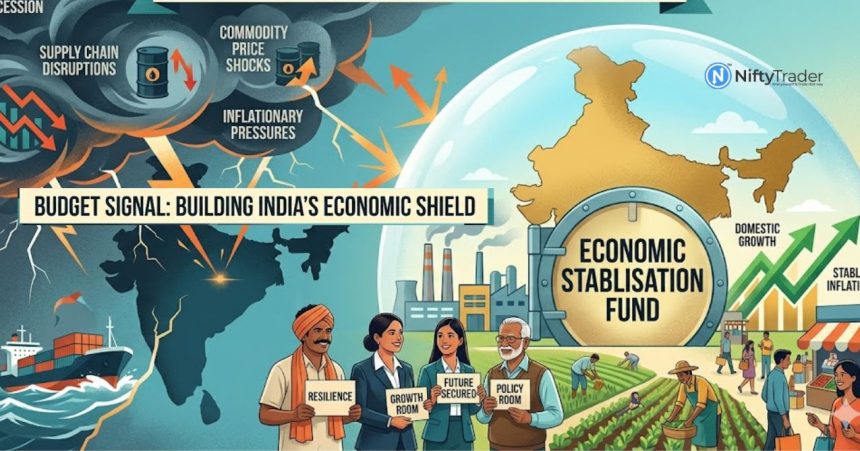
India may soon gain a stronger fiscal cushion to deal with global economic turbulence. Nirmala Sitharaman told Parliament that the government plans to create an Economic Stabilisation Fund, aimed at giving the country fiscal flexibility when external shocks hit the economy.
The proposal comes as policymakers increasingly worry about geopolitical tensions, supply-chain disruptions, and commodity shocks that can quickly spill into domestic markets.
For investors and traders, the move signals a broader attempt by the government to build a financial buffer capable of stabilising growth without derailing fiscal targets during periods of global volatility.
What Just Changed
The government has proposed setting up an Economic Stabilisation Fund to respond quickly to global disruptions that could affect India’s economy.
According to the finance minister, the fund would create “fiscal headroom” so that policymakers can intervene when external shocks such as geopolitical crises or supply-chain disruptions impact economic stability.
Early indications suggest ₹57,381.84 crore has been earmarked under supplementary spending discussions to support the mechanism.
In simple terms, the fund would function as an economic shock absorber, allowing the government to deploy fiscal support rapidly during periods of global stress.
Why It Matters Today
The proposal arrives at a time when global economic uncertainty is rising, from commodity volatility to geopolitical conflicts that could disrupt trade and energy markets.
For financial markets, India’s macro stability has become a key pillar supporting investor confidence. A dedicated stabilisation mechanism could help reduce the risk of abrupt policy responses during crises.
Several implications stand out:
Macro Stability Signal
A fiscal buffer reduces the risk that global shocks could force sudden spending cuts or emergency borrowing.
Investor Confidence
Policy preparedness often supports foreign investor sentiment, particularly in volatile global environments.
Government Spending Continuity
Infrastructure and capital expenditure programmes are less likely to be disrupted if external shocks emerge.
Even though the fund is still at the proposal stage, the signal from policymakers is clear: India wants greater fiscal flexibility before the next global shock arrives.
Why Markets Should Care
When global shocks occur such as oil spikes, trade disruptions, or tightening global liquidity governments often face a difficult trade-off between supporting growth and maintaining fiscal discipline.
A stabilisation fund can reduce that dilemma by creating pre-allocated fiscal space.
This matters because India’s fiscal strategy already aims to gradually reduce the deficit while maintaining growth momentum under the latest budget framework.
If implemented effectively, the fund could help:
-
Stabilise markets during external shocks
-
Protect government spending plans
-
Maintain investor confidence in fiscal management
In effect, it could operate as a macro-stability buffer, similar to sovereign fiscal reserves used by some advanced economies.
Global Risks Driving the Move
The proposal comes as policymakers worldwide navigate overlapping economic risks:
-
Ongoing geopolitical tensions affecting energy markets
-
Supply-chain disruptions raising manufacturing costs
-
Commodity price volatility
-
Slower global growth impacting exports
Officials say the fund would cover “unanticipated expenditure arising from volatile global dynamics.”
The goal is to ensure that external shocks do not trigger sudden fiscal slippages or emergency policy adjustments.
Possible Sector Implications
Although the stabilisation fund itself is a fiscal mechanism rather than a market instrument, several sectors could benefit indirectly.
Infrastructure & Capital Goods
Government infrastructure spending could continue even during economic stress.
Energy & Commodities
Temporary fiscal support during commodity spikes may reduce volatility in fuel-sensitive industries.
Financials
Banks and NBFCs benefit from macro stability and predictable government policy.
Export-Linked Industries
Government buffers could help manage trade disruptions or demand shocks.
What Traders Should Watch Next
Markets will likely track three key developments:
Final Structure of the Fund
How large the corpus becomes and how quickly it can be deployed.
Funding Mechanism
Whether it will rely on surplus revenues, borrowings, or budget reallocations.
Crisis-Response Triggers
The economic conditions that would activate the fund.
Until these details emerge, there remains uncertainty over whether the mechanism will function as a powerful stabilisation tool or mainly a policy signal.
The Bigger Policy Signal
The proposal highlights a broader shift in India’s economic strategy.
Instead of reacting to crises after they occur, policymakers appear increasingly focused on building fiscal buffers in advance.
However, a gap could emerge between market expectations of a large, flexible stabilisation fund and the actual size or deployment rules once finalised. If the corpus proves smaller or harder to access than investors anticipate, the market impact could be limited.
Looking ahead, the biggest risk lies in whether the fund can scale quickly enough to address large external shocks such as energy price spikes or global financial tightening.
If executed effectively, the Economic Stabilisation Fund could become a key part of India’s macro-policy toolkit helping protect growth even when global conditions turn volatile.
Market Take
The proposed Economic Stabilisation Fund signals that policymakers want greater fiscal flexibility before global shocks hit.
For markets, this reinforces the narrative of India’s macro stability, a factor that has increasingly supported investor confidence and capital inflows.
FAQs
What is India’s Economic Stabilisation Fund?
India’s proposed Economic Stabilisation Fund is a fiscal buffer designed to help the government respond quickly to global economic shocks such as geopolitical crises, commodity spikes, or supply-chain disruptions.
How large is the proposed stabilisation fund?
Early discussions indicate around ₹57,381.84 crore could be earmarked through supplementary spending provisions, though the final structure and size are yet to be confirmed.
Why is India creating a stabilisation fund now?
Rising geopolitical tensions, commodity volatility, and supply-chain disruptions have increased global economic uncertainty. The fund aims to ensure India has fiscal flexibility during such shocks.
How could the stabilisation fund impact financial markets?
A stabilisation fund can improve investor confidence by ensuring the government has resources to support growth and maintain spending during global crises.
Which sectors could benefit the most?
Infrastructure, capital goods, financials, energy-linked sectors, and export-oriented industries could benefit indirectly from improved macro stability and continued government spending.