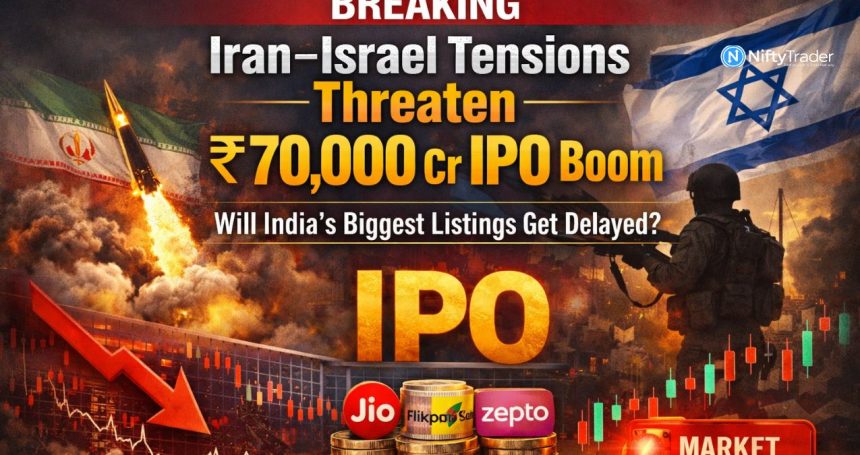
India’s upcoming IPO pipeline, including marquee names like Reliance Jio Platforms, Flipkart, and Zepto, is facing a new uncertainty trigger.
A potential escalation in the ongoing Iran–Israel conflict in 2026 is now raising a key market question:
Can global risk-off sentiment derail India’s biggest IPO wave in years?
With an estimated ₹70,000 crore+ IPO pipeline at stake, this is no longer just geopolitical news it’s a capital markets risk event.
What Just Changed
-
Rising tensions in the Middle East are pushing global markets into risk-off mode
-
Oil prices are seeing upward pressure, increasing macro uncertainty
-
Global investors are turning cautious on emerging market allocations
For IPOs, this matters immediately:
-
The timing of listings becomes uncertain
-
Valuations face pressure
-
Institutional demand weakens
Why IPO Markets Are the First to React
IPO markets are extremely sensitive to sentiment shifts even more than secondary markets.
When uncertainty rises:
-
Investors demand higher discounts
-
Large IPOs get delayed or resized
-
Anchor investor participation weakens
This is critical because India is currently sitting on one of its strongest IPO pipelines in recent years.
What’s at Stake: India’s Mega IPO Queue
Several high-profile listings are either expected or under preparation:
-
Telecom and digital platform plays
-
E-commerce and consumption-led businesses
-
New-age tech and quick commerce firms
These deals rely heavily on:
-
Foreign institutional flows
-
Strong risk appetite
-
Stable global conditions
A sustained geopolitical shock can disrupt all three.
Market Signal: This Is About Liquidity, Not Just Listings
This development is less about whether IPOs will happen and more about the following:
At what valuation, and with what demand?
Key risks markets are now pricing in:
-
Lower listing premiums
-
Reduced oversubscription levels
-
Higher volatility post-listing
Sector Impact: Who Feels It First
🔴 Negative Pressure
-
High-growth / loss-making IPO candidates
-
Consumption-driven new-age companies
-
Capital-intensive businesses
🟡 Neutral to Mixed
-
Defensive sectors
-
Cash-flow stable companies
🟢 Relative Beneficiaries
-
Oil & energy (if crude spikes)
-
Select PSU / commodity plays
What Traders Should Watch Now
This story is evolving and traders should focus on
-
Crude oil trends
-
FII flows in primary vs secondary markets
-
IPO filing delays or valuation revisions
-
Global equity volatility (especially US markets)
The Bigger Picture
India’s IPO momentum has been built on:
-
Strong domestic liquidity
-
Retail participation
-
Global capital inflows
But geopolitical shocks like this test a key assumption:
Is the risk appetite still intact when uncertainty rises globally?
Forward-Looking Risk Insight
Markets are currently in a price-discovery tension phase, where issuers are anchoring to peak valuations while investors are recalibrating risk premiums. If volatility sustains, this mismatch could force repricing across India’s IPO landscape—potentially reshaping the entire FY cycle.
Bottom Line
This is not a confirmed disruption yet.
But markets are beginning to price in a possibility:
If global tensions escalate, India’s biggest IPO cycle could slow down, stretch out, or reprice.
For now, the IPO pipeline remains intact, but sentiment has clearly turned more cautious than confident.
Also check:
Frequently Asked Questions
1. How does the Iran–Israel conflict impact India’s IPO market?
Geopolitical tensions typically trigger a global risk-off sentiment, which reduces investor appetite for new listings. This can lead to IPO delays, lower valuations, and weaker subscription demand, especially from foreign institutional investors.
2. Why are IPO markets more sensitive than secondary markets?
IPO markets depend heavily on investor confidence and forward expectations. Unlike secondary markets, where price discovery already exists, IPO pricing requires strong demand visibility—making them more vulnerable to sudden uncertainty.
3. Which Indian IPOs could be affected the most?
High-growth and new-age companies, especially those with aggressive valuations or limited profitability, are more exposed. These businesses rely on strong liquidity and risk appetite, which tends to weaken during geopolitical stress.
4. Will India’s ₹70,000 crore IPO pipeline be delayed?
There is no confirmed disruption yet, but delays or valuation adjustments are increasingly possible if global volatility persists. The expectation gap between issuer pricing and investor comfort may widen if risk sentiment deteriorates further.
5. What role do foreign investors play in IPO success?
Foreign institutional investors (FIIs) are critical for large IPOs as they provide anchor investments and liquidity support. Any pullback in FII participation can significantly impact subscription levels and listing performance.
6. Which sectors may outperform despite IPO market stress?
Energy, commodities, and select PSU stocks may benefit if oil prices rise due to geopolitical tensions. Defensive sectors with stable cash flows could also see relatively better investor interest.
7. What key indicators should investors track now?
Investors should closely monitor:
-
Crude oil price trends
-
FII inflows/outflows
-
IPO filing updates and valuation revisions
-
Global equity market volatility
8. Is this a short-term disruption or a structural risk?
At this stage, the situation remains uncertain. A short-lived geopolitical flare-up may only cause temporary delays, but a prolonged conflict could structurally impact capital flows and IPO momentum.